



 Chat with AI
Exam 18: Breasts and Axillae

Exam 1: Health Assessment29 Questions
Exam 2: Human Development Across the Lifespan29 Questions
Exam 3: Wellness and Health Promotion29 Questions
Exam 4: Cultural Considerations29 Questions
Exam 5: Psychosocial Assessment29 Questions
Exam 6: Assessment of Vulnerable Populations30 Questions
Exam 7: Interviewing and Communication Techniques30 Questions
Exam 8: The Health History28 Questions
Exam 9: Techniques and Equipment29 Questions
Exam 10: General Survey32 Questions
Exam 11: Pain Assessment29 Questions
Exam 12: Nutritional Assessment31 Questions
Exam 13: Skin, Hair, Nails29 Questions
Exam 14: Head, Neck, and Related Lymphatics34 Questions
Exam 15: Eye34 Questions
Exam 16: Ears, Nose, Mouth, and Throat34 Questions
Exam 17: Respiratory System31 Questions
Exam 18: Breasts and Axillae31 Questions
Exam 19: Cardiovascular System28 Questions
Exam 20: Peripheral Vascular System28 Questions
Exam 21: Abdomen29 Questions
Exam 22: Urinary System33 Questions
Exam 23: Male Reproduction System29 Questions
Exam 24: Female Reproduction System30 Questions
Exam 25: Musculoskeletal System32 Questions
Exam 26: Neurologic System34 Questions
Exam 27: Pregnant Females26 Questions
Exam 28: Hospitalized Patient25 Questions
Exam 29: Complete Health Assessment26 Questions
Select questions type


During a health assessment, a male client voices concern that he is at risk for breast cancer. The nurse is aware that further evaluation of the client's history should focus on predisposing factors that increase the chance for breast cancer in males. The interview should include questions related to which factors?
(Multiple Choice)
4.8/5  (85)
(85) The nurse is preparing an educational session regarding the causes for male gynecomastia. Which items will the nurse include in the session?
(Multiple Choice)
4.9/5 (78)
(78) A menopausal woman comes to the clinic with complaints of thin, watery nipple discharge with blood present. Based on this data, which disorder does the nurse suspect?
(Multiple Choice)
4.9/5 (83)
(83) The nurse is teaching a group of high school males about self-breast examination. Which comment by a participant in the teaching session indicates appropriate understanding?
(Multiple Choice)
4.8/5 (78)
(78) During a focused assessment, the female client reports breast tenderness, swelling, and lymph node enlargement around the time of her period. Which response by the nurse is the most appropriate?
(Multiple Choice)
4.9/5 (86)
(86) A female client asks the nurse when the best time is to perform self-breast examination (SBE). Which response by the nurse is the most appropriate?
(Multiple Choice)
4.9/5 (74)
(74) The nurse working in a predominately-Hispanic community outlines a breast health screening. Which should the nurse be aware of in order to provide the most culturally competent care to this population?
(Multiple Choice)
4.8/5 (78)
(78) The nurse is examining a client with a history of benign breast disease. Which findings does the nurse anticipate when assessing this client's breasts?
(Multiple Choice)
4.8/5 (86)
(86) The nurse is teaching an older adult client about breast self-examination (BSE). Which should the nurse provide during this instruction?
(Multiple Choice)
4.9/5 (76)
(76) The mother of a late school-age female client voices concern to the nurse regarding her daughter's breast development and breast tenderness. Which response by the nurse is the most appropriate to the client's mother?
(Multiple Choice)
4.9/5 (71)
(71) The nurse is preparing a poster on self-breast examination and is labeling the anatomical structures of the breast. Which location will the nurse use to identify the tail of Spence? 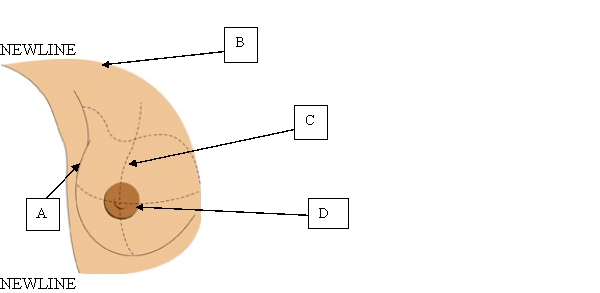
(Multiple Choice)
4.8/5 (87)
(87) 
Filters
- Essay(0)
- Multiple Choice(0)
- Short Answer(0)
- True False(0)
- Matching(0)