



 Chat with AI
Exam 16: Aldehydes and Ketones

Exam 1: The Basics158 Questions
Exam 2: Families of Carbon151 Questions
Exam 3: Acids and Bases149 Questions
Exam 4: Nomenclature and Conformations of Alkanes and Cycloalkanes163 Questions
Exam 5: Stereochemistry179 Questions
Exam 6: Nucleophilic Reactions91 Questions
Exam 7: Alkenes and Alkynes I220 Questions
Exam 8: Alkenes and Alkynes II163 Questions
Exam 9: Nuclear Magnetic Resonance and Mass Spectrometry158 Questions
Exam 10: Radical Reactions148 Questions
Exam 11: Alcohols and Ethers256 Questions
Exam 12: Alcohols From Carbonyl Compounds210 Questions
Exam 13: Conjugated Unsaturated Systems201 Questions
Exam 14: Aromatic Compounds186 Questions
Exam 15: Reactions of Aromatic Compounds207 Questions
Exam 16: Aldehydes and Ketones189 Questions
Exam 17: Carboxylic Acids and Their Derivatives213 Questions
Exam 18: Reactions at the Α Carbon of Carbonyl Compounds190 Questions
Exam 19: Condensation and Conjugate Addition Reactions of Carbonyl Compounds182 Questions
Exam 20: Amines207 Questions
Exam 21: Transition Metal Complexes86 Questions
Exam 22: Carbohydrates124 Questions
Exam 23: Lipids127 Questions
Exam 24: Amino Acids and Proteins135 Questions
Exam 25: Nucleic Acids and Protein Synthesis126 Questions
Select questions type



Select the structure of the major product in the following reaction. 
(Multiple Choice)
4.8/5  (80)
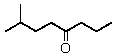
(80) The 1H NMR spectrum of a compound with formula C7H14O gives two signals.Which of these structures is a possible one for this compound?
(Multiple Choice)
4.8/5 (81)
(81) 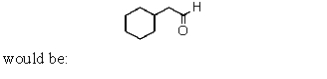
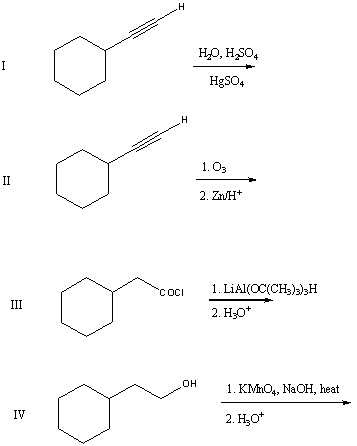
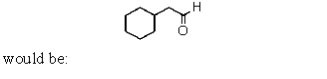
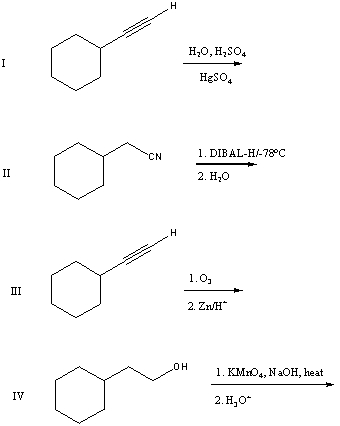
Which of the following procedures would not yield  as a product?
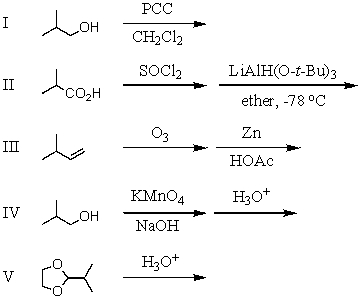
as a product? (Multiple Choice)
4.7/5 (91)
(91) Stereoisomers can exist in the case of which of the following?
(Multiple Choice)
4.9/5 (87)
(87) What is the correct structure for 3-methyl-5-(2,5-dinitrophenyl)pentanal? 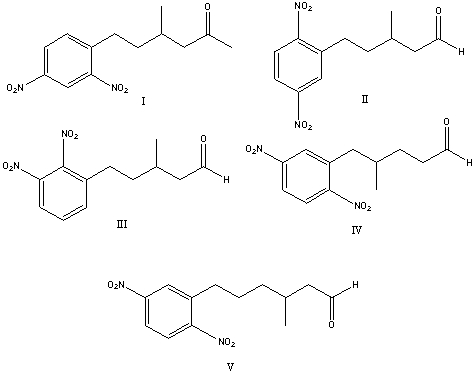
(Multiple Choice)
4.9/5 (87)
(87) Which of the following is formed when 3-methylcyclopentanone reacts with hydroxylamine? 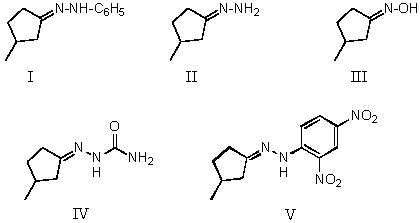
(Multiple Choice)
4.9/5 (80)
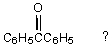
(80) 
Select the structure of the major product in the following reaction. 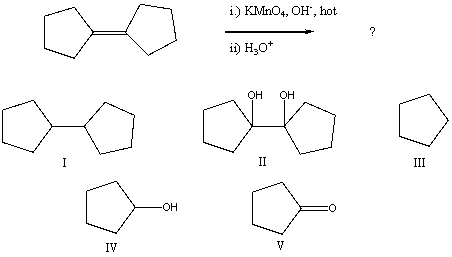
(Multiple Choice)
5.0/5 (77)
(77) Complete the following reaction sequence,giving structural details of all significant intermediates and the final product. 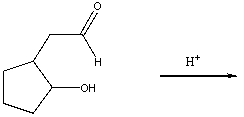
(Essay)
4.7/5 (85)
(85) Propose a structure that fits the following spectroscopic data:
C4H8O
IR: 1737 cm−1
Broadband decoupled 13C NMR: 15.48,41.07,204.86
DEPT experiments show: signal at 41.07 as CH and signal at 15.48 as CH3
(Essay)
4.9/5 (83)
(83) 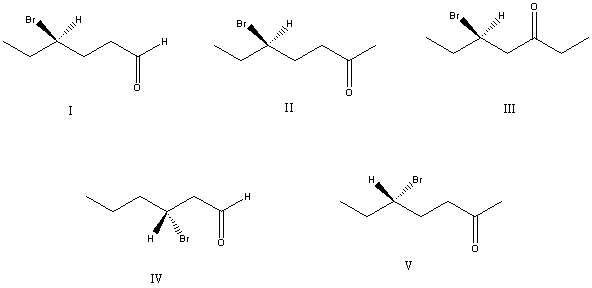
Draw a complete mechanism,using arrow convention to indicate electron movement,for the following transformation: 
(Essay)
4.8/5 (85)
(85) The 13C NMR spectrum of a compound with formula C7H14O gives three signals.Which of these structures is a possible one for this compound?
(Multiple Choice)
4.8/5 (77)
(77) What would be the product of the following reaction sequence? 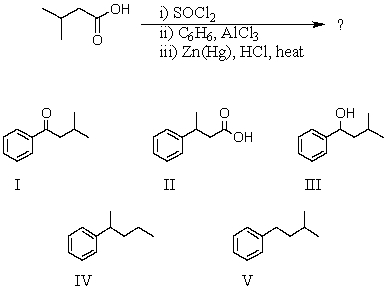
(Multiple Choice)
4.9/5 (73)
(73) The following reduction can be carried out with which reagent(s)? 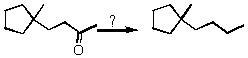
(Multiple Choice)
4.8/5 (77)
(77) Propose a structure that fits the following spectroscopic data:
C5H10O
IR: 1717 cm−1
Broadband decoupled 13C NMR: 13.70,17.41,29.78,45.71,208.93
DEPT experiments show: signals at 13.70,29.78 as CH3 and signals at 17.41,45.71 as CH2
(Essay)
4.8/5 (78)
(78) 
Filters
- Essay(0)
- Multiple Choice(0)
- Short Answer(0)
- True False(0)
- Matching(0)