



 Chat with AI
Exam 15: Reactions of Aromatic Compounds

Exam 1: The Basics158 Questions
Exam 2: Families of Carbon151 Questions
Exam 3: Acids and Bases149 Questions
Exam 4: Nomenclature and Conformations of Alkanes and Cycloalkanes163 Questions
Exam 5: Stereochemistry179 Questions
Exam 6: Nucleophilic Reactions91 Questions
Exam 7: Alkenes and Alkynes I220 Questions
Exam 8: Alkenes and Alkynes II163 Questions
Exam 9: Nuclear Magnetic Resonance and Mass Spectrometry158 Questions
Exam 10: Radical Reactions148 Questions
Exam 11: Alcohols and Ethers256 Questions
Exam 12: Alcohols From Carbonyl Compounds210 Questions
Exam 13: Conjugated Unsaturated Systems201 Questions
Exam 14: Aromatic Compounds186 Questions
Exam 15: Reactions of Aromatic Compounds207 Questions
Exam 16: Aldehydes and Ketones189 Questions
Exam 17: Carboxylic Acids and Their Derivatives213 Questions
Exam 18: Reactions at the Α Carbon of Carbonyl Compounds190 Questions
Exam 19: Condensation and Conjugate Addition Reactions of Carbonyl Compounds182 Questions
Exam 20: Amines207 Questions
Exam 21: Transition Metal Complexes86 Questions
Exam 22: Carbohydrates124 Questions
Exam 23: Lipids127 Questions
Exam 24: Amino Acids and Proteins135 Questions
Exam 25: Nucleic Acids and Protein Synthesis126 Questions
Select questions type


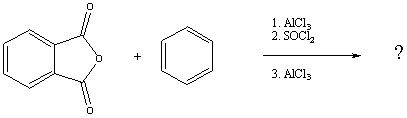
Which of these species is/are proposed as intermediate(s)in the mechanism for the Birch reduction?
(Multiple Choice)
4.9/5  (88)
(88) 
Using a potential energy diagram,explain/illustrate the preferential formation of the 2 substituted product instead of the 3 product in the electrophilic aromatic substitution of furan. 
(Essay)
4.7/5 (87)
(87) Which of the following reactions would give the product(s)indicated in substantial amounts (i.e.,in greater than 50% yield)? 
(Multiple Choice)
4.9/5 (78)
(78) What would you expect to be the major product obtained from the following reaction? 
(Multiple Choice)
4.9/5 (75)
(75) Which of these is the rate-determining step in the sulfonation of benzene?
(Multiple Choice)
4.8/5 (75)
(75) Which is the best sequence of reactions for the following transformation? 
(Multiple Choice)
4.9/5 (79)
(79) Which of the compounds listed below would you expect to give the greatest amount of meta-product when subjected to ring nitration? 
(Multiple Choice)
4.8/5 (72)
(72) Using a potential energy diagram,explain/illustrate the preferential formation of the 2 substituted product instead of the 3 product in the electrophilic aromatic substitution of thiophene. 
(Essay)
4.8/5 (72)
(72) Which of these compounds gives essentially a single product on electrophilic substitution of a third group?
(Multiple Choice)
5.0/5 (100)
(100) Which of the following would be the best synthesis of 1,4-dimethyl-2-nitrobenzene?
(Multiple Choice)
4.7/5 (76)
(76) Suggest a reasonable synthetic strategy for the synthesis of 6-methyl-3-phenyl-3-heptanol from 4-methylpentanoyl chloride,(CH3)2CHCH2CH2COCl
(Essay)
4.8/5 (70)
(70) The major product(s),A,of the following reaction, 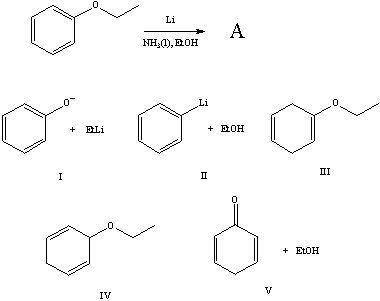 would be:
 (Multiple Choice)
4.9/5 (78)
(78) What would you expect to be the major product obtained from the following reaction? 
(Multiple Choice)
5.0/5 (77)
(77) Which of the following reactions could be used to synthesize tert-butylbenzene?
(Multiple Choice)
4.8/5 (73)
(73) Which alkyl halide can undergo both SN1 and SN2 reactions in nonacidic solvents?
(Multiple Choice)
4.8/5 (74)
(74) Which would be the product,X,of the following reaction sequence? 
(Multiple Choice)
4.8/5 (90)
(90) What would you expect to be the major product obtained from the following reaction? 
(Multiple Choice)
4.8/5 (97)
(97) Which reagent(s)would you use to carry out the following transformation? ethylbenzene benzoic acid
(Multiple Choice)
4.8/5 (76)
(76) Which reagent(s)would you use to carry out the following transformation? ethylbenzene 1-chloro-1-phenylethane
(Multiple Choice)
4.7/5 (82)
(82) 
Filters
- Essay(0)
- Multiple Choice(0)
- Short Answer(0)
- True False(0)
- Matching(0)