



 Chat with AI
Exam 13: Conjugated Unsaturated Systems

Exam 1: The Basics158 Questions
Exam 2: Families of Carbon151 Questions
Exam 3: Acids and Bases149 Questions
Exam 4: Nomenclature and Conformations of Alkanes and Cycloalkanes163 Questions
Exam 5: Stereochemistry179 Questions
Exam 6: Nucleophilic Reactions91 Questions
Exam 7: Alkenes and Alkynes I220 Questions
Exam 8: Alkenes and Alkynes II163 Questions
Exam 9: Nuclear Magnetic Resonance and Mass Spectrometry158 Questions
Exam 10: Radical Reactions148 Questions
Exam 11: Alcohols and Ethers256 Questions
Exam 12: Alcohols From Carbonyl Compounds210 Questions
Exam 13: Conjugated Unsaturated Systems201 Questions
Exam 14: Aromatic Compounds186 Questions
Exam 15: Reactions of Aromatic Compounds207 Questions
Exam 16: Aldehydes and Ketones189 Questions
Exam 17: Carboxylic Acids and Their Derivatives213 Questions
Exam 18: Reactions at the Α Carbon of Carbonyl Compounds190 Questions
Exam 19: Condensation and Conjugate Addition Reactions of Carbonyl Compounds182 Questions
Exam 20: Amines207 Questions
Exam 21: Transition Metal Complexes86 Questions
Exam 22: Carbohydrates124 Questions
Exam 23: Lipids127 Questions
Exam 24: Amino Acids and Proteins135 Questions
Exam 25: Nucleic Acids and Protein Synthesis126 Questions
Select questions type


Ignoring stereochemistry,the 1:1 reaction of bromine with 1,3-cyclohexadiene at 25 C in the dark and in the absence of peroxide forms which of these? 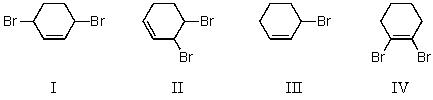
(Multiple Choice)
4.8/5  (82)
(82) The HOMO of 1,3-pentadiene has how many electrons in its excited state?
(Multiple Choice)
4.8/5 (79)
(79) Which pair does not represent a pair of resonance structures? 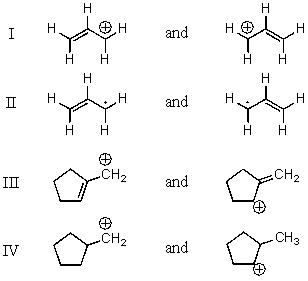
(Multiple Choice)
4.8/5 (83)
(83) 1,3-Butadiene has how many electrons in its ground state bonding molecular orbitals?
(Multiple Choice)
4.9/5 (85)
(85) The LUMO of 1,3-pentadiene has how many electrons in its excited state?
(Multiple Choice)
4.8/5 (87)
(87) Indicate which products would be obtained from the chlorination of 1,5-hexadiene at high temperature (500 C),using a 1:1 mole ratio of the reactants. 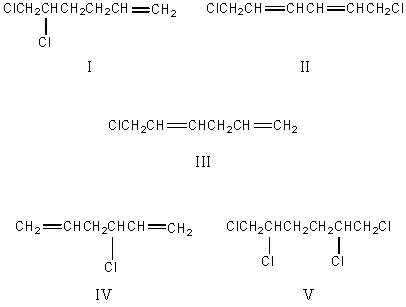
(Multiple Choice)
4.7/5 (86)
(86) 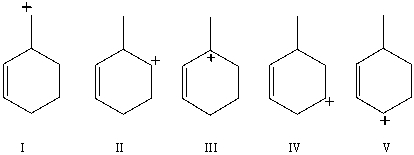
Which of the following dieneophiles is most reactive in a Diels-Alder reaction: 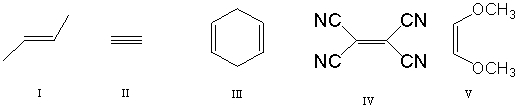
(Multiple Choice)
4.9/5 (83)
(83) The substituent R on the bicyclic compound shown is considered to be? 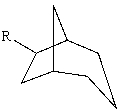
(Multiple Choice)
4.9/5 (80)
(80) 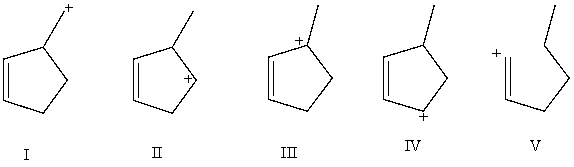
A reaction under kinetic (or rate)control will yield predominantly:
(Multiple Choice)
4.9/5 (86)
(86) A reaction under kinetic (or rate)control will yield predominantly: ___.
(Essay)
4.7/5 (85)
(85) Which reagent would convert 1,3-pentadiene into 3-penten-2-ol?
(Multiple Choice)
4.9/5 (83)
(83) What reagents would be needed to synthesize the following substance via the Diels-Alder reaction? Give stereochemical details,as relevant. 
(Essay)
4.8/5 (84)
(84) Show the steps and reagents necessary to prepare the following compound with a Diels-Alder reaction incorporated in the synthesis.Use retrosynthetic analysis as a tool to guide your synthesis. 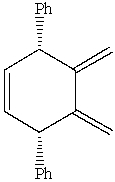
(Essay)
4.8/5 (89)
(89) Which of the following dieneophiles is most reactive in a Diels-Alder reaction: 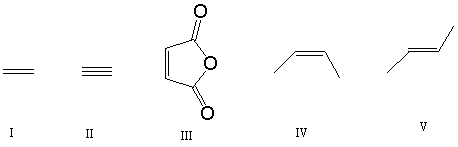
(Multiple Choice)
4.7/5 (78)
(78) 
Filters
- Essay(0)
- Multiple Choice(0)
- Short Answer(0)
- True False(0)
- Matching(0)