



 Chat with AI
Exam 2: Families of Carbon

Exam 1: The Basics158 Questions
Exam 2: Families of Carbon151 Questions
Exam 3: Acids and Bases149 Questions
Exam 4: Nomenclature and Conformations of Alkanes and Cycloalkanes163 Questions
Exam 5: Stereochemistry179 Questions
Exam 6: Nucleophilic Reactions91 Questions
Exam 7: Alkenes and Alkynes I220 Questions
Exam 8: Alkenes and Alkynes II163 Questions
Exam 9: Nuclear Magnetic Resonance and Mass Spectrometry158 Questions
Exam 10: Radical Reactions148 Questions
Exam 11: Alcohols and Ethers256 Questions
Exam 12: Alcohols From Carbonyl Compounds210 Questions
Exam 13: Conjugated Unsaturated Systems201 Questions
Exam 14: Aromatic Compounds186 Questions
Exam 15: Reactions of Aromatic Compounds207 Questions
Exam 16: Aldehydes and Ketones189 Questions
Exam 17: Carboxylic Acids and Their Derivatives213 Questions
Exam 18: Reactions at the Α Carbon of Carbonyl Compounds190 Questions
Exam 19: Condensation and Conjugate Addition Reactions of Carbonyl Compounds182 Questions
Exam 20: Amines207 Questions
Exam 21: Transition Metal Complexes86 Questions
Exam 22: Carbohydrates124 Questions
Exam 23: Lipids127 Questions
Exam 24: Amino Acids and Proteins135 Questions
Exam 25: Nucleic Acids and Protein Synthesis126 Questions
Select questions type


For the following reaction sequence (it is not necessary to understand the chemistry)what significant change(s)would be expected by IR (ignoring C-H absorptions)? 
(Multiple Choice)
4.8/5  (90)
(90) What functional group is present in the following compound? 
(Multiple Choice)
4.9/5 (74)
(74) For the following reaction sequence (it is not necessary to understand the chemistry)what significant change(s)would be expected by IR (ignoring C-H absorptions)? 
(Multiple Choice)
4.8/5 (74)
(74) What functional group(s)is/are present in the following compound? 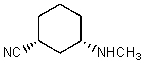
(Multiple Choice)
4.9/5 (83)
(83) For the following reaction sequence (it is not necessary to understand the chemistry)what significant change(s)would be expected by IR (ignoring C-H absorptions)? 
(Multiple Choice)
4.8/5 (66)
(66) What functional group(s)is/are present in the following compound? 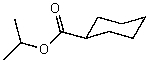
(Multiple Choice)
4.9/5 (86)
(86) The higher the wave number in the infrared spectra,the greater the energy that is required to vibrate the bond.
(True/False)
4.9/5 (90)
(90) The six p electrons in benzene are ___ about the ring,which explains why all of the C-C bonds are the same length.
(Short Answer)
4.7/5 (89)
(89) What alkyl groups are attached to the benzene ring in the following example? 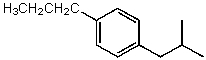
(Multiple Choice)
4.9/5 (83)
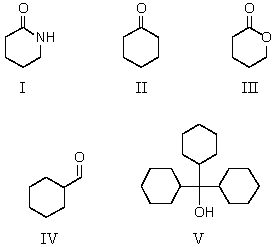
(83) The following substance is expected to have the lowest solubility in which of the following solvent(s)? 
(Multiple Choice)
4.9/5 (95)
(95) 
Examine the following IR spectrum,for substance Q (C7H14O2).Which oxygen containing functional group is most likely present in Q? 
(Short Answer)
4.8/5 (81)
(81) Carbon dioxide is non-polar,despite the fact that oxygen is much more electronegative than carbon.Briefly explain why,using relevant diagrams as appropriate to illustrate your answer.
(Essay)
4.9/5 (61)
(61) Organic compounds are classified into chemical families on the basis of similarities in chemical properties; these similarities are primarily due to the presence of characteristic arrangements of atoms known as ___.
(Short Answer)
4.8/5 (88)
(88) For the following reaction sequence (it is not necessary to understand the chemistry)what significant change(s)would be expected by IR (ignoring C-H absorptions)? 
(Multiple Choice)
4.8/5 (77)
(77) For the functional group(s)on the following molecule what characteristic IR absorption(s)would be expected (ignoring C-H absorptions)? 
(Multiple Choice)
5.0/5 (82)
(82) The absorption band for the O-H stretch in the IR spectrum of an alcohol is sharp and narrow in the case of
(Multiple Choice)
4.9/5 (84)
(84) 
Filters
- Essay(0)
- Multiple Choice(0)
- Short Answer(0)
- True False(0)
- Matching(0)