



 Chat with AI
Exam 1: The Basics

Exam 1: The Basics158 Questions
Exam 2: Families of Carbon151 Questions
Exam 3: Acids and Bases149 Questions
Exam 4: Nomenclature and Conformations of Alkanes and Cycloalkanes163 Questions
Exam 5: Stereochemistry179 Questions
Exam 6: Nucleophilic Reactions91 Questions
Exam 7: Alkenes and Alkynes I220 Questions
Exam 8: Alkenes and Alkynes II163 Questions
Exam 9: Nuclear Magnetic Resonance and Mass Spectrometry158 Questions
Exam 10: Radical Reactions148 Questions
Exam 11: Alcohols and Ethers256 Questions
Exam 12: Alcohols From Carbonyl Compounds210 Questions
Exam 13: Conjugated Unsaturated Systems201 Questions
Exam 14: Aromatic Compounds186 Questions
Exam 15: Reactions of Aromatic Compounds207 Questions
Exam 16: Aldehydes and Ketones189 Questions
Exam 17: Carboxylic Acids and Their Derivatives213 Questions
Exam 18: Reactions at the Α Carbon of Carbonyl Compounds190 Questions
Exam 19: Condensation and Conjugate Addition Reactions of Carbonyl Compounds182 Questions
Exam 20: Amines207 Questions
Exam 21: Transition Metal Complexes86 Questions
Exam 22: Carbohydrates124 Questions
Exam 23: Lipids127 Questions
Exam 24: Amino Acids and Proteins135 Questions
Exam 25: Nucleic Acids and Protein Synthesis126 Questions
Select questions type


The bond angles for the bold-faced C in CH3CH2CH2+ would be expected to be approximately:
(Multiple Choice)
4.9/5  (87)
(87) In which structure(s)below does the oxygen have a formal charge of +1?  s
s (Multiple Choice)
4.7/5 (70)
(70) Which of the following is an ion with a negative one charge?
(Multiple Choice)
4.7/5 (83)
(83) Which of the following molecules or ions has a nitrogen with a formal charge of -1?
(Multiple Choice)
4.8/5 (73)
(73) Which of the following species is/are not a resonance form(s)of the anionic species in the box? 
(Multiple Choice)
4.8/5 (86)
(86) Which of the following species exhibits resonance stabilization?
(Multiple Choice)
4.8/5 (89)
(89) In which structure(s)below does nitrogen have a formal charge of +1? 
(Multiple Choice)
4.9/5 (70)
(70) Draw the Lewis structure of nitroethane CH3CH2NO2,clearly indicating resonance contributors as well as non-bonding pairs of electrons and formal charges,as relevant.
(Essay)
4.8/5 (80)
(80) There are three fundamental rules that we use in writing electronic configurations for atoms and molecules.The configuration shown below (for oxygen)violates one of these rules.Which one? 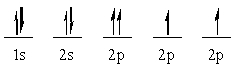
(Short Answer)
4.8/5 (78)
(78) Identify the atomic and/or hybridized orbitals in the C-O sigma bond in acetone. 
(Multiple Choice)
5.0/5 (84)
(84) Considering Lewis structures,which of these compounds possesses a single unpaired electron?
(Multiple Choice)
4.9/5 (85)
(85) Which of the following species is/are not a resonance form(s)of the species in the box? 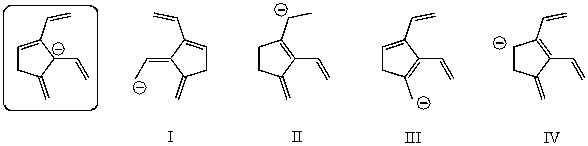
(Multiple Choice)
4.8/5 (71)
(71) According to molecular orbital theory,in the case of a carbon-carbon double bond,the carbon-carbon bonding electrons of higher energy occupy this molecular orbital:
(Multiple Choice)
4.7/5 (75)
(75) Which of the following species are resonance forms of the species in the box? 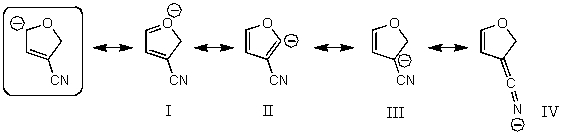
(Multiple Choice)
4.8/5 (86)
(86) Listed below are electron dot formulas for several simple molecules and ions.All valence electrons are shown; however,electrical charges have been omitted deliberately. 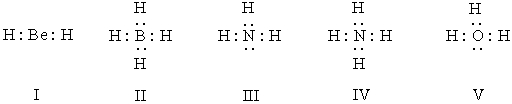 Which of the structures is negatively charged?
 (Multiple Choice)
4.9/5 (84)
(84) Which of the following species is a resonance form of the following species? 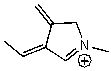
(Multiple Choice)
4.9/5 (83)
(83) Identify the atomic orbitals in the C-H sigma bond in acetylene (ethyne).
(Multiple Choice)
4.8/5 (82)
(82) Draw the Lewis structure of the nitrite ion,NO2-,clearly indicating resonance contributors as well as non-bonding pairs of electrons and formal charges,as relevant.
(Essay)
4.9/5 (79)
(79) When atomic orbitals of the same phase overlap a(n)___ molecular orbital is formed.
(Short Answer)
4.7/5 (76)
(76) 
Filters
- Essay(0)
- Multiple Choice(0)
- Short Answer(0)
- True False(0)
- Matching(0)