



 Chat with AI
Exam 11: Gravity

Exam 1: Systems of Measurement86 Questions
Exam 2: Motion in One Dimension103 Questions
Exam 3: Motion in Two and Three Dimensions67 Questions
Exam 4: Newtons Laws117 Questions
Exam 5: Applications of Newtons Laws75 Questions
Exam 6: Work and Energy71 Questions
Exam 7: Conservation of Energy73 Questions
Exam 8: Systems of Particles and Conservation of Linear Momentum107 Questions
Exam 9: Rotation119 Questions
Exam 10: Conservation of Angular Momentum67 Questions
Exam 11: Gravity90 Questions
Exam 12: Static Equilibrium and Elasticity65 Questions
Exam 13: Fluids91 Questions
Exam 14: Oscillations138 Questions
Exam 15: Wave Motion122 Questions
Exam 16: Superposition and Standing Waves125 Questions
Exam 17: Temperature and the Kinetic Theory of Gases85 Questions
Exam 18: Heat and the First Law of Thermodynamics114 Questions
Exam 19: The Second Law of Thermodynamics61 Questions
Exam 20: Thermal Properties and Processes54 Questions
Select questions type


Kepler's second law, "a line joining any planet to the Sun sweeps out equal areas in equal times" is based on which conservation principle?
(Multiple Choice)
4.8/5  (78)
(78) The radius of the moon is R. A satellite orbiting the moon in a circular orbit has an acceleration due to the moon's gravity of 0.14 m/s2. The acceleration due to gravity at the moon's surface is 1.62 m/s2. The height of the satellite above the moon's surface is
(Multiple Choice)
4.7/5 (75)
(75) 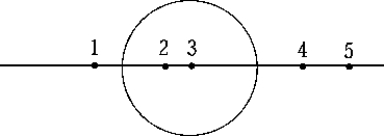 Test masses are used to measure the gravitational field at various positions in and near a solid sphere of uniform density. The gravitational field will have its greatest value at point
 (Multiple Choice)
4.9/5 (79)
(79) Suppose that a satellite is in a circular orbit at a height of 2.00 106 m above Earth's surface. What is the period of the satellite's motion at this elevation?
(Multiple Choice)
4.9/5 (70)
(70) According to Newton's law of universal gravitation, if the distance between two bodies is tripled, the gravitational force between them is
(Multiple Choice)
4.7/5 (69)
(69) What is the difference in the force of gravity on a 1.0-kg mass at the bottom of the deepest ocean trench and that at the top of the highest mountain? Assume that G = 9.8 m/s2 at sea level. The radius of Earth at sea level is 6.37 106 m. The deepest trench is the Marianas Trench, south of Guam, which has a depth
D = 1.103 104 m below sea level. The highest mountain is Everest in Nepal, which has a height of h = 8.847 103 m above sea level. The difference is
(Multiple Choice)
4.8/5 (76)
(76) Suppose that a satellite is in a circular orbit at a height of 2.00 106 m above Earth's surface. What is the acceleration due to gravity at this elevation?
(Multiple Choice)
5.0/5 (84)
(84) The mass density of a planet varies with distance from the center as 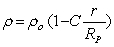 where C is a dimensionless constant, and RP is the radius of the planet. The gravitational field of the planet for r < RP is
 (Multiple Choice)
4.8/5 (87)
(87) A spring scale and a balance are used to "weigh" a body at the equator and later at a higher latitude, which has a different value for the acceleration due to gravity. Which of the following is a true statement concerning these weightings?
(Multiple Choice)
4.9/5 (79)
(79) During the lunar mission of Apollo 11, Armstrong and Aldrin descended to the moon's surface in the lunar module while Collins remained in orbit in the command module. If the command module's period was 2 hours and 20 minutes, how high above the moon's surface did it orbit? (mmoon = 7.35 1022 kg, Rmoon = 1.74 106 m, and G = 6.67 10-11 N · m2/kg2.)
(Multiple Choice)
4.8/5 (69)
(69) 
Filters
- Essay(0)
- Multiple Choice(0)
- Short Answer(0)
- True False(0)
- Matching(0)