



 Chat with AI
Exam 11: Gravity

Exam 1: Systems of Measurement86 Questions
Exam 2: Motion in One Dimension103 Questions
Exam 3: Motion in Two and Three Dimensions67 Questions
Exam 4: Newtons Laws117 Questions
Exam 5: Applications of Newtons Laws75 Questions
Exam 6: Work and Energy71 Questions
Exam 7: Conservation of Energy73 Questions
Exam 8: Systems of Particles and Conservation of Linear Momentum107 Questions
Exam 9: Rotation119 Questions
Exam 10: Conservation of Angular Momentum67 Questions
Exam 11: Gravity90 Questions
Exam 12: Static Equilibrium and Elasticity65 Questions
Exam 13: Fluids91 Questions
Exam 14: Oscillations138 Questions
Exam 15: Wave Motion122 Questions
Exam 16: Superposition and Standing Waves125 Questions
Exam 17: Temperature and the Kinetic Theory of Gases85 Questions
Exam 18: Heat and the First Law of Thermodynamics114 Questions
Exam 19: The Second Law of Thermodynamics61 Questions
Exam 20: Thermal Properties and Processes54 Questions
Select questions type


Two satellites of the same mass are placed in orbits around Earth. Satellite One is at an altitude of 1RE and Satellite Two at an altitude of 2RE where RE = 6370 km is the radius of Earth. What is the ratio of the potential energy of Satellite One to Satellite Two?
(Multiple Choice)
4.8/5  (81)
(81) Suppose a rocket is fired vertically upward from the surface of Earth with one-half of the escape speed. How far from the center of Earth will it reach before it begins to fall back? (Let g = 9.8 m/s2 and RE = 6370 km.)
(Multiple Choice)
4.9/5 (88)
(88) The radius R of a stable, circular orbit for a satellite of mass m and velocity v about a planet of mass M is given by
(Multiple Choice)
4.8/5 (69)
(69) Test masses are used to measure the gravitational field at various positions in and near a hollow spherical shell. The gravitational field will have its greatest value at point(s) 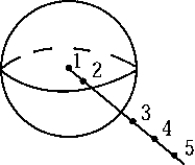
(Multiple Choice)
4.7/5 (91)
(91) At the surface of the moon, the acceleration due to the gravity of the moon is  . At a distance from the center of the moon equal to three times the radius of the moon, the acceleration due to the gravity of the moon is
 (Multiple Choice)
4.8/5 (95)
(95) A satellite in circular orbit 1.609 106 m above the surface of Earth (re = 6.436 106 m) has an acceleration toward Earth of
(Multiple Choice)
4.8/5 (67)
(67) Newton's law of gravity is F = GMm/r2. What are the SI units of the gravitational constant G?
(Multiple Choice)
5.0/5 (79)
(79) A satellite is orbiting Earth in an elliptical orbit. The distance of the satellite from Earth at the aphelion (rA) is twice that at the perihelion (rB). The total energy (potential and kinetic) of the satellite at A is _____ the total energy at B. 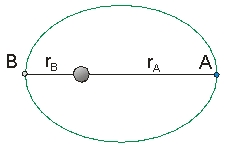
(Multiple Choice)
5.0/5 (82)
(82) An object whose mass is 6 kg experiences a gravitational force of 30 N  at some point P. The gravitational field at this point is
 (Multiple Choice)
4.8/5 (84)
(84) Kepler's second law of planetary motion states that the radius vector from the sun to a planet sweeps out equal areas in equal times. This relationship is a consequence of which of the following conservation principles?
(Multiple Choice)
4.8/5 (62)
(62) Use the following scenario to answer the next problem.
NASA's "Weightless Wonder" flights can simulate "zero-g" or some other extraterrestrial gravity by flying a C-9 jet plane in a parabolic path. One path the plane takes is expressed as y = yo + 0.8 x - 1.02 10-4 x2 where yo is the highest point, and x and y are the horizontal and vertical coordinates (in m).
-What is the horizontal speed of the plane if the flight is to simulate lunar gravity,
GMoon = 1.62 m/s2.
(Multiple Choice)
4.8/5 (76)
(76) The mass and radius of the planet Venus are 81% and 95% that of Earth, respectively. How much faster or slower (as a percentage) is the escape velocity from Venus compared to that of Earth?
(Multiple Choice)
4.7/5 (72)
(72) Four identical masses, each of mass M, are placed at the corners of a square of side L. The total potential energy of the masses is equal to -xGM 2/L, where x equals
(Multiple Choice)
4.9/5 (68)
(68) Suppose that a satellite is in a circular orbit at a height of 2.00 106 m above Earth's surface. What is the speed of a satellite in this orbit?
(Multiple Choice)
4.9/5 (89)
(89) The mass of Earth is ME = 6.0 1024 kg, and the mass of the Sun is 2.0 1030 kg. They are a distance of 1.5 108 km apart. Calculate the acceleration of Earth due to the gravitational attraction of the Sun. (G = 6.67 10-11 N·m2/kg2)
(Multiple Choice)
4.8/5 (78)
(78) Of the five masses in orbit around the central mass, the one with the longest period of revolution is 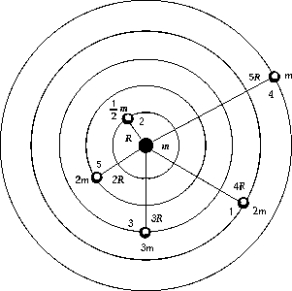
(Multiple Choice)
4.9/5 (93)
(93) An object weighs 37.0 N on Earth. If the mass of the moon is one eighty-first that of Earth and its radius one-fourth that of Earth, the weight of this object on the moon would be
(Multiple Choice)
4.8/5 (77)
(77) If we neglect the effects of air resistance, the impact speed of a body of mass m released from rest at an altitude of 2 108 m above the surface of Earth (me = 5.99 1024 kg, re = 6.37 106 m) is
(Multiple Choice)
4.7/5 (73)
(73) A planet is made of two distinct materials. From the core to R/2, the density of the material is 4000 kg/m3, and from R/2 to R the density is 3000 kg/m3. What is the gravity at the surface of the planet if R = 5000 km?
(Multiple Choice)
4.9/5 (78)
(78) Two objects with masses M1 = 30,000 kg and M2 = 70,000 kg are initially very far apart and at rest. If due to gravitational attraction the two objects attract each other, calculate their total kinetic energy when they are 100 km apart.
(Multiple Choice)
4.8/5 (76)
(76) 
Filters
- Essay(0)
- Multiple Choice(0)
- Short Answer(0)
- True False(0)
- Matching(0)