



 Chat with AI
Exam 11: Gravity

Exam 1: Systems of Measurement86 Questions
Exam 2: Motion in One Dimension103 Questions
Exam 3: Motion in Two and Three Dimensions67 Questions
Exam 4: Newtons Laws117 Questions
Exam 5: Applications of Newtons Laws75 Questions
Exam 6: Work and Energy71 Questions
Exam 7: Conservation of Energy73 Questions
Exam 8: Systems of Particles and Conservation of Linear Momentum107 Questions
Exam 9: Rotation119 Questions
Exam 10: Conservation of Angular Momentum67 Questions
Exam 11: Gravity90 Questions
Exam 12: Static Equilibrium and Elasticity65 Questions
Exam 13: Fluids91 Questions
Exam 14: Oscillations138 Questions
Exam 15: Wave Motion122 Questions
Exam 16: Superposition and Standing Waves125 Questions
Exam 17: Temperature and the Kinetic Theory of Gases85 Questions
Exam 18: Heat and the First Law of Thermodynamics114 Questions
Exam 19: The Second Law of Thermodynamics61 Questions
Exam 20: Thermal Properties and Processes54 Questions
Select questions type


Suppose a planet exists that has half the mass of Earth and half its radius. On the surface of that planet, the acceleration due to gravity is
(Multiple Choice)
4.7/5  (89)
(89) As a satellite falls into a lower orbit, its speed _______.
(Multiple Choice)
4.7/5 (93)
(93) Which of the following statements is one of Kepler's three laws of planetary motion?
(Multiple Choice)
4.9/5 (92)
(92) A satellite of 1000 kg is in a circular orbit at a height of RE above the surface of Earth. Calculate the minimum energy required to put such a satellite into this orbit. (RE = 6.38 106 m, ME = 5.98 1024 kg, G = 6.67 10-11 N·m2/kg2)
(Multiple Choice)
4.9/5 (70)
(70) You need an expression for the acceleration of the moon toward Earth. If the mass of the earth is Me, the mass of the moon Mm, the separation of Earth and moon r, and the appropriate gravitational constant is G, the correct expression for the moon's acceleration is
(Multiple Choice)
5.0/5 (81)
(81) Kepler's law of the harmonic (the period-distance relationship) is an example of
(Multiple Choice)
4.8/5 (68)
(68) Halley's comet returns to the vicinity of the sun (and Earth) about once every 76 years. Its last appearance was in 1986. What is the average distance from Halley's comet to the sun, given that the average distance from Earth to the sun is 1.50 1011m?
(Multiple Choice)
4.9/5 (84)
(84) A satellite whose mass is 1000 kg is in a circular orbit 1000 km above the surface of the earth. A space scientist wants to transfer the satellite to a circular orbit 1500 km above the surface. The amount of work that must be done to accomplish this is
(Multiple Choice)
4.8/5 (87)
(87) 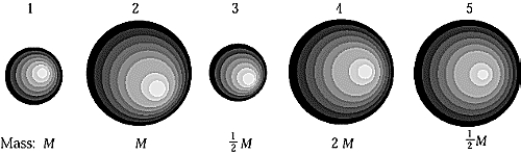 Five homogeneous planets have relative masses and sizes as shown in the figure. A body of mass m would weigh least on which planet?
 (Multiple Choice)
4.7/5 (76)
(76) If the mass of a planet is doubled with no increase in its size, the escape speed for that planet is
(Multiple Choice)
4.7/5 (86)
(86) You are in a spaceship that has a mass of 13 104 kg and is 2.2 1012 m from a black hole near the center of the galaxy. The gravitational force exerted by the black hole on the spaceship is 46 N. The force on the ship when it has moved to one-third of its original distance from the black hole is
(Multiple Choice)
4.9/5 (85)
(85) A space rocket is launched such that very far from Earth it has a speed of 20 km/s. What was its initial launch speed from the surface of Earth? (RE = 6.38 106 m, ME = 5.98 1024 kg, G = 6.67 10-11 N·m2/kg2)
(Multiple Choice)
4.8/5 (82)
(82) What is the escape speed from the sun, beginning (from rest relative to the sun) at the orbit of Earth, R = 1.50 108 km. (Given: G = 6.67 10-11 N · m2/kg2; mass of the sun = 2.0 1030 kg.)
(Multiple Choice)
4.9/5 (89)
(89) With what velocity must a body be projected vertically upward from the earth's surface, in the absence of friction, to rise to a height equal to the earth's radius (6400 km)?
(Multiple Choice)
4.9/5 (88)
(88) A body experiences a gravitational force with a magnitude of 100 N in a region of space where the magnitude of the gravitational field is 20 m/s2. The mass of the body is
(Multiple Choice)
4.8/5 (77)
(77) A satellite with a mass m is in a stable circular orbit about a planet with a mass M. The universal gravitational constant is G. The radius of the orbit is R. The ratio of the potential energy of the satellite to its kinetic energy is
(Multiple Choice)
4.9/5 (69)
(69) If a planet has a mass twice that of Earth and a radius four times that of Earth, the ratio of the acceleration due to gravity on the planet to that on Earth is
(Multiple Choice)
4.8/5 (84)
(84) 
Filters
- Essay(0)
- Multiple Choice(0)
- Short Answer(0)
- True False(0)
- Matching(0)