



 Chat with AI
Exam 9: Rotation

Exam 1: Systems of Measurement86 Questions
Exam 2: Motion in One Dimension103 Questions
Exam 3: Motion in Two and Three Dimensions67 Questions
Exam 4: Newtons Laws117 Questions
Exam 5: Applications of Newtons Laws75 Questions
Exam 6: Work and Energy71 Questions
Exam 7: Conservation of Energy73 Questions
Exam 8: Systems of Particles and Conservation of Linear Momentum107 Questions
Exam 9: Rotation119 Questions
Exam 10: Conservation of Angular Momentum67 Questions
Exam 11: Gravity90 Questions
Exam 12: Static Equilibrium and Elasticity65 Questions
Exam 13: Fluids91 Questions
Exam 14: Oscillations138 Questions
Exam 15: Wave Motion122 Questions
Exam 16: Superposition and Standing Waves125 Questions
Exam 17: Temperature and the Kinetic Theory of Gases85 Questions
Exam 18: Heat and the First Law of Thermodynamics114 Questions
Exam 19: The Second Law of Thermodynamics61 Questions
Exam 20: Thermal Properties and Processes54 Questions
Select questions type


A point P is at a distance R from the axis of rotation of a rigid body. The linear speed, centripetal acceleration, and tangential acceleration of the point can be expressed as
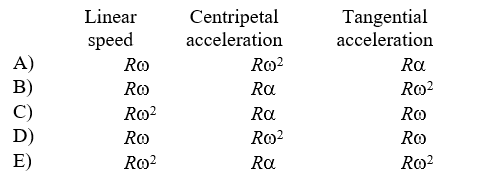
(Short Answer)
4.8/5  (83)
(83) 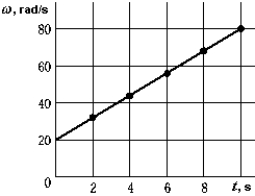 The data used to construct the graph were taken from the tachometer of an airplane. The angular acceleration during the 10 s interval was
 (Multiple Choice)
4.8/5 (91)
(91) A uniform cylinder (I =  mR2) of diameter 0.20 m and mass 12 kg rolls without slipping down a 37º inclined plane. The gain in translational kinetic energy of the cylinder when it has rolled 5 m down the incline of the plane is approximately
 (Multiple Choice)
4.8/5 (79)
(79) A solid cylinder, a hollow cylinder, and a square block of equal masses are released at the top of an inclined plane. The cylinders roll down and the block slides down, all with negligible frictional losses. In what order will they arrive at the bottom?
(Multiple Choice)
4.9/5 (78)
(78) Two objects, m1 and m2, both of mass m, are placed on a horizontal platform which is rotating at a constant angular velocity. m1 is located at a distance  R from the axis of rotation and m2 is located at a R. The tangential acceleration of mass m1 ____ to the tangential acceleration of m2.
 (Multiple Choice)
4.9/5 (70)
(70) You have a friend who lives in the southern part of the United States, and you live in the northern part. As Earth rotates, your linear velocity is ___________ hers, and your angular velocity is ____________ hers.
(Multiple Choice)
4.8/5 (65)
(65) A cord attached to a 3.63-kg mass is wrapped around a wheel of radius 0.610 m and released. The moment of inertia of the wheel is 2.71 kg · m2. If the wheel rotates on frictionless bearings, the acceleration of the falling weight is
(Multiple Choice)
4.9/5 (80)
(80) The information on a compact disc is scanned by a laser initially at a radius of 2.4 cm and then out to a maximum of 6.0 cm. Because the dimensions of the pit information remains constant with radius the disk motor adjusts so that the tangential velocity remains a constant. What is the ratio of the inner to outer rotational frequencies?
(Multiple Choice)
4.7/5 (84)
(84) You are pedaling a bicycle at 9.8 m/s. The radius of the wheels of the bicycle is 51.9cm. The angular velocity of rotation of the wheels is
(Multiple Choice)
4.9/5 (77)
(77) In the figure, the rotational inertia of the wheel and axle about the center is
12.0 kg · m2, the constant force F is 39.2 N, and the radius r is 0.800 m. The wheel starts from rest. When the force has acted through 2.00 m, the rotational velocity acquired by the wheel due to this force will be 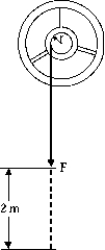
(Multiple Choice)
5.0/5 (94)
(94) You give an orbiting satellite a command to rotate through an angle given by
= at + bt2 - ct4
Where a, b, and c are constants and is in radians if t is in seconds. What is the angular acceleration of this satellite at time t?
(Multiple Choice)
4.9/5 (84)
(84) The ball shown in the figure will loop-the-loop if it starts from a point high enough on the incline. When the ball is at point A, the centripetal force on it is best represented by which of the following vectors? 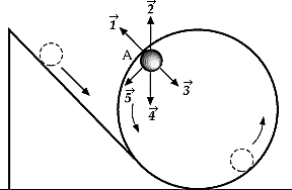
(Multiple Choice)
4.9/5 (82)
(82) A thin solid disk of radius R = 0.5 m and mass M = 2.0 kg is rolling without slipping on a horizontal surface with a linear speed v = 5.0 m/s. The disk now rolls without slipping up an inclined plane that is at an angle of 60 degrees to the vertical. Calculate the maximum height that the disk rolls up the incline.
(Multiple Choice)
5.0/5 (76)
(76) A record turntable rotates through 5.0 rad in 2.8 s as it is accelerated uniformly from rest. What is the angular velocity at the end of that time?
(Multiple Choice)
4.7/5 (82)
(82) In a laboratory experiment, various torques are applied to a rotor and the angular acceleration is measured. The results are plotted on the accompanying graph. From the graph, the moment of inertia of the rotor is 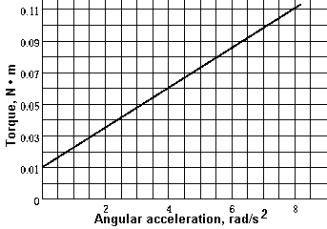
(Multiple Choice)
4.9/5 (74)
(74) A solid disk (I =  MR2) that is 10 cm in diameter has a mass of 4 kg. The force applied at the outer surface required to produce an angular acceleration of 6 rad/s2 about an axis through the center of the disc is
 (Multiple Choice)
4.9/5 (84)
(84) A uniform disk (Io = ½ mR2) of mass m and radius R is suspended from a point on its rim. The moment of inertia of the disk about an axis perpendicular to the disk through the pivot point is
(Multiple Choice)
4.9/5 (81)
(81) Assume that all of the mass of a bicycle wheel is concentrated at its rim. Such a wheel of mass 1.2 kg and radius 30 cm starts from rest at the top of a hill 100 m long and inclined at 20º to the horizontal. What will be the speed of the wheel at the bottom of the hill if it rolls without slipping?
(Multiple Choice)
4.9/5 (81)
(81) A spherical shell and a solid sphere (both of the same total mass) are rotating about a diameter at the same angular frequency and with the same rotational kinetic energy. What is the ratio of the spherical shell radius to the solid sphere (i.e., Rspherical shell/Rsolid sphere)?
(Multiple Choice)
4.9/5 (90)
(90) 
Filters
- Essay(0)
- Multiple Choice(0)
- Short Answer(0)
- True False(0)
- Matching(0)