



 Chat with AI
Exam 9: Rotation

Exam 1: Systems of Measurement86 Questions
Exam 2: Motion in One Dimension103 Questions
Exam 3: Motion in Two and Three Dimensions67 Questions
Exam 4: Newtons Laws117 Questions
Exam 5: Applications of Newtons Laws75 Questions
Exam 6: Work and Energy71 Questions
Exam 7: Conservation of Energy73 Questions
Exam 8: Systems of Particles and Conservation of Linear Momentum107 Questions
Exam 9: Rotation119 Questions
Exam 10: Conservation of Angular Momentum67 Questions
Exam 11: Gravity90 Questions
Exam 12: Static Equilibrium and Elasticity65 Questions
Exam 13: Fluids91 Questions
Exam 14: Oscillations138 Questions
Exam 15: Wave Motion122 Questions
Exam 16: Superposition and Standing Waves125 Questions
Exam 17: Temperature and the Kinetic Theory of Gases85 Questions
Exam 18: Heat and the First Law of Thermodynamics114 Questions
Exam 19: The Second Law of Thermodynamics61 Questions
Exam 20: Thermal Properties and Processes54 Questions
Select questions type


Use the figure the problem.
A mass m = 0.5 kg is hung from a pulley with moment of inertia I = 0.20kg.m2 and radius R = 10cm. There is friction in the pulley. The mass is dropped from rest, and after 2s it traveled 4m. 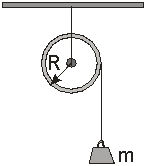 -What is the angular acceleration of the pulley?
 (Multiple Choice)
4.8/5  (74)
(74) A hoop of mass 50 kg rolls without slipping. If the center-of-mass of the hoop has a translational speed of 4.0 m/s, the total kinetic energy of the hoop is
(Multiple Choice)
4.8/5 (91)
(91) When an object is moving in a circle at constant speed, its acceleration is
(Multiple Choice)
4.9/5 (79)
(79) 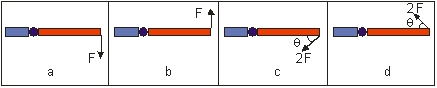 The diagrams above show the application of a force to a level arm. The arms are of the same length and = 30 . Which diagram has the largest (magnitude) torque about the hinge?
 (Multiple Choice)
4.8/5 (80)
(80) A thin, massless string is wrapped around a 0.25m radius grindstone supported by bearings that produce negligible frictional torque. A steady tension of 20 N in the string causes the grindstone to move from rest to a speed of 60 rad/s in 12s. The moment of inertia of the grindstone is 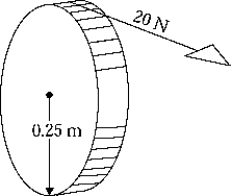
(Multiple Choice)
4.8/5 (77)
(77) Two solid balls (one large, the other small) and a cylinder roll down a hill. Which has the greatest speed at the bottom and which the least?
(Multiple Choice)
4.9/5 (77)
(77) A wheel rotates through 6.0 rad in 2.0 s as it is uniformly brought to rest. The initial angular velocity of the wheel before braking began was
(Multiple Choice)
4.9/5 (73)
(73) Two points, A and B, are on a disk that rotates about an axis. Point A is closer to the axis than point B. Which of the following is not true?
(Multiple Choice)
4.8/5 (88)
(88) 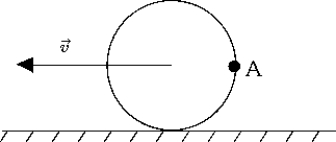 A bicycle is moving at a speed v = 12.6 m/s. A small stone is stuck to one of the tires. At the instant the stone is at point A in the figure, it comes free. The velocity of the stone (magnitude and direction) relative to Earth just after release is
 (Multiple Choice)
4.9/5 (81)
(81) A cylinder (I = ½mR2) rolls along a level floor with a speed v. The work required to stop this cylinder is
(Multiple Choice)
4.8/5 (77)
(77) 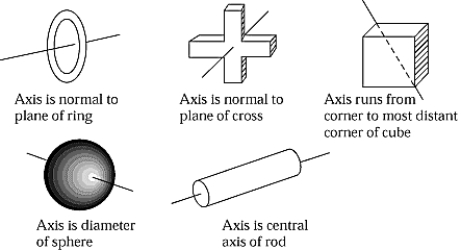 If all of the objects illustrated in the figure have equal masses, the moment of inertia about the indicated axis is largest for the
 (Multiple Choice)
4.7/5 (85)
(85) In the laboratory, a solid cylinder is permitted to roll down a plane inclined at an angle with the horizontal. If no slipping occurs, which of the following is true?
(Multiple Choice)
4.9/5 (94)
(94) The torque exerted on a perfectly spherical orbiting communications satellite by the gravitational pull of the earth is
(Multiple Choice)
4.8/5 (60)
(60) A spherically symmetric object with mass m = 0.2 kg and radius r = 10 cm, rolls without slipping on a horizontal surface with speed 1 m/s. It then rolls up an incline that is at an angle 30 with the horizon and comes to rest at a distance of 0.6 m along the incline. What is the moment of inertia of the object about an axis through the center of mass?
(Multiple Choice)
4.8/5 (93)
(93) 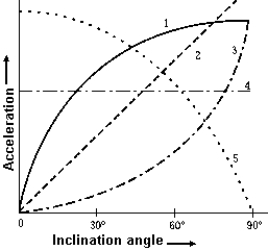 The curve that most nearly represents the acceleration of an object rolling down an inclined plane as a function of the angle of inclination is
 (Multiple Choice)
4.9/5 (85)
(85) The moment of inertia of a certain cylinder, whose mass is not distributed uniformly, is 0.6mR2 about its geometric axis. The translational speed of the center of mass after it starts from rest and rolls 14 m down a 30º incline is approximately
(Multiple Choice)
4.7/5 (81)
(81) For a disc of mass M and radius R that is rolling without slipping, which is greater, its translational or its rotational kinetic energy?
(Multiple Choice)
4.8/5 (84)
(84) 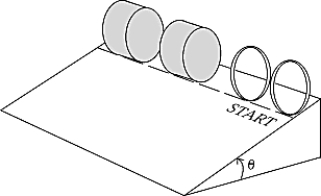 You are given two hoops (I =
 mR2), which are (1) brass and (2) wood, and two cylinders (I = mR2), which are (3) brass and (4) wood; each has radius R. If all are released from the same starting line at the same time, the one(s) that reach the bottom first are
You are given two hoops (I = mR2), which are (1) brass and (2) wood, and two cylinders (I = mR2), which are (3) brass and (4) wood; each has radius R. If all are released from the same starting line at the same time, the one(s) that reach the bottom first are (Multiple Choice)
4.8/5 (78)
(78) Which of the following statements about the motion of the second hand of a clock is true?
(Multiple Choice)
4.8/5 (84)
(84) 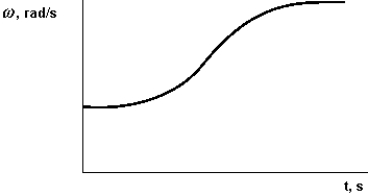 What physical quantity is represented by the slope of the curve shown on the graph?
 (Multiple Choice)
4.7/5 (77)
(77) 
Filters
- Essay(0)
- Multiple Choice(0)
- Short Answer(0)
- True False(0)
- Matching(0)