



 Chat with AI
Exam 9: Rotation

Exam 1: Systems of Measurement86 Questions
Exam 2: Motion in One Dimension103 Questions
Exam 3: Motion in Two and Three Dimensions67 Questions
Exam 4: Newtons Laws117 Questions
Exam 5: Applications of Newtons Laws75 Questions
Exam 6: Work and Energy71 Questions
Exam 7: Conservation of Energy73 Questions
Exam 8: Systems of Particles and Conservation of Linear Momentum107 Questions
Exam 9: Rotation119 Questions
Exam 10: Conservation of Angular Momentum67 Questions
Exam 11: Gravity90 Questions
Exam 12: Static Equilibrium and Elasticity65 Questions
Exam 13: Fluids91 Questions
Exam 14: Oscillations138 Questions
Exam 15: Wave Motion122 Questions
Exam 16: Superposition and Standing Waves125 Questions
Exam 17: Temperature and the Kinetic Theory of Gases85 Questions
Exam 18: Heat and the First Law of Thermodynamics114 Questions
Exam 19: The Second Law of Thermodynamics61 Questions
Exam 20: Thermal Properties and Processes54 Questions
Select questions type


A bicycle wheel, a hollow sphere, and a solid sphere each have the same mass and radius. They each rotate about an axis through their centers. Which has the greatest moment of inertia and which has the least?
(Multiple Choice)
4.7/5  (91)
(91) A solid cylinder, a hollow cylinder, and a square block of equal masses are released at the top of an inclined plane. The cylinders roll down and the block slides down, all with negligible frictional losses. Which of the following will happen?
(Multiple Choice)
4.9/5 (85)
(85) A wheel rotates with a constant nonzero angular acceleration. Which of the following quantities remains constant in magnitude?
(Multiple Choice)
4.8/5 (81)
(81) 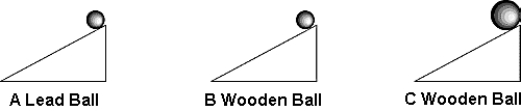 Three solid, homogeneous spheres are on identical inclined planes. If there are no frictional losses, which of the following statements correctly relates the translational speeds at the bottoms of the inclined planes?
 (Multiple Choice)
4.8/5 (74)
(74) A solid spherical ball of mass M and radius R rolls without slipping down an inclined plane from a height h. Compare the center of mass speed of the ball at the bottom of the plane with the speed obtained if the ball were simply dropped from a height h.
(Multiple Choice)
4.9/5 (86)
(86) Water is drawn from a well in a bucket tied to the end of a rope whose other end wraps around a cylinder of mass 50 kg and diameter 25 cm. As you turn this cylinder with a crank, the rope raises the bucket. If the mass of a bucket of water is 20 kg, what torque must you apply to the crank to raise the bucket of water at a constant speed?
(Multiple Choice)
4.7/5 (77)
(77) A 0.3-kg object is being whirled in a horizontal circle at the end of a 1.5 m long string. If the string breaks when the number of revolutions per minute, rpm = 200, then find the maximum tension in the string.
(Multiple Choice)
4.9/5 (74)
(74) A serious audiophile prefers to listen to music on his vinyl record turntable. The 12-inch diameter disk rotates at a constant 33  rpm. How fast is the record passing by the pickup cartridge tip at a radius of 4 inches? (1 inch = 2.54 cm)
 (Multiple Choice)
4.9/5 (76)
(76) Use the figure the problem.
A mass m = 0.5 kg is hung from a pulley with moment of inertia I = 0.20kg.m2 and radius R = 10cm. There is friction in the pulley. The mass is dropped from rest, and after 2s it traveled 4m. 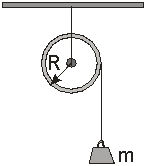 -What is the torque due to friction?
 (Multiple Choice)
4.7/5 (82)
(82) 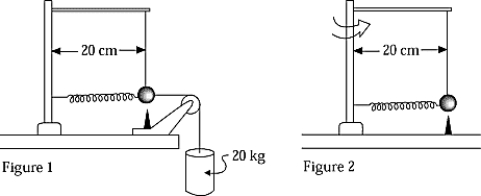 A 2-kg sphere attached to an axle by a spring is displaced from its rest position to a radius of 20 cm from the axle centerline by a standard mass of 20 kg, as in Figure 1. The same 2-kg sphere is also displaced 20 cm from the axle centerline, as in Figure 2, when the sphere is rotated at a speed of approximately
 (Multiple Choice)
4.7/5 (75)
(75) Two blocks m1 (= 0.4 kg) and m2 (= 0.6 kg) are initially positioned at x = 0.6 and
X = 1.1m. One cord is used to couple the blocks together and another to attach m1 to a vertical pole at the origin. The blocks are made to rotate in a horizontal circle on a frictionless surface. If the period of rotation is 0.4s then calculate the ratio of the tension for the inner cord divided by the tension in the outer cord.
(Multiple Choice)
4.9/5 (74)
(74) You are whirling a stone on the end of a string in a horizontal circle of radius
R = 0.65m with a frequency of 4 rev/s when the string breaks. Just after the string breaks, the velocity of the stone is
(Multiple Choice)
4.9/5 (76)
(76) The moment of inertia of a slim rod about a transverse axis through one end is mL2/3, where m is the mass of the rod and L is its length. The moment of inertia of a 0.24-kg meterstick about a transverse axis through its center is
(Multiple Choice)
4.7/5 (83)
(83) A 7.00-kg mass and a 4.00-kg mass are mounted on a spindle that is free to turn about the x axis as shown. Assume the mass of the arms and the spindle to be negligible. The magnitude of the resultant torque is approximately 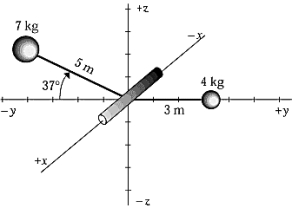
(Multiple Choice)
5.0/5 (69)
(69) For a hoop (ring) of mass M and radius R that is rolling without slipping, which is greater, its translational or its rotational kinetic energy?
(Multiple Choice)
4.9/5 (73)
(73) A wheel starting from rest has a constant angular acceleration. After 3.0 s the angular velocity of the wheel is 7.5 rad/s. This same angular acceleration continues for a further 7.0 s after which it drops suddenly to zero. In the first 20.0 s how many revolutions does the wheel make?
(Multiple Choice)
4.8/5 (77)
(77) A wheel on a car is rolling without slipping along level ground. The speed of the car is 36 m/s. The wheel has an outer diameter of 50 cm. The speed of the top of the wheel is
(Multiple Choice)
4.8/5 (71)
(71) A wheel of radius R is rolling without slipping. The velocity of the point on the rim that is in contact with the surface, relative to the surface, is
(Multiple Choice)
4.9/5 (99)
(99) Two small masses, mA = 4.0 10-3 kg and mB = 2.0 10-3 kg, are connected by a 1.0-m rod of negligible mass. The angular acceleration about B produced by a force of 0.016 N applied at A is approximately 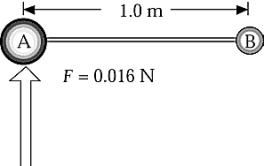
(Multiple Choice)
4.8/5 (72)
(72) 
Filters
- Essay(0)
- Multiple Choice(0)
- Short Answer(0)
- True False(0)
- Matching(0)