



 Chat with AI
Exam 7: Conservation of Energy

Exam 1: Systems of Measurement86 Questions
Exam 2: Motion in One Dimension103 Questions
Exam 3: Motion in Two and Three Dimensions67 Questions
Exam 4: Newtons Laws117 Questions
Exam 5: Applications of Newtons Laws75 Questions
Exam 6: Work and Energy71 Questions
Exam 7: Conservation of Energy73 Questions
Exam 8: Systems of Particles and Conservation of Linear Momentum107 Questions
Exam 9: Rotation119 Questions
Exam 10: Conservation of Angular Momentum67 Questions
Exam 11: Gravity90 Questions
Exam 12: Static Equilibrium and Elasticity65 Questions
Exam 13: Fluids91 Questions
Exam 14: Oscillations138 Questions
Exam 15: Wave Motion122 Questions
Exam 16: Superposition and Standing Waves125 Questions
Exam 17: Temperature and the Kinetic Theory of Gases85 Questions
Exam 18: Heat and the First Law of Thermodynamics114 Questions
Exam 19: The Second Law of Thermodynamics61 Questions
Exam 20: Thermal Properties and Processes54 Questions
Select questions type


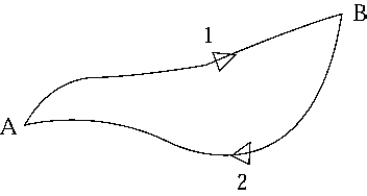 Consider a motion in which a particle goes from A B along path 1 and from B back to A along path 2, as shown.
W(AB, 1) = work in going from A B along path 1.
W(BA, 2) = work in going from B A along path 2.
If only conservative forces are acting, then
Consider a motion in which a particle goes from A B along path 1 and from B back to A along path 2, as shown.
W(AB, 1) = work in going from A B along path 1.
W(BA, 2) = work in going from B A along path 2.
If only conservative forces are acting, then (Multiple Choice)
4.9/5  (86)
(86) The binding energy of a deuteron is 2.22 MeV. This means that
(Multiple Choice)
4.8/5 (85)
(85) 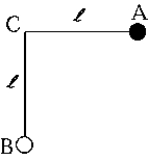 A simple pendulum has a bob of mass M. The bob is on a light string of length
 . The string is fixed at C. At position A, the string is horizontal and the bob is at rest. The bob is released from A and swings to B, where the string is vertical. The tension in the string when the bob first reaches B is
A simple pendulum has a bob of mass M. The bob is on a light string of length . The string is fixed at C. At position A, the string is horizontal and the bob is at rest. The bob is released from A and swings to B, where the string is vertical. The tension in the string when the bob first reaches B is (Multiple Choice)
4.9/5 (92)
(92) 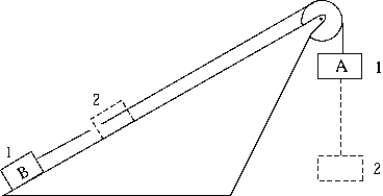 A system comprising two blocks is shown, one of which is on an inclined plane. The pulley is of negligible mass and is frictionless. The system starts from rest at position 1 and accelerates. Measurements taken when the blocks reach position 2 indicate that
(1)the kinetic energy of block A has changed by 330 J;
(2)the potential energy of block A has changed by 588 J;
(3)the kinetic energy of block B has changed by 110 J; and
(4)the potential energy of block B has changed by 98 J.
The amount of mechanical energy that has been converted to heat because of friction is
A system comprising two blocks is shown, one of which is on an inclined plane. The pulley is of negligible mass and is frictionless. The system starts from rest at position 1 and accelerates. Measurements taken when the blocks reach position 2 indicate that
(1)the kinetic energy of block A has changed by 330 J;
(2)the potential energy of block A has changed by 588 J;
(3)the kinetic energy of block B has changed by 110 J; and
(4)the potential energy of block B has changed by 98 J.
The amount of mechanical energy that has been converted to heat because of friction is (Multiple Choice)
4.8/5 (78)
(78) By what fraction does your mass increase when you and your car travel down the highway at 70 mph? Assume that the total mass of your car and occupant is 2000 kg.
(Multiple Choice)
4.9/5 (87)
(87) A 10-kg box is pushed up a plane inclined at 37º with the horizontal. The box starts from rest and is pushed 5 m along the incline with a uniform acceleration of 2 m/s2. The coefficient of kinetic friction is 0.20 and the pushing force is parallel to the plane. The increase in the potential energy of the box is
(Multiple Choice)
4.8/5 (77)
(77) A 5200-kg cable car in Hong Kong is pulled a distance of 360 m up a hill inclined at 12º from the horizontal. The change in the potential energy of the car is
(Multiple Choice)
5.0/5 (77)
(77) Use the figure to the right for the next problem.
An object of mass m = 200 g slides down a frictionless ramp from a height H = 60 cm. Near the bottom of the ramp, the path changes into an arc of a circle with radius r = 20 cm. The arc has coefficient of kinetic friction k = 0.4. The
angle = 120 and points P1 and P2 which are the ends of the arc, are at the same height. 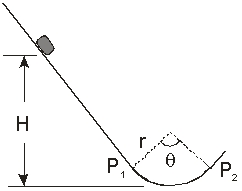 -A 5-kg box is pushed 5 m up a plane that is inclined at 30º with the horizontal. The coefficient of kinetic friction between the box and the plane is 0.20. The change in potential energy of the box is approximately
 (Multiple Choice)
4.8/5 (74)
(74) 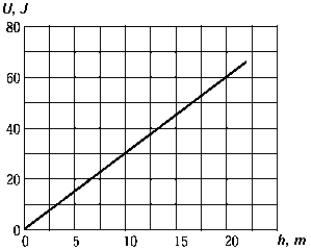 The graph shows a plot of the gravitational potential energy U of a 1-kg body as a function of its height h above the surface of a planet. The acceleration due to gravity at the surface of the planet is
 (Multiple Choice)
4.9/5 (82)
(82) A projectile of mass m is propelled from ground level with kinetic energy of 450 J. At the exact top of its trajectory, its kinetic energy is 250 J. To what height above the starting point does the projectile rise?
(Multiple Choice)
4.8/5 (74)
(74) A block with a mass M = 4.85 kg is resting on a slide that has a curved surface. There is no friction. The speed of the block after it has slid along the slide sufficiently far for its vertical drop to be 19.6 m is
(Multiple Choice)
4.8/5 (72)
(72) Use the figure to the right for the next problem.
An object of mass m = 200 g slides down a frictionless ramp from a height H = 60 cm. Near the bottom of the ramp, the path changes into an arc of a circle with radius r = 20 cm. The arc has coefficient of kinetic friction k = 0.4. The
angle = 120 and points P1 and P2 which are the ends of the arc, are at the same height.
-The work done by a conservative force between two points is
-The work done by a conservative force between two points is (Multiple Choice)
4.9/5 (77)
(77) 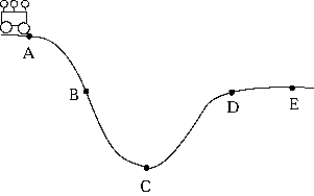 A roller coaster starts from rest at point A. If you ignore friction and take the zero of potential energy to be at C,
 (Multiple Choice)
4.8/5 (96)
(96) 
Filters
- Essay(0)
- Multiple Choice(0)
- Short Answer(0)
- True False(0)
- Matching(0)