



 Chat with AI
Exam 7: Conservation of Energy

Exam 1: Systems of Measurement86 Questions
Exam 2: Motion in One Dimension103 Questions
Exam 3: Motion in Two and Three Dimensions67 Questions
Exam 4: Newtons Laws117 Questions
Exam 5: Applications of Newtons Laws75 Questions
Exam 6: Work and Energy71 Questions
Exam 7: Conservation of Energy73 Questions
Exam 8: Systems of Particles and Conservation of Linear Momentum107 Questions
Exam 9: Rotation119 Questions
Exam 10: Conservation of Angular Momentum67 Questions
Exam 11: Gravity90 Questions
Exam 12: Static Equilibrium and Elasticity65 Questions
Exam 13: Fluids91 Questions
Exam 14: Oscillations138 Questions
Exam 15: Wave Motion122 Questions
Exam 16: Superposition and Standing Waves125 Questions
Exam 17: Temperature and the Kinetic Theory of Gases85 Questions
Exam 18: Heat and the First Law of Thermodynamics114 Questions
Exam 19: The Second Law of Thermodynamics61 Questions
Exam 20: Thermal Properties and Processes54 Questions
Select questions type


 A 5-kg mass with initial velocity 20 m/s slides along a frictionless horizontal surface then up a frictionless ramp (2 m long and at an angle 30 degrees to the horizontal) and onto a second horizontal surface. The block slides over a rough surface 15 m in length ( k = 0.4) before moving again on a frictionless surface and then impacting upon an uncompressed spring. If the block compresses the spring a distance 2 m, what is the spring constant k for the spring?
 (Multiple Choice)
4.8/5  (76)
(76) The potential energy function for a conservative force acting in the x direction on a particle is shown below. The number of points where the net force on the particle is equal to zero are 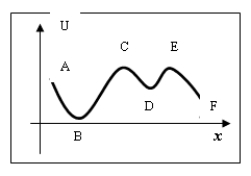
(Multiple Choice)
4.8/5 (71)
(71) A 4.0-kg block starts from rest and slides 5.0 m down a plane inclined at 60º to the horizontal. The coefficient of kinetic friction between the surface and the block is 0.20. The work done by friction on the block is
(Multiple Choice)
4.7/5 (76)
(76) Assuming the incline to be frictionless and the zero of gravitational potential energy to be at the elevation of the horizontal line, 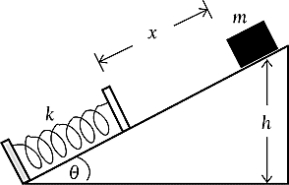
(Multiple Choice)
4.8/5 (67)
(67) A mass m is released from a height 80 cm from the right-hand side of the track shown in the diagram at right. There is only friction acting along the horizontal portion 30 cm either side of the midpoint O with a kinetic coefficient of friction of k = 0.4. Determine (i) how many times does the mass m pass through the midpoint O, and (ii) how far from the midpoint does it come to rest. 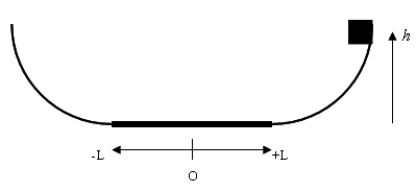
(Multiple Choice)
4.8/5 (78)
(78) In magazine car tests an important indicator of performance is the zero to 60 mph (0 to 96.6 km/h) acceleration time. A time below 6 s is considered to be extremely quick. If a car with mass 1300 kg were dropped vertically from a great height, how long would it take to go from zero to 60 mph and what would the magnitude of the change in gravitational potential energy be during this time? (neglect air resistance)
(Multiple Choice)
4.8/5 (78)
(78) A 75-kg man climbs the stairs to the fifth floor of a building, a total height of 16 m. His potential energy has increased by
(Multiple Choice)
4.8/5 (84)
(84) A spring with force constant k = 300 N/m is compressed 9.0 cm. What is the potential energy in the spring?
(Multiple Choice)
4.8/5 (78)
(78) A mass, m, slides down a frictionless incline and hits a spring with spring constant k. Find the spring compression when the acceleration of the mass is zero. 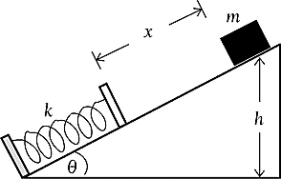
(Multiple Choice)
4.7/5 (74)
(74) Use the figure to the right for the next problems.
A flexible rope of mass m and length L = L1 + L2, hangs over a frictionless peg, as shown in the figure. 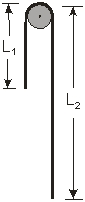 -What is the change in potential energy when the end of the rope just slides off the peg?
 (Multiple Choice)
4.8/5 (84)
(84) An electron has a rest mass of 0.511 MeV. From this information one can conclude that the rest mass of an electron is
(Multiple Choice)
4.9/5 (65)
(65) A proton has a rest mass of 938 MeV. From this information one can conclude that the rest mass of a proton is
(Multiple Choice)
4.9/5 (78)
(78) 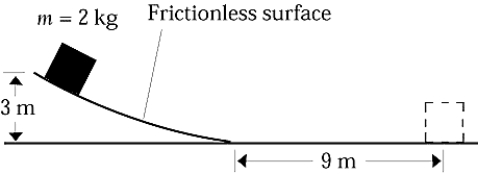 The block shown in the figure is sliding on a frictionless surface. Its speed when it reaches the level portion of the surface on which it is sliding will be
 (Multiple Choice)
4.8/5 (85)
(85) Use the figure to the right for the next problem.
An object of mass m = 200 g slides down a frictionless ramp from a height H = 60 cm. Near the bottom of the ramp, the path changes into an arc of a circle with radius r = 20 cm. The arc has coefficient of kinetic friction k = 0.4. The
angle = 120 and points P1 and P2 which are the ends of the arc, are at the same height. 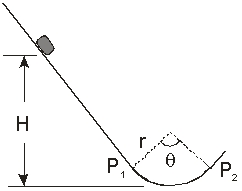 -What is the speed of the object at point P1?
 (Multiple Choice)
4.9/5 (75)
(75) Susana ascends a mountain via a short, steep trail. Sean ascends the same mountain via a long, gentle trail. Which of the following statements is true?
(Multiple Choice)
4.9/5 (71)
(71) The rest mass of a proton is 1.67 10-27 kg. From this information one can conclude that the rest energy of a proton is
(Multiple Choice)
4.9/5 (88)
(88) Use the figure to the right for the next problem.
An object of mass m = 200 g slides down a frictionless ramp from a height H = 60 cm. Near the bottom of the ramp, the path changes into an arc of a circle with radius r = 20 cm. The arc has coefficient of kinetic friction k = 0.4. The
angle = 120 and points P1 and P2 which are the ends of the arc, are at the same height.
-What is the kinetic energy of the object at point P2?
-What is the kinetic energy of the object at point P2? (Multiple Choice)
4.8/5 (87)
(87) Which potential energy versus displacement curve best represents that of an extended spring? 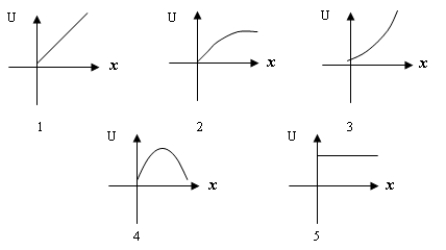
(Multiple Choice)
4.8/5 (89)
(89) 
Filters
- Essay(0)
- Multiple Choice(0)
- Short Answer(0)
- True False(0)
- Matching(0)