



 Chat with AI
Exam 7: Conservation of Energy

Exam 1: Systems of Measurement86 Questions
Exam 2: Motion in One Dimension103 Questions
Exam 3: Motion in Two and Three Dimensions67 Questions
Exam 4: Newtons Laws117 Questions
Exam 5: Applications of Newtons Laws75 Questions
Exam 6: Work and Energy71 Questions
Exam 7: Conservation of Energy73 Questions
Exam 8: Systems of Particles and Conservation of Linear Momentum107 Questions
Exam 9: Rotation119 Questions
Exam 10: Conservation of Angular Momentum67 Questions
Exam 11: Gravity90 Questions
Exam 12: Static Equilibrium and Elasticity65 Questions
Exam 13: Fluids91 Questions
Exam 14: Oscillations138 Questions
Exam 15: Wave Motion122 Questions
Exam 16: Superposition and Standing Waves125 Questions
Exam 17: Temperature and the Kinetic Theory of Gases85 Questions
Exam 18: Heat and the First Law of Thermodynamics114 Questions
Exam 19: The Second Law of Thermodynamics61 Questions
Exam 20: Thermal Properties and Processes54 Questions
Select questions type


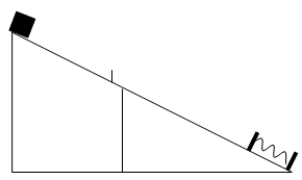 A 3-kg block sits on an incline where the top half of the incline has a coefficient of kinetic friction of 0.5 and the bottom half is frictionless. The angle of inclination is 35 degrees. If the block is released and travels 10 m along the rough part of the incline and then 10 m along the smooth part before it makes contact with the spring (k = 200 N/m), calculate the distance the spring is compressed.
 (Multiple Choice)
4.8/5  (90)
(90) A mass m is released from a height 60 cm from the right-hand side of the track shown in the diagram at right. There is only friction acting on the mass on the horizontal portion 35 cm either side of the midpoint O, with a kinetic coefficient of friction of k = 0.5. Determine what is the velocity of the block the first time it passes through the midpoint, and on which side of the midpoint does it stop? 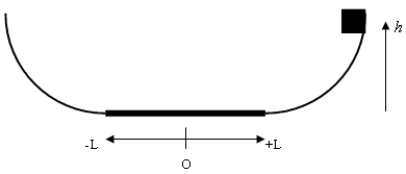
(Multiple Choice)
4.8/5 (73)
(73) 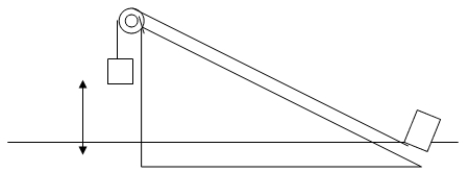 A hanging block A (mA = 15 kg) is connected by a light cable and a pulley wheel to a second block B (mB = 10 kg) situated at the bottom of a frictionless inclined plane with angle 30 to the horizontal. If the hanging block is released from rest 5 m above the ground, find the maximum distance that block B travels up along the inclined plane.
 (Multiple Choice)
4.7/5 (77)
(77) If you drive at the posted speed limit of 70 mph on the interstate, what is the fraction of your speed compared to the speed of light?
(Multiple Choice)
4.8/5 (70)
(70) The rest mass of an electron is 9.11 10-31 kg. From this information one can conclude that the rest energy of an electron is
(Multiple Choice)
4.9/5 (94)
(94) Assuming the incline to be frictionless and the zero of gravitational potential energy to be at the elevation of the horizontal line, 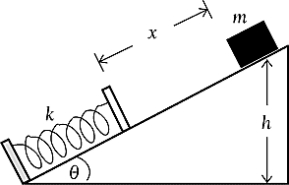
(Multiple Choice)
5.0/5 (88)
(88) A child is sitting on the seat of a swing with ropes 10 m long. Her father pulls the swing back until the ropes make a 37º angle with the vertical and then releases the swing. If air resistance is neglected, what is the speed of the child at the bottom of the arc of the swing when the ropes are vertical?
(Multiple Choice)
4.8/5 (69)
(69) A block of mass, m, is pushed up against a spring, compressing it a distance x, and is then released. The spring projects the block along a frictionless horizontal surface, giving the block a speed v. The same spring projects a second block of mass 4m, giving it a speed 3v. What distance was the spring compressed in the second case?
(Multiple Choice)
4.9/5 (76)
(76) Calculate the work done by a force,  , along the path (0,0) P1 (2,0) P2 (2,2).
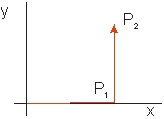
, along the path (0,0) P1 (2,0) P2 (2,2). (Multiple Choice)
4.8/5 (84)
(84) Use the figure to the right to answer the next problems.
An object of mass m = 100 g slides down without rolling a rough incline from a height H = 60 cm. At
h = 30 cm, the object flies off the incline. The coefficient of kinetic friction is 0.4, and the angle = 30 . 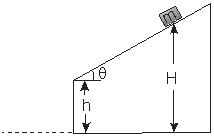 -How far from the base of the elevated incline does the object hit the floor?
 (Multiple Choice)
4.9/5 (79)
(79) 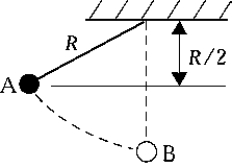 Release mass m on a string from rest at point A. As it passes the lowest point B, the tension in the string is
 (Multiple Choice)
5.0/5 (90)
(90) Use the figure to the right to answer the next problems.
An object of mass m = 100 g slides down without rolling a rough incline from a height H = 60 cm. At
h = 30 cm, the object flies off the incline. The coefficient of kinetic friction is 0.4, and the angle = 30 .
-The minimum amount of energy released in an electron-positron annihilation is
-The minimum amount of energy released in an electron-positron annihilation is (Multiple Choice)
4.7/5 (75)
(75) When a hydrogen atom absorbs a photon with E = 4.089 10-19 J, what is the frequency of the photon?
(Multiple Choice)
4.8/5 (86)
(86) 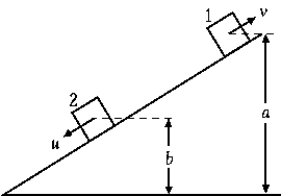 A block of mass m starts from position 1 and moves up a frictionless inclined plane with an initial speed v. At some later time the block has moved down the plane and at position 2 has a speed u. If a and b are the heights above the bottom of the plane, the magnitude of u can be determined from
 (Multiple Choice)
4.7/5 (87)
(87) 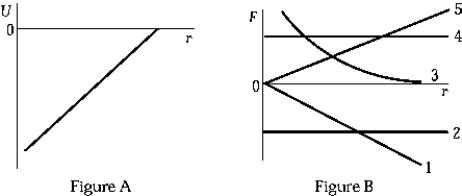 When the potential energy U(r) is given as in Figure A, then the force is given in Figure B by curve
 (Multiple Choice)
5.0/5 (83)
(83) 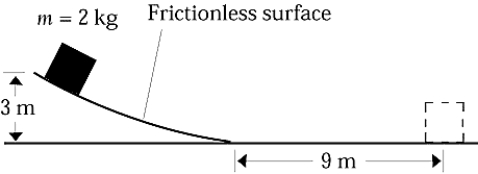 The block shown in the figure is sliding on a frictionless surface. Its speed when it has traveled 9 m along the horizontal surface will be
 (Multiple Choice)
4.8/5 (85)
(85) 
Filters
- Essay(0)
- Multiple Choice(0)
- Short Answer(0)
- True False(0)
- Matching(0)