
Exam 13: Limits: a Preview of Calculus

arrow
  • Select Tags
search iconSearch Question
  • Select Tags

Determine whether the sequence an=n4−15−n4a _ { \mathrm { n } } = \frac { n ^ { 4 } - 1 } { 5 - n ^ { 4 } } converges or diverges. If it converges, find the limit.

Free
(Essay)
4.8/5
(74)
Correct Answer:
Verified

Converges; lim⁡n→∞n4−15−n4=−1\lim _ { n \rightarrow \infty } \frac { n ^ { 4 } - 1 } { 5 - n ^ { 4 } } = - 1

Use the definition of area as a limit to find the area of the region that lies under the graph of f(x)=2xf ( x ) = 2 x over the interval 1≤x≤31 \leq x \leq 3 .

Free
(Essay)
4.8/5
(87)
Correct Answer:
Verified

Width: Δx=3−1n=2n\Delta x = \frac { 3 - 1 } { n } = \frac { 2 } { n } , REP: xk=(1)+k(2n)=1+2knx _ { k } = ( 1 ) + k \left( \frac { 2 } { n } \right) = 1 + \frac { 2 k } { n } , Height: f(xk)=2(1+2kn)=2+4knf \left( x _ { k } \right) = 2 \left( 1 + \frac { 2 k } { n } \right) = 2 + \frac { 4 k } { n } . A=lim⁡n→∞∑k=1nf(xk)Δx=lim⁡n→∞∑k=1n[(2+4kn)⋅2n]=lim⁡n→∞∑k=1n(4n+8kn2)=lim⁡n→∞4n∑k=1n1+lim⁡n→∞8n2∑k=1nk=lim⁡n→∞[4n⋅n]+lim⁡n→∞[8n2⋅n(n+1)2]=lim⁡n→∞[4]+lim⁡n→∞[4+4n]=8\begin{aligned}A & = \lim _ { n \rightarrow \infty } \sum _ { k = 1 } ^ { n } f \left( x _ { k } \right) \Delta x = \lim _ { n \rightarrow \infty } \sum _ { k = 1 } ^ { n } \left[ \left( 2 + \frac { 4 k } { n } \right) \cdot \frac { 2 } { n } \right] = \lim _ { n \rightarrow \infty } \sum _ { k = 1 } ^ { n } \left( \frac { 4 } { n } + \frac { 8 k } { n ^ { 2 } } \right) \\& = \lim _ { n \rightarrow \infty } \frac { 4 } { n } \sum _ { k = 1 } ^ { n } 1 + \lim _ { n \rightarrow \infty } \frac { 8 } { n ^ { 2 } } \sum _ { k = 1 } ^ { n } k = \lim _ { n \rightarrow \infty } \left[ \frac { 4 } { n } \cdot n \right] + \lim _ { n \rightarrow \infty } \left[ \frac { 8 } { n ^ { 2 } } \cdot \frac { n ( n + 1 ) } { 2 } \right] = \lim _ { n \rightarrow \infty } [ 4 ] + \lim _ { n \rightarrow \infty } \left[ 4 + \frac { 4 } { n } \right] = 8\end{aligned}

Evaluate lim⁡x→4x2−4xx−4\lim _ { x \rightarrow 4 } \frac { x ^ { 2 } - 4 x } { x - 4 } .

Free
(Essay)
4.9/5
(87)
Correct Answer:
Verified

lim⁡x→4x2−4xx−4=4\lim _ { x \rightarrow 4 } \frac { x ^ { 2 } - 4 x } { x - 4 } = 4

Evaluate lim⁡t→3t2−913−1t\lim _ { t \rightarrow 3 } \frac { t ^ { 2 } - 9 } { \frac { 1 } { 3 } - \frac { 1 } { t } } .

(Essay)
4.7/5
(97)

For the function g whose graph is given, state the value of the given quantity if it exists.  For the function g whose graph is given, state the value of the given quantity if it exists.    a)  \lim _ { x \rightarrow 4 ^ { - } } g ( t )   b)  \lim _ { x \rightarrow 4 ^ { + } } g ( t )   c)  \lim _ { x \rightarrow 4 } g ( t ) a) lim⁡x→4−g(t)\lim _ { x \rightarrow 4 ^ { - } } g ( t ) b) lim⁡x→4+g(t)\lim _ { x \rightarrow 4 ^ { + } } g ( t ) c) lim⁡x→4g(t)\lim _ { x \rightarrow 4 } g ( t )
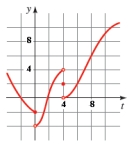
(Essay)
4.9/5
(86)

Find the derivative of f(x)=2xx−2f ( x ) = \frac { 2 x } { x - 2 } at the point (−3,65)\left( - 3 , \frac { \mathfrak { 6 } } {5 } \right) .

(Essay)
4.8/5
(79)

Find the derivative of f(x)=5x−x2f ( x ) = 5 x - x ^ { 2 } at the point (52,254)\left( \frac { 5 } { 2 } , \frac { 25 } { 4 } \right) .

(Essay)
4.8/5
(75)

Evaluate lim⁡x→3/24x2−16x+152x−3\lim _ { x \rightarrow 3/2 } \frac { 4 x ^ { 2 } - 16 x + 15 } { 2 x - 3 } .

(Essay)
5.0/5
(89)

Use the definition of area as a limit to find the area of the region that lies under the graph of f(x)=5f ( x ) = 5 over the interval 0≤x≤50 \leq x \leq 5 .

(Essay)
4.9/5
(78)

Use a graphing device to determine whether lim⁡x→−2x3−x2−10x−8−2x3−12x2−6x+20\lim _ { x \rightarrow - 2 } \frac { x ^ { 3 } - x ^ { 2 } - 10 x - 8 } { - 2 x ^ { 3 } - 12 x ^ { 2 } - 6 x + 20 } exists. If the limit exists, estimate its value to two decimal places.

(Essay)
4.7/5
(80)

Find the derivative of f(x)=1x+1f ( x ) = \frac { 1 } { \sqrt { x + 1 } } at the point (3,12)\left( 3 , \frac { 1 } { 2 } \right) .

(Essay)
4.9/5
(75)

Find the derivative of the function at the given number. g(x)=2−2x2g ( x ) = 2 - 2 x ^ { 2 } at 2

(Essay)
4.7/5
(80)

Find lim⁡x→∞12x−1\lim _ { x \rightarrow \infty } \frac { 1 } { 2 x - 1 } .

(Essay)
4.9/5
(66)

Find the derivative of the function at the given number. f(x)=2+2xf ( x ) = 2 + 2 \sqrt { x } at 4

(Essay)
4.8/5
(80)

Use a table of values to estimate the value of lim⁡x→∞5x2x2+x\lim _ { x \rightarrow \infty } \frac { 5 x } { \sqrt { 2 x ^ { 2 } + x } } . Then use a graphing device to confirm your result graphically.

(Essay)
4.8/5
(64)

Determine whether the sequence an=lim⁡n→∞15n3[n(n+1)(2n+1)6]a _ { n } = \lim _ { n \rightarrow \infty } \frac { 15 } { n ^ { 3 } } \left[ \frac { n ( n + 1 ) ( 2 n + 1 ) } { 6 } \right] converges or diverges. If it converges, find the limit.

(Essay)
4.8/5
(79)

Evaluate the limit if it exists. lim⁡t→0(13t−1t2+3t)\lim _ { t \rightarrow 0 } \left( \frac { 1 } { 3 t } - \frac { 1 } { t ^ { 2 } + 3 t } \right)

(Essay)
4.8/5
(93)

Complete the table of values (to five decimal places) and use the table to estimate the value of lim⁡x→93−x9−x\lim _ { x \rightarrow 9 } \frac { 3 - \sqrt { x } } { 9 - x } . x 8.9 8.99 8.999 9.001 9.01 9.1 f(x)

(Essay)
4.9/5
(84)

Estimate the area under the graph of f(x)=x2−1f ( x ) = x ^ { 2 } - 1 from x=1x = 1 to x=5x = 5 using (a) four approximating rectangles and right endpoints. (b) four approximating rectangles and left endpoints. (c) eight approximating rectangles and right endpoints.

(Essay)
4.8/5
(78)

Evaluate the limit if it exists. lim⁡h→0(5+h)−1−5−1h\lim _ { h \rightarrow 0 } \frac { ( 5 + h ) ^ { - 1 } - 5 ^ { - 1 } } { h }

(Essay)
4.8/5
(80)
Showing 1 - 20 of 66
close modal

Filters

  • Essay(0)
  • Multiple Choice(0)
  • Short Answer(0)
  • True False(0)
  • Matching(0)