Exam 9: Vectors in Two and Three Dimensions

arrow
  • Select Tags
search iconSearch Question
  • Select Tags

Find a vector that is perpendicular to the plane passing through the three given points. P(3,0,1),Q(0,2,−5),R(−2,0,5)P ( 3,0,1 ) , Q ( 0,2 , - 5 ) , R ( - 2,0,5 )

Free
(Essay)
4.8/5
(85)
Correct Answer:
Verified

⟨8,42,10⟩\langle 8,42,10 \rangle

Find the vectors u+v\mathbf { u } + \mathbf { v } , u−v\mathbf { u } - \mathbf { v } , and 3u−12v3 \mathbf { u } - \frac { 1 } { 2 } \mathbf { v } . u=⟨a,2b,3c⟩,v=⟨−a,b,−2c⟩\mathbf { u } = \langle a , 2 b , 3 c \rangle , \mathbf { v } = \langle - a , b , - 2 c \rangle

Free
(Essay)
4.7/5
(73)
Correct Answer:
Verified

u+v=⟨0,3b,c⟩;u−v=⟨2a,b,5c⟩;3u−12v=⟨72a,112b,10c⟩\mathbf { u } + \mathbf { v } = \langle 0,3 b , c \rangle ; \mathbf { u } - \mathbf { v } = \langle 2 a , b , 5c \rangle ; 3 \mathbf { u } - \frac { 1 } { 2 } \mathbf { v } = \left\langle \frac { 7 } { 2 } a , \frac { 11 } { 2 } b , 10 c \right\rangle

Determine whether u=⟨−12,2⟩\mathbf { u } = \left\langle - \frac { 1 } { 2 } , 2 \right\rangle is orthogonal to v=⟨−2,12⟩\mathbf { v } = \left\langle - 2 , \frac { 1 } { 2 } \right\rangle .

Free
(Essay)
5.0/5
(80)
Correct Answer:
Verified

u⋅v=(−12)(−2)+(2)(12)=2\mathbf { u } \cdot \mathbf { v } = \left( - \frac { 1 } { 2 } \right) ( - 2 ) + ( 2 ) \left( \frac { 1 } { 2 } \right) = 2 , not orthogonal

Given u=⟨4,−3⟩\mathbf { u } = \langle 4 , - 3 \rangle and v=⟨9,2⟩\mathbf { v } = \langle 9,2 \rangle , calculate proj⁡vu\operatorname { proj } _ { \mathbf { v } } \mathbf { u } and then resolve u\mathbf { u } into u1\mathbf { u } _ { 1 } and u2\mathbf { u } _ { 2 } .

(Essay)
4.9/5
(86)

Find the area of the parallelogram determined by the given vectors. u=⟨0,−2,3⟩,v=⟨5,−5,0⟩\mathbf { u } = \langle 0 , - 2,3 \rangle , \mathbf { v } = \langle 5 , - 5,0 \rangle

(Essay)
4.7/5
(78)

A description of a line is given. Find parametric equations for the line. The line perpendicular to the xz-plane that contains the point (3,−1,4)( 3 , - 1,4 ) .

(Essay)
4.8/5
(86)

Describe the surface represented by the given equation. x=3x = 3

(Short Answer)
4.8/5
(79)

The lengths of two vectors a and b, and the angle θ \theta between them, are given. Find the length of their cross product, ∣a×b∣| \mathbf { a } \times \mathbf { b } | . ∣a∣=0.12,∣b∣=1.25,θ=85∘| \mathbf { a } | = 0.12 , | \mathbf { b } | = 1.25 , \theta = 85 ^ { \circ }

(Short Answer)
4.9/5
(77)

Find ∣v∣| v | and ∣u+v∣| \mathbf { u } + \mathbf { v } | , given that u=2i−j\mathbf { u } = 2 \mathbf { i } - \mathbf { j } and v=i\mathbf { v } = \mathbf { i } .

(Essay)
4.9/5
(86)

Two vectors u and v are given. Find the angle (expressed in degrees) between u and v. u=i+2j−3k,v=j+k\mathbf { u } = \mathbf { i } + 2 \mathbf { j } - 3 \mathbf { k } , \mathbf { v } = \mathbf { j } + \mathbf { k }

(Essay)
4.7/5
(84)

Find the vector v with initial point P and terminal point Q. P(2,−1,0)P ( 2 , - 1,0 ) , Q(0,−2,5)Q ( 0 , - 2,5 )

(Essay)
4.8/5
(77)

Two vectors u and v are given. Find their dot product u⋅v\mathbf { u } \cdot \mathbf { v } . u=⟨−3,0,3⟩,v=⟨2,4,13⟩\mathbf { u } = \langle - 3,0,3 \rangle , \mathbf { v } = \langle 2,4 , \frac { 1 } { 3 } \rangle

(Essay)
4.8/5
(63)

Find an equation of a sphere with the given radius r and center C. r=7r = \sqrt { 7 } ; C(3,−1,0)C ( 3 , - 1,0 )

(Essay)
4.8/5
(81)

Given that the forces F1=⟨−10,3⟩\mathbf { F } _ { 1 } = \langle - 10,3 \rangle , F2=⟨−4,1⟩\mathbf { F } _ { 2 } = \langle - 4,1 \rangle and F]=⟨4,−10⟩\mathbf { F } _ { ] } = \langle 4 , - 10 \rangle are acting on a point PP , find the resultant force, magnitude and the additional force required in order for the forces to be in equilibrium.

(Essay)
5.0/5
(84)

Find parametric equations for the line that passes through the points P and Q. P(2,−1,−1),Q(0,1,−3)P ( 2 , - 1 , - 1 ) , \quad Q ( 0,1 , - 3 )

(Essay)
4.9/5
(81)

Describe the trace of the sphere (x−1)2+(y−4)2+(z−3)2=144( x - 1 ) ^ { 2 } + ( y - 4 ) ^ { 2 } + ( z - 3 ) ^ { 2 } = 144 through (a) the xz-plane in (b) the plane z=−2z = - 2 .

(Essay)
4.8/5
(79)

Find ∣12v∣\left| \frac { 1 } { 2 } \mathbf { v } \right| , ∣u−v∣| \mathbf { u } - \mathbf { v } | and ∣u∣−∣v∣| \mathbf { u } | - | \mathbf { v } | , given that u=⟨1\mathbf { u } = \langle 1 ,  3) \text { 3) } and v=⟨−2,1⟩\mathbf { v } = \langle - 2,1 \rangle .

(Essay)
4.9/5
(81)

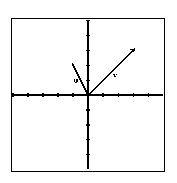
Given u\mathbf { u } and v\mathbf { v } in the figure, sketch v−u\mathbf { v } - \mathbf { u } .  Given  \mathbf { u }  and  \mathbf { v }  in the figure, sketch  \mathbf { v } - \mathbf { u }  .

(Essay)
4.7/5
(91)

Find the vector with initial point P(6,3)P ( 6,3 ) and terminal point Q(−6,−3)Q ( - 6 , - 3 ) .

(Essay)
4.8/5
(64)

Find the area of the parallelogram determined by the given vectors. u=2i−2j+2k,v=2i+2j−2k\mathbf { u } = 2 \mathbf { i } - 2 \mathbf { j } + 2 \mathbf { k } , \mathbf { v } = 2 \mathbf { i } + 2 \mathbf { j } - 2 \mathbf { k }

(Essay)
4.9/5
(80)
Showing 1 - 20 of 96
close modal

Filters

  • Essay(0)
  • Multiple Choice(0)
  • Short Answer(0)
  • True False(0)
  • Matching(0)