



 Chat with AI
Exam 16: The Markets for Labor, Capital, and Land

Exam 1: The Role and Method of Economics194 Questions
Exam 2: Eight Powerful Ideas212 Questions
Exam 3: Scarcity, Trade-Offs, and Production Possibilities182 Questions
Exam 4: Demand, Supply, and Market Equilibrium231 Questions
Exam 5: Market in Motion and Price Controls252 Questions
Exam 6: Elasticities271 Questions
Exam 7: Market Efficiency and Welfare128 Questions
Exam 8: Market Failure259 Questions
Exam 9: Public Finance and Public Choice62 Questions
Exam 10: Consumer Choice Theory206 Questions
Exam 11: The Firm: Production and Costs147 Questions
Exam 12: Firms in Perfectly Competitive Markets124 Questions
Exam 13: Monopoly and Antitrust62 Questions
Exam 14: Monopolistic Competition and Product Differentiation207 Questions
Exam 15: Oligopoly and Strategic Behavior68 Questions
Exam 16: The Markets for Labor, Capital, and Land131 Questions
Exam 17: Income, Poverty and Health Care252 Questions
Exam 18: Introduction to Macroeconomics: Unemployment, Inflation, and Economic Fluctuations152 Questions
Exam 19: Measuring Economic Performance152 Questions
Exam 20: Economic Growth in the Global Economy163 Questions
Exam 21: Financial Markets, Saving, and Investment146 Questions
Select questions type


If MPC = 0.8, a $200 billion increase in government purchases would have what size effect on the "first round" of induced added consumption?
(Multiple Choice)
4.9/5  (74)
(74) The larger the marginal propensity to consume, the larger the multiplier effect.
(True/False)
4.7/5 (78)
(78) According to the supply-side view of fiscal policy, if the impact on tax revenues is the same, does it make any difference whether the government cuts taxes in a way that reduces marginal tax rates or in a way that does not reduce marginal tax rates?
(Multiple Choice)
4.9/5 (67)
(67) Which of the following statements is not true with regard to automatic stabilizers?
(Multiple Choice)
4.7/5 (66)
(66) Which of the following propositions would a proponent of supply-side economics be most likely to stress?
(Multiple Choice)
4.8/5 (82)
(82) Supply-side advocates believe that when taxes and regulations are too burdensome, people will:
(Multiple Choice)
5.0/5 (66)
(66) Economists agree that the multiplier effect on real output is close to zero when:
(Multiple Choice)
4.8/5 (86)
(86) Based on the situation depicted in the graph below, which of the following would be an appropriate fiscal policy response? 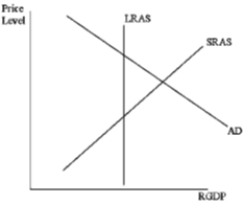
(Multiple Choice)
4.8/5 (84)
(84) Other things equal, contractionary fiscal policy will lead to:
(Multiple Choice)
4.8/5 (73)
(73) Why is the tax multiplier smaller than the government spending multiplier?
(Essay)
4.8/5 (89)
(89) Contractionary fiscal policy may have a larger effect in reducing aggregate demand in an open economy than a closed economy.
(True/False)
4.8/5 (74)
(74) If government policy makers were worried about the inflationary potential of the economy, which of the following would be a correct fiscal policy change?
(Multiple Choice)
4.9/5 (74)
(74) The effect of a tax multiplier on aggregate demand is larger than that of the government spending multiplier.
(True/False)
4.8/5 (80)
(80) 
Filters
- Essay(0)
- Multiple Choice(0)
- Short Answer(0)
- True False(0)
- Matching(0)