



 Chat with AI
Exam 17: Income, Poverty and Health Care

Exam 1: The Role and Method of Economics194 Questions
Exam 2: Eight Powerful Ideas212 Questions
Exam 3: Scarcity, Trade-Offs, and Production Possibilities182 Questions
Exam 4: Demand, Supply, and Market Equilibrium231 Questions
Exam 5: Market in Motion and Price Controls252 Questions
Exam 6: Elasticities271 Questions
Exam 7: Market Efficiency and Welfare128 Questions
Exam 8: Market Failure259 Questions
Exam 9: Public Finance and Public Choice62 Questions
Exam 10: Consumer Choice Theory206 Questions
Exam 11: The Firm: Production and Costs147 Questions
Exam 12: Firms in Perfectly Competitive Markets124 Questions
Exam 13: Monopoly and Antitrust62 Questions
Exam 14: Monopolistic Competition and Product Differentiation207 Questions
Exam 15: Oligopoly and Strategic Behavior68 Questions
Exam 16: The Markets for Labor, Capital, and Land131 Questions
Exam 17: Income, Poverty and Health Care252 Questions
Exam 18: Introduction to Macroeconomics: Unemployment, Inflation, and Economic Fluctuations152 Questions
Exam 19: Measuring Economic Performance152 Questions
Exam 20: Economic Growth in the Global Economy163 Questions
Exam 21: Financial Markets, Saving, and Investment146 Questions
Select questions type


Even though the use of checks lower transaction costs when compared to the use of paper currency, it is unlikely that the use of paper or metallic currency will disappear entirely. Why?
(Essay)
4.8/5  (84)
(84) A bank receives a demand deposit of $3,000. The bank loans out $1,800 of this deposit and increases its excess reserves by $300. What is the required reserve ratio?
(Multiple Choice)
4.8/5 (87)
(87) Rising reserve requirements, other things being equal, would tend to:
(Multiple Choice)
4.8/5 (70)
(70) Financial institutions are not very heavily leveraged, to prevent risk to the banking system.
(True/False)
4.8/5 (72)
(72) Suppose you found $1,000 hidden in your mattress and deposited it in a demand deposit account at your bank. If the reserve requirement was 20 percent, the deposit would directly create ____ in excess reserves and ultimately lead to a ____ total increase in the money supply, if all banks in the system lend out 100 percent of their excess reserves.
(Multiple Choice)
4.8/5 (93)
(93) If the required reserve ratio was 25 percent, a bank that received currency deposits of $16,000:
(Multiple Choice)
4.9/5 (68)
(68) If a bank has $1 million in demand deposits, $400,000 in reserves, and faces a 30 percent reserve requirement, the amount of money that a bank could initially create by loaning out their excess reserves is:
(Multiple Choice)
4.8/5 (84)
(84) People continue to value money because they have confidence in its convertibility into goods and services.
(True/False)
4.8/5 (69)
(69) If a bank receiving a new deposit of $200,000 would be able, as a result, to increase their lending by at most $120,000, then the required reserve ratio equals:
(Multiple Choice)
4.7/5 (84)
(84) If the reserve requirement for a bank is $200,000 for a deposit of $1 million, then the money multiplier is:
(Multiple Choice)
4.7/5 (86)
(86) Which of the following changes would clearly decrease the supply of money in the banking system?
(Multiple Choice)
4.8/5 (88)
(88) 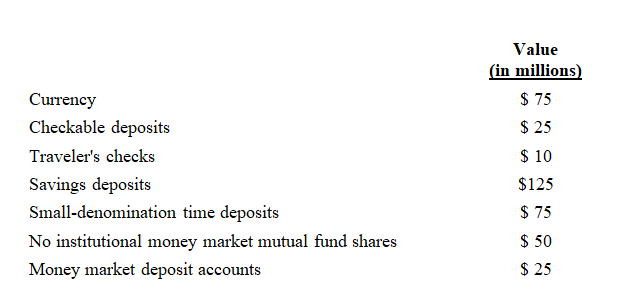
In its original role as lender of last resort, the Fed was supposed to:
(Multiple Choice)
4.9/5 (75)
(75) Barter system is less desirable than using money for exchange because:
(Multiple Choice)
4.7/5 (91)
(91) In the financial crisis of 2008, which of the following were not among the consequences of high leverage in the banking industry?
(Multiple Choice)
4.9/5 (69)
(69) 
Filters
- Essay(0)
- Multiple Choice(0)
- Short Answer(0)
- True False(0)
- Matching(0)