



 Chat with AI
Exam 19: Measuring Economic Performance

Exam 1: The Role and Method of Economics194 Questions
Exam 2: Eight Powerful Ideas212 Questions
Exam 3: Scarcity, Trade-Offs, and Production Possibilities182 Questions
Exam 4: Demand, Supply, and Market Equilibrium231 Questions
Exam 5: Market in Motion and Price Controls252 Questions
Exam 6: Elasticities271 Questions
Exam 7: Market Efficiency and Welfare128 Questions
Exam 8: Market Failure259 Questions
Exam 9: Public Finance and Public Choice62 Questions
Exam 10: Consumer Choice Theory206 Questions
Exam 11: The Firm: Production and Costs147 Questions
Exam 12: Firms in Perfectly Competitive Markets124 Questions
Exam 13: Monopoly and Antitrust62 Questions
Exam 14: Monopolistic Competition and Product Differentiation207 Questions
Exam 15: Oligopoly and Strategic Behavior68 Questions
Exam 16: The Markets for Labor, Capital, and Land131 Questions
Exam 17: Income, Poverty and Health Care252 Questions
Exam 18: Introduction to Macroeconomics: Unemployment, Inflation, and Economic Fluctuations152 Questions
Exam 19: Measuring Economic Performance152 Questions
Exam 20: Economic Growth in the Global Economy163 Questions
Exam 21: Financial Markets, Saving, and Investment146 Questions
Select questions type


If inflation rises or falls faster than people forecast in the short run but not in the long run, what are the shapes of the Phillips curves?
(Multiple Choice)
4.9/5  (76)
(76) What do rational expectations theorists believe? What is their critics' point of view?
(Essay)
4.7/5 (69)
(69) With rational expectations, a policy that would increase AD would lead to:
(Multiple Choice)
4.8/5 (64)
(64) If the public has rational expectations, an attempt to increase aggregate demand to stimulate the economy will:
(Multiple Choice)
4.9/5 (80)
(80) When the short run aggregate supply curve shifts right, it ___ the short-run Phillips curve.
(Multiple Choice)
4.8/5 (80)
(80) If the public has correct rational expectations and the Fed reduces both reserve requirements and the discount rate, it would be expected to result in:
(Multiple Choice)
4.8/5 (70)
(70) If people expect economic fluctuations to be permanent and caused primarily by supply-side shifts, then the result is likely to be a positive relationship between the inflation rate and the unemployment rate.
(True/False)
4.9/5 (74)
(74) Using Taylor rule, the federal funds rate is increased or decreased according to what is happening to both real GDP and inflation.
(True/False)
4.7/5 (85)
(85) When the short run aggregate supply curve shifts left, it ___ the short-run Phillips curve.
(Multiple Choice)
4.8/5 (65)
(65) A.H. Phillips developed the Phillips curve concept by looking at the relationship between:
(Multiple Choice)
4.8/5 (80)
(80) According to Milton Friedman, the short-run trade-off between unemployment and inflation comes from unanticipated inflation.
(True/False)
4.8/5 (82)
(82) Which of the following believe that discretionary monetary policy and discretionary fiscal policy are effective countercyclical policy actions? activists
(Multiple Choice)
4.9/5 (78)
(78) Exhibit 19-1
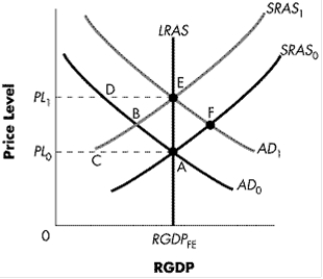
-Refer to Exhibit 19-1. If an increase in aggregate demand from AD0 to AD1 is fully anticipated, the economy will move from point A to point ____ in the short run.
-Refer to Exhibit 19-1. If an increase in aggregate demand from AD0 to AD1 is fully anticipated, the economy will move from point A to point ____ in the short run. (Multiple Choice)
4.7/5 (91)
(91) Which of the following would move the economy up and to the left along a short run Phillips Curve?
(Multiple Choice)
4.9/5 (85)
(85) Movements up along a particular short run Phillips curve ____ consistent with movements up along a short run aggregate supply curve; movements to the right along a particular short run Phillips curve ____ consistent with movements to the right along a short run aggregate supply curve;
(Multiple Choice)
4.8/5 (73)
(73) 
Filters
- Essay(0)
- Multiple Choice(0)
- Short Answer(0)
- True False(0)
- Matching(0)