



 Chat with AI
Exam 20: Galaxies

Exam 1: Why Learn Astronomy 86 Questions
Exam 2: Patterns in the Skymotions of Earth89 Questions
Exam 3: Motion of Astronomical Bodies78 Questions
Exam 4: Gravity and Orbits74 Questions
Exam 5: Light81 Questions
Exam 6: The Tools of the Astronomer88 Questions
Exam 7: The Birth and Evolution of Planetary Systems77 Questions
Exam 8: The Terrestrial Planets and Earths Moon82 Questions
Exam 9: Atmospheres of the Terrestrial Planets81 Questions
Exam 10: Worlds of Gas and Liquid the Giant Planets88 Questions
Exam 11: Planetary Adornments Moons and Rings91 Questions
Exam 12: Dwarf Planets and Small Solar System Bodies87 Questions
Exam 13: Taking the Measure of Stars83 Questions
Exam 14: Our Starthe Sun86 Questions
Exam 15: Star Formation and the Interstellar Medium84 Questions
Exam 16: Evolution of Low-Mass Stars88 Questions
Exam 17: Evolution of High-Mass Stars88 Questions
Exam 18: Relativity and Black Holes87 Questions
Exam 19: The Expanding Universe86 Questions
Exam 20: Galaxies93 Questions
Exam 21: The Milky Waya Normal Spiral Galaxy93 Questions
Exam 22: Modern Cosmology85 Questions
Exam 23: Large-Scale Structure in the Universe59 Questions
Exam 24: Life61 Questions
Select questions type


How does the appearance of an AGN depend on the viewing angle to the nucleus?
(Essay)
4.8/5  (84)
(84) Active star formation does not occur in elliptical galaxies because they:
(Multiple Choice)
4.9/5 (86)
(86) Dark matter is distributed inside galaxies in exactly the same way as luminous matter,although the total mass of dark matter is much larger than that of luminous matter.
(True/False)
4.7/5 (73)
(73) Dark matter consists of material that emits radiation at wavelengths other than visible light.
(True/False)
4.9/5 (94)
(94) How did astronomers determine that elliptical galaxies are composed mostly of dark matter?
(Multiple Choice)
5.0/5 (89)
(89) The Hubble tuning fork diagram represents an evolutionary diagram of galaxies from elliptical to spiral.
(True/False)
4.9/5 (78)
(78) Long-lasting spiral density waves occur in the disk of a spiral galaxy when:
(Multiple Choice)
4.8/5 (73)
(73) Why do rotation curves of galaxies imply that dark matter exists?
(Multiple Choice)
4.9/5 (94)
(94) What makes up the majority of the mass of an individual spiral galaxy?
(Multiple Choice)
5.0/5 (74)
(74) We know that spiral galaxies contain dark matter because the gas in the disk rotates with a velocity that decreases in a way that is proportional to r-1/2.
(True/False)
4.9/5 (64)
(64) Quasars were first discovered in which region of the electromagnetic spectrum?
(Multiple Choice)
4.8/5 (87)
(87) What is the most likely candidate for making up the dark matter in galaxies?
(Essay)
4.9/5 (89)
(89) If you measure the spectrum emitted by a cloud of gas that orbits a nearby spiral galaxy and the observed wavelength of a hydrogen emission line is 658.4 nm while the rest wavelength of that line is 656.3 nm,what is the velocity of this gas cloud along your line of sight (i.e. ,the radial velocity)? Note that the speed of light is 3 × 10⁵ km/s.
(Multiple Choice)
4.8/5 (78)
(78) 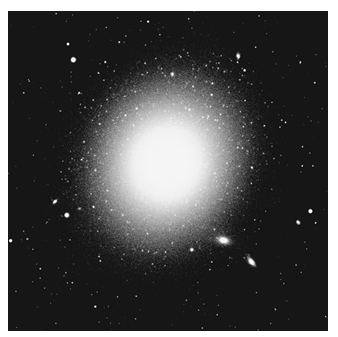
If you measure the velocity of a cloud of gas that is rotating around the center of a galaxy in a circular orbit with radius R,you can determine:
(Multiple Choice)
4.8/5 (86)
(86) Which of these would NOT be useful for measuring the mass of the dark matter halo in a spiral galaxy?
(Multiple Choice)
4.9/5 (72)
(72) How did Hubble use his tuning fork diagram to classify galaxies? Is there any significance to this organization?
(Essay)
4.8/5 (70)
(70) 
Filters
- Essay(0)
- Multiple Choice(0)
- Short Answer(0)
- True False(0)
- Matching(0)