



 Chat with AI
Exam 18: Relativity and Black Holes

Exam 1: Why Learn Astronomy 86 Questions
Exam 2: Patterns in the Skymotions of Earth89 Questions
Exam 3: Motion of Astronomical Bodies78 Questions
Exam 4: Gravity and Orbits74 Questions
Exam 5: Light81 Questions
Exam 6: The Tools of the Astronomer88 Questions
Exam 7: The Birth and Evolution of Planetary Systems77 Questions
Exam 8: The Terrestrial Planets and Earths Moon82 Questions
Exam 9: Atmospheres of the Terrestrial Planets81 Questions
Exam 10: Worlds of Gas and Liquid the Giant Planets88 Questions
Exam 11: Planetary Adornments Moons and Rings91 Questions
Exam 12: Dwarf Planets and Small Solar System Bodies87 Questions
Exam 13: Taking the Measure of Stars83 Questions
Exam 14: Our Starthe Sun86 Questions
Exam 15: Star Formation and the Interstellar Medium84 Questions
Exam 16: Evolution of Low-Mass Stars88 Questions
Exam 17: Evolution of High-Mass Stars88 Questions
Exam 18: Relativity and Black Holes87 Questions
Exam 19: The Expanding Universe86 Questions
Exam 20: Galaxies93 Questions
Exam 21: The Milky Waya Normal Spiral Galaxy93 Questions
Exam 22: Modern Cosmology85 Questions
Exam 23: Large-Scale Structure in the Universe59 Questions
Exam 24: Life61 Questions
Select questions type


Explain why no object that has mass can ever move at a speed equal to the speed of light.At what velocity do massless particles (e.g. ,photons)travel in vacuum?
(Essay)
5.0/5  (78)
(78) As shown in this figure,an observer in a windowless room notices that light from a flashlight does not follow a straight path,but instead seems to be bent downwards as it crosses the room.What does the observer conclude is happening? 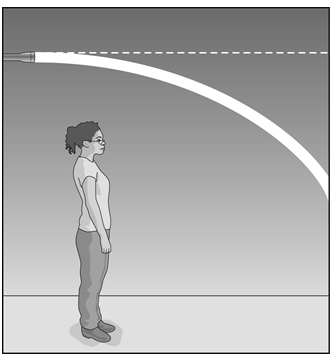
(Multiple Choice)
4.9/5 (87)
(87) Which of the following is a consequence of Einstein's special theory of relativity?
(Multiple Choice)
4.8/5 (76)
(76) If the Sun suddenly turned into a black hole,what would be the radius of its event horizon?
(Multiple Choice)
4.7/5 (81)
(81) Gravity is nothing more than a curvature in the fabric of spacetime.
(True/False)
5.0/5 (74)
(74) Gravitational lensing allows us to see distant objects brightened and distorted because of massive objects in the path that the light from the object travels.
(True/False)
4.9/5 (58)
(58) You measure that an object has a mass of exactly 1 kg by weighing it in the Earth's gravitational field.The equivalence principle says that the mass you would measure by trying to accelerate it would be:
(Multiple Choice)
4.7/5 (82)
(82) How would the Newtonian theory explain the orbit of the Earth around the Sun? What would the explanation be in general relativity?
(Essay)
4.9/5 (90)
(90) The bending of light passing near a massive object is called:
(Multiple Choice)
4.8/5 (66)
(66) One result of relativity is that an astronaut in a windowless spacecraft could tell the difference between falling freely and the presence of a nearby gravitational source.
(True/False)
4.9/5 (79)
(79) According to relativity,spacecraft that can travel faster than the speed of light are:
(Multiple Choice)
4.8/5 (71)
(71) 
Filters
- Essay(0)
- Multiple Choice(0)
- Short Answer(0)
- True False(0)
- Matching(0)