



 Chat with AI
Exam 16: Evolution of Low-Mass Stars

Exam 1: Why Learn Astronomy 86 Questions
Exam 2: Patterns in the Skymotions of Earth89 Questions
Exam 3: Motion of Astronomical Bodies78 Questions
Exam 4: Gravity and Orbits74 Questions
Exam 5: Light81 Questions
Exam 6: The Tools of the Astronomer88 Questions
Exam 7: The Birth and Evolution of Planetary Systems77 Questions
Exam 8: The Terrestrial Planets and Earths Moon82 Questions
Exam 9: Atmospheres of the Terrestrial Planets81 Questions
Exam 10: Worlds of Gas and Liquid the Giant Planets88 Questions
Exam 11: Planetary Adornments Moons and Rings91 Questions
Exam 12: Dwarf Planets and Small Solar System Bodies87 Questions
Exam 13: Taking the Measure of Stars83 Questions
Exam 14: Our Starthe Sun86 Questions
Exam 15: Star Formation and the Interstellar Medium84 Questions
Exam 16: Evolution of Low-Mass Stars88 Questions
Exam 17: Evolution of High-Mass Stars88 Questions
Exam 18: Relativity and Black Holes87 Questions
Exam 19: The Expanding Universe86 Questions
Exam 20: Galaxies93 Questions
Exam 21: The Milky Waya Normal Spiral Galaxy93 Questions
Exam 22: Modern Cosmology85 Questions
Exam 23: Large-Scale Structure in the Universe59 Questions
Exam 24: Life61 Questions
Select questions type


Describe the structure of a red giant star just before the helium flash takes place.How does this compare to the structure of a horizontal-branch star?
(Essay)
4.7/5  (82)
(82) 
The Ring Nebula is a planetary nebula that currently has a radius of 1.2 × 10¹³ km and an expansion velocity of 250 km/s.Approximately how long ago did its parent star die and eject its outer layers?
(Multiple Choice)
4.8/5 (83)
(83) When helium fusion begins in the core of a red giant star,the situation quickly gets out of control because electron-degeneracy pressure does not respond to changes in:
(Multiple Choice)
4.9/5 (80)
(80) In what two ways does temperature affect the rate of nuclear reactions?
(Essay)
4.8/5 (66)
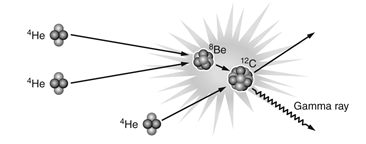
(66) Explain what the triple-alpha process is and when it takes place in evolving stars.
(Essay)
5.0/5 (93)
(93) A star's surface temperature during the horizontal branch phase is determined primarily by its:
(Multiple Choice)
4.7/5 (95)
(95) A 1M⨀ star in a binary system could create the following chemical element and eject it into the interstellar medium:
(Multiple Choice)
4.7/5 (95)
(95) A white dwarf star has a luminosity equal to 10−4 L⨀ and a temperature twice that of the Sun (i.e. ,T = 10,600 K).What is the radius of the white dwarf,expressed as a ratio to the solar radius?
(Essay)
4.8/5 (75)
(75) A low-mass main-sequence star's climb up the red giant branch is halted by:
(Multiple Choice)
4.9/5 (75)
(75) Why does the core of a main-sequence star have to be hotter to burn helium into carbon than hydrogen into helium?
(Essay)
4.8/5 (92)
(92) During which phase of the evolution of a low-mass star does it have two separate regions of nuclear burning occurring in its interior?
(Multiple Choice)
5.0/5 (82)
(82) A white dwarf with a temperature of 30,000 K would shine brightest at what wavelength?
(Multiple Choice)
4.8/5 (81)
(81) If a main-sequence star were gaining mass by being in an interacting binary system,what would happen to that star's luminosity and why?
(Multiple Choice)
4.9/5 (68)
(68) As a main-sequence star burns its core supply of hydrogen,what happens?
(Multiple Choice)
4.9/5 (86)
(86) When a spectral-type G2 star like the Sun leaves the main sequence:
(Multiple Choice)
4.9/5 (85)
(85) 
Filters
- Essay(0)
- Multiple Choice(0)
- Short Answer(0)
- True False(0)
- Matching(0)