



 Chat with AI
Exam 15: Star Formation and the Interstellar Medium

Exam 1: Why Learn Astronomy 86 Questions
Exam 2: Patterns in the Skymotions of Earth89 Questions
Exam 3: Motion of Astronomical Bodies78 Questions
Exam 4: Gravity and Orbits74 Questions
Exam 5: Light81 Questions
Exam 6: The Tools of the Astronomer88 Questions
Exam 7: The Birth and Evolution of Planetary Systems77 Questions
Exam 8: The Terrestrial Planets and Earths Moon82 Questions
Exam 9: Atmospheres of the Terrestrial Planets81 Questions
Exam 10: Worlds of Gas and Liquid the Giant Planets88 Questions
Exam 11: Planetary Adornments Moons and Rings91 Questions
Exam 12: Dwarf Planets and Small Solar System Bodies87 Questions
Exam 13: Taking the Measure of Stars83 Questions
Exam 14: Our Starthe Sun86 Questions
Exam 15: Star Formation and the Interstellar Medium84 Questions
Exam 16: Evolution of Low-Mass Stars88 Questions
Exam 17: Evolution of High-Mass Stars88 Questions
Exam 18: Relativity and Black Holes87 Questions
Exam 19: The Expanding Universe86 Questions
Exam 20: Galaxies93 Questions
Exam 21: The Milky Waya Normal Spiral Galaxy93 Questions
Exam 22: Modern Cosmology85 Questions
Exam 23: Large-Scale Structure in the Universe59 Questions
Exam 24: Life61 Questions
Select questions type


If you could watch stars forming out of a gas cloud,which stars would form first?
(Multiple Choice)
4.9/5  (70)
(70) The dust in the interstellar medium comes primarily from the stellar winds of main-sequence stars.
(True/False)
4.8/5 (84)
(84) The figures below show the spectrum of a star,along with five other spectra labeled A through E. 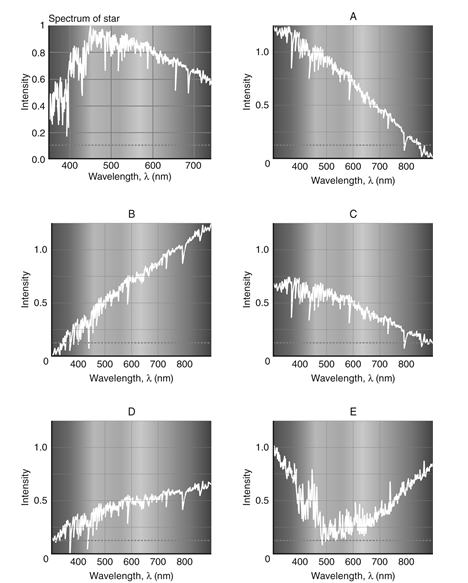 Which one of the labeled spectra shows what the spectrum of that star would look like if it were viewed through a significant amount of interstellar dust?
 (Multiple Choice)
4.9/5 (77)
(77) At what wavelength are H II regions most clearly visible,and why do H II regions mark the regions where new stars are currently being formed?
(Essay)
4.9/5 (83)
(83) We detect neutral gas in the interstellar medium by looking for radiation at 21 cm that arises when:
(Multiple Choice)
4.8/5 (88)
(88) When a 3 M⨀ protostar forms,it starts out at the top of the Hayashi track with a luminosity of 4,000 L⨀ and a temperature of 3600 K.What is its radius at this point (give the answer in units of R⨀),and how many times larger is it at this stage compared to its radius as a main-sequence star,which is about 2.5 R⨀? For reference,the Sun's temperature is 5800 K.
(Essay)
4.9/5 (67)
(67) Why does the surface temperature of a low-mass protostar remain nearly constant as its core contracts?
(Essay)
5.0/5 (87)
(87) When radiation from an object passes through the interstellar medium:
(Multiple Choice)
4.9/5 (69)
(69) Which of the following stars spend the longest time on their Hayashi tracks?
(Multiple Choice)
4.8/5 (66)
(66) A typical molecular cloud has a temperature of approximately:
(Multiple Choice)
4.7/5 (90)
(90) The H- atom is important in protostars because it acts as a powerful temperature regulator.
(True/False)
4.9/5 (74)
(74) The coldest molecular clouds in our galaxy have temperatures of approximately 1000 K.
(True/False)
4.7/5 (75)
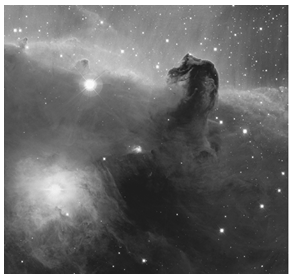
(75) 
Molecular hydrogen atoms are found only inside dense clouds where they are shielded from stellar radiation.
(True/False)
4.8/5 (70)
(70) If a 1 M⨀protostar starts out on the Hayashi track with a temperature of 3300 K and a luminosity of 320 L⨀,what is its approximate radius?
(Multiple Choice)
4.9/5 (73)
(73) 
Filters
- Essay(0)
- Multiple Choice(0)
- Short Answer(0)
- True False(0)
- Matching(0)