



 Chat with AI
Exam 10: Worlds of Gas and Liquid the Giant Planets

Exam 1: Why Learn Astronomy 86 Questions
Exam 2: Patterns in the Skymotions of Earth89 Questions
Exam 3: Motion of Astronomical Bodies78 Questions
Exam 4: Gravity and Orbits74 Questions
Exam 5: Light81 Questions
Exam 6: The Tools of the Astronomer88 Questions
Exam 7: The Birth and Evolution of Planetary Systems77 Questions
Exam 8: The Terrestrial Planets and Earths Moon82 Questions
Exam 9: Atmospheres of the Terrestrial Planets81 Questions
Exam 10: Worlds of Gas and Liquid the Giant Planets88 Questions
Exam 11: Planetary Adornments Moons and Rings91 Questions
Exam 12: Dwarf Planets and Small Solar System Bodies87 Questions
Exam 13: Taking the Measure of Stars83 Questions
Exam 14: Our Starthe Sun86 Questions
Exam 15: Star Formation and the Interstellar Medium84 Questions
Exam 16: Evolution of Low-Mass Stars88 Questions
Exam 17: Evolution of High-Mass Stars88 Questions
Exam 18: Relativity and Black Holes87 Questions
Exam 19: The Expanding Universe86 Questions
Exam 20: Galaxies93 Questions
Exam 21: The Milky Waya Normal Spiral Galaxy93 Questions
Exam 22: Modern Cosmology85 Questions
Exam 23: Large-Scale Structure in the Universe59 Questions
Exam 24: Life61 Questions
Select questions type


Jupiter's mass is more than twice the mass of all the other planets in our Solar System combined.
(True/False)
4.9/5  (76)
(76) Which giant planet does NOT radiate more energy into space than it receives from the Sun?
(Multiple Choice)
4.8/5 (77)
(77) If you tracked the motion of the clouds near Jupiter's Great Red Spot,which of the following diagrams shows the correct motion you would observe?
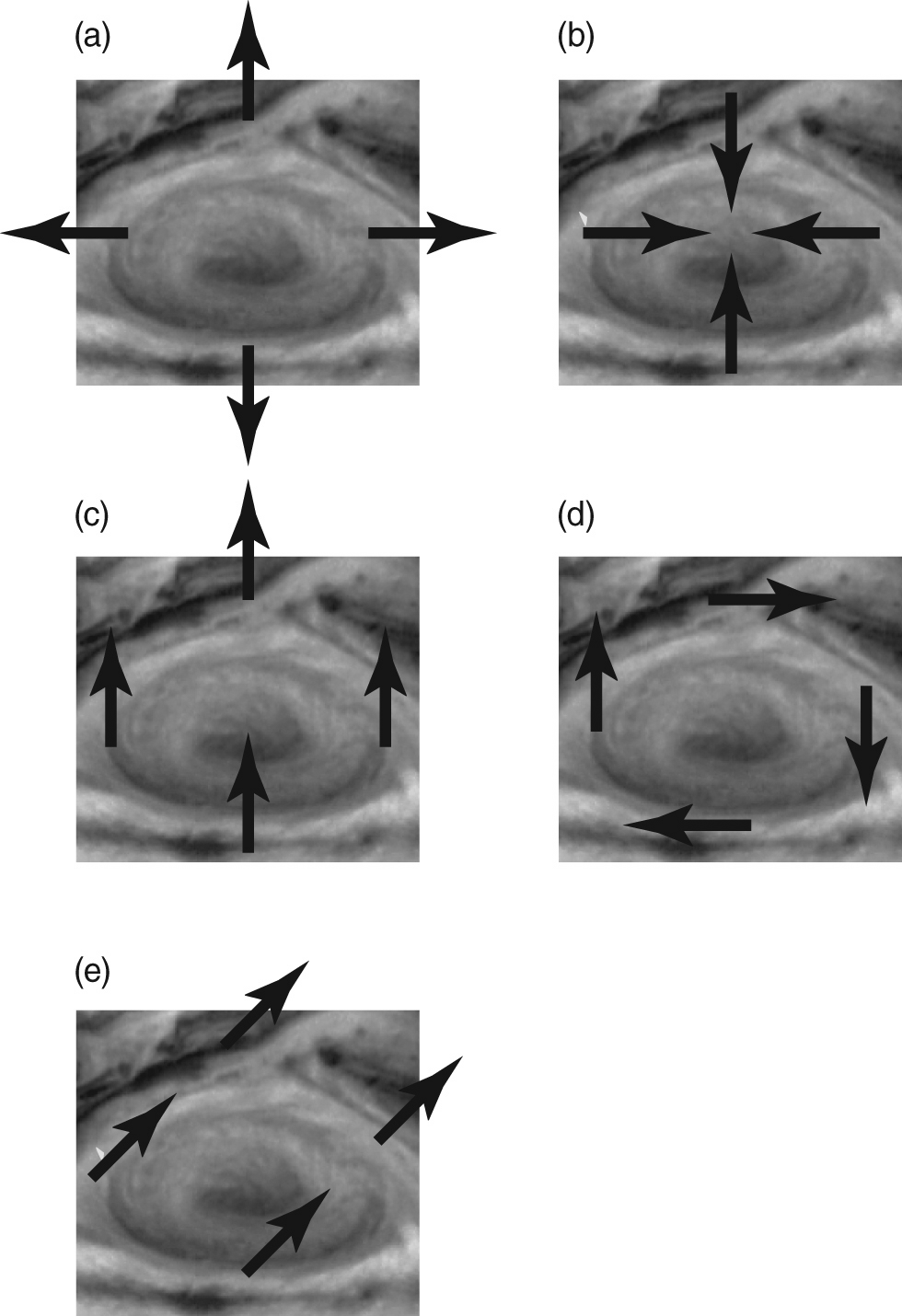
(Multiple Choice)
4.9/5 (75)
(75) When charged particles oscillate around magnetic field lines of a planet,they emit radiation in the microwave region of the spectrum.
(True/False)
4.8/5 (65)
(65) On the giant planets,the atmospheric vortices that occur almost always lie between oppositely directed zonal winds.
(True/False)
4.9/5 (77)
(77) Each season is on Uranus lasts approximate 21 Earth years because:
(Multiple Choice)
4.9/5 (73)
(73) If you monitor Jupiter's atmosphere and you see a storm near the equator move from a longitude of 60° west to a longitude of 80° west over six days,what is the wind speed at this storm's latitude on Jupiter? Note that these positions are measured on a coordinate system that rotates with the planet's interior,and the radius of Jupiter is 7.2 × 10⁷ m .
(Multiple Choice)
4.8/5 (81)
(81) The compositions of Uranus and Neptune differ primarily from that of Jupiter and Saturn in that the outer two planets contain more:
(Multiple Choice)
4.8/5 (65)
(65) We refer to some of the inner regions of Jupiter and Saturn as metallic hydrogen because they:
(Multiple Choice)
4.9/5 (81)
(81) If you were to fly to Jupiter from the Earth,which of these parts of Jupiter would you hit first?
(Multiple Choice)
4.8/5 (76)
(76) The Jovian atmospheric vortices are created by a combination of the Coriolis effect and:
(Multiple Choice)
4.7/5 (82)
(82) What causes the horizontal bands on Jupiter and Saturn to have different colors? How can they be used to probe different altitudes in their atmospheres?
(Essay)
4.9/5 (77)
(77) What measurement tells us that the interiors of Uranus and Neptune are made of mostly water?
(Multiple Choice)
4.9/5 (77)
(77) The radiation belts around Jupiter are much stronger than those found around the Earth because:
(Multiple Choice)
4.8/5 (85)
(85) Which of these observations would allow you to measure the mass of a planet?
(Multiple Choice)
4.9/5 (83)
(83) The different cloud layers seen in Jupiter's bands represent clouds at different altitudes in Jupiter's atmosphere.
(True/False)
4.8/5 (69)
(69) Where do Uranus's and Neptune's strong magnetic fields originate?
(Multiple Choice)
4.9/5 (79)
(79) Which of the giant planets was predicted to exist mathematically before it was ever seen through a telescope?
(Multiple Choice)
4.8/5 (68)
(68) 
Filters
- Essay(0)
- Multiple Choice(0)
- Short Answer(0)
- True False(0)
- Matching(0)