



 Chat with AI
Exam 9: Atmospheres of the Terrestrial Planets

Exam 1: Why Learn Astronomy 86 Questions
Exam 2: Patterns in the Skymotions of Earth89 Questions
Exam 3: Motion of Astronomical Bodies78 Questions
Exam 4: Gravity and Orbits74 Questions
Exam 5: Light81 Questions
Exam 6: The Tools of the Astronomer88 Questions
Exam 7: The Birth and Evolution of Planetary Systems77 Questions
Exam 8: The Terrestrial Planets and Earths Moon82 Questions
Exam 9: Atmospheres of the Terrestrial Planets81 Questions
Exam 10: Worlds of Gas and Liquid the Giant Planets88 Questions
Exam 11: Planetary Adornments Moons and Rings91 Questions
Exam 12: Dwarf Planets and Small Solar System Bodies87 Questions
Exam 13: Taking the Measure of Stars83 Questions
Exam 14: Our Starthe Sun86 Questions
Exam 15: Star Formation and the Interstellar Medium84 Questions
Exam 16: Evolution of Low-Mass Stars88 Questions
Exam 17: Evolution of High-Mass Stars88 Questions
Exam 18: Relativity and Black Holes87 Questions
Exam 19: The Expanding Universe86 Questions
Exam 20: Galaxies93 Questions
Exam 21: The Milky Waya Normal Spiral Galaxy93 Questions
Exam 22: Modern Cosmology85 Questions
Exam 23: Large-Scale Structure in the Universe59 Questions
Exam 24: Life61 Questions
Select questions type


Most of Earth's present-day atmosphere comes from a combination of what three sources?
(Essay)
5.0/5  (67)
(67) When learning about light,we predicted that Venus should have a temperature of 250 K based on its albedo and distance from the Sun.Why is Venus's observed average surface temperature equal to 740 K,which is hot enough to melt lead?
(Multiple Choice)
5.0/5 (76)
(76) Based solely on mass and distance from the Sun,which of the following terrestrial planets would you expect to retain the densest secondary atmosphere?
(Multiple Choice)
4.7/5 (87)
(87) Why did the terrestrial planets lose the majority of the gas in their primary atmospheres?
(Multiple Choice)
4.9/5 (70)
(70) What makes carbon dioxide a highly effective greenhouse gas?
(Multiple Choice)
4.9/5 (75)
(75) The best way to look for life on other planets is to search for absorption from nitrogen in their atmospheres in the infrared region of the spectrum.
(True/False)
4.9/5 (69)
(69) Without the ozone layer,life on Earth would be in danger from increased levels of _________ radiation.
(Multiple Choice)
4.8/5 (78)
(78) 
A gas eventually will escape from a planet's atmosphere if the average velocity of its atoms exceeds 1⁄6 times the escape velocity of the planet.If the average velocity of water vapor in Venus's atmosphere is 0.5 km/s,what would be the average velocity of a single hydrogen atom? If Venus's escape velocity is 11 km/s,will hydrogen atoms eventually escape?
(Essay)
5.0/5 (77)
(77) Aurorae are produced only near the northern and southern magnetic poles of a planet because charged particles arriving in the solar wind cannot cross the magnetic field lines.
(True/False)
4.9/5 (77)
(77) Suppose you go out hiking in the snow on a mountain top on a cold winter day when the temperature outside is 0 C = 273 K and the pressure is 0.75 bar.If you brought along a package of potato chips that was sealed at sea level when the temperature was 24 C = 297 K,what would have happened to the volume of the bag of chips? By how much will the volume have changed?
(Essay)
4.8/5 (81)
(81) The nitrogen in the Earth's atmosphere primarily came from:
(Multiple Choice)
4.8/5 (84)
(84) Earth releases the energy it receives from the Sun by emitting _________ radiation.
(Multiple Choice)
4.8/5 (85)
(85) What is the reason Mercury has so little gas in its atmosphere?
(Multiple Choice)
4.8/5 (72)
(72) In the stratosphere of the Earth's atmosphere,how does the temperature vary with increasing altitude and what causes this variation?
(Essay)
5.0/5 (66)
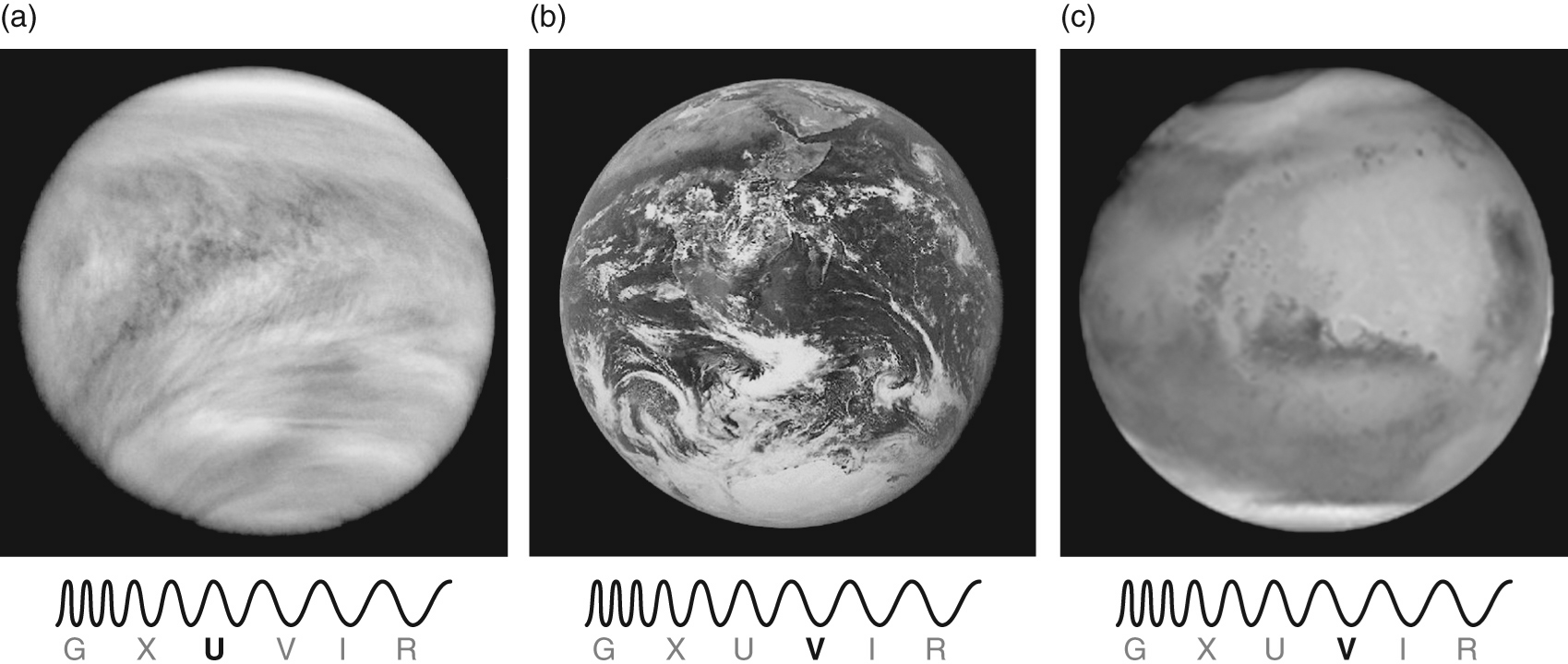
(66) Venus's atmospheric clouds are so thick that the surface of the planet is not seen when observing it in visible light.
(True/False)
4.8/5 (95)
(95) Approximately _________ years ago,_________ began producing oxygen in enough amounts to be a significant fraction in the Earth's atmosphere.
(Multiple Choice)
4.8/5 (89)
(89) Earth's atmosphere is a (seemingly)enormous blanket roughly 250 km thick.What percentage of Earth's radius,which is 6,400 km,does this represent? How does it compare to the average depth of the oceans,which is 3 km?
(Essay)
4.7/5 (74)
(74) 
Filters
- Essay(0)
- Multiple Choice(0)
- Short Answer(0)
- True False(0)
- Matching(0)