



 Chat with AI
Exam 8: The Terrestrial Planets and Earths Moon

Exam 1: Why Learn Astronomy 86 Questions
Exam 2: Patterns in the Skymotions of Earth89 Questions
Exam 3: Motion of Astronomical Bodies78 Questions
Exam 4: Gravity and Orbits74 Questions
Exam 5: Light81 Questions
Exam 6: The Tools of the Astronomer88 Questions
Exam 7: The Birth and Evolution of Planetary Systems77 Questions
Exam 8: The Terrestrial Planets and Earths Moon82 Questions
Exam 9: Atmospheres of the Terrestrial Planets81 Questions
Exam 10: Worlds of Gas and Liquid the Giant Planets88 Questions
Exam 11: Planetary Adornments Moons and Rings91 Questions
Exam 12: Dwarf Planets and Small Solar System Bodies87 Questions
Exam 13: Taking the Measure of Stars83 Questions
Exam 14: Our Starthe Sun86 Questions
Exam 15: Star Formation and the Interstellar Medium84 Questions
Exam 16: Evolution of Low-Mass Stars88 Questions
Exam 17: Evolution of High-Mass Stars88 Questions
Exam 18: Relativity and Black Holes87 Questions
Exam 19: The Expanding Universe86 Questions
Exam 20: Galaxies93 Questions
Exam 21: The Milky Waya Normal Spiral Galaxy93 Questions
Exam 22: Modern Cosmology85 Questions
Exam 23: Large-Scale Structure in the Universe59 Questions
Exam 24: Life61 Questions
Select questions type


The rovers named Spirit and Opportunity that recently explored the surface of Mars discovered:
(Multiple Choice)
4.8/5  (83)
(83) Which of the following is NOT a requirement for a planetary magnetic dynamo?
(Multiple Choice)
5.0/5 (86)
(86) Present-day erosion on the surface of the Moon is primarily caused by:
(Multiple Choice)
4.8/5 (76)
(76) Which of the following will NOT be a consequence of Earth's consumption of the bulk of its radioactive "fuel" in the future?
(Multiple Choice)
4.7/5 (87)
(87) The center of Earth has approximately the same temperature as the surface of the Sun.
(True/False)
4.9/5 (87)
(87) The smoother,less cratered surfaces of the Moon resulted from those areas being protected by the Moon's proximity to Earth.
(True/False)
4.9/5 (79)
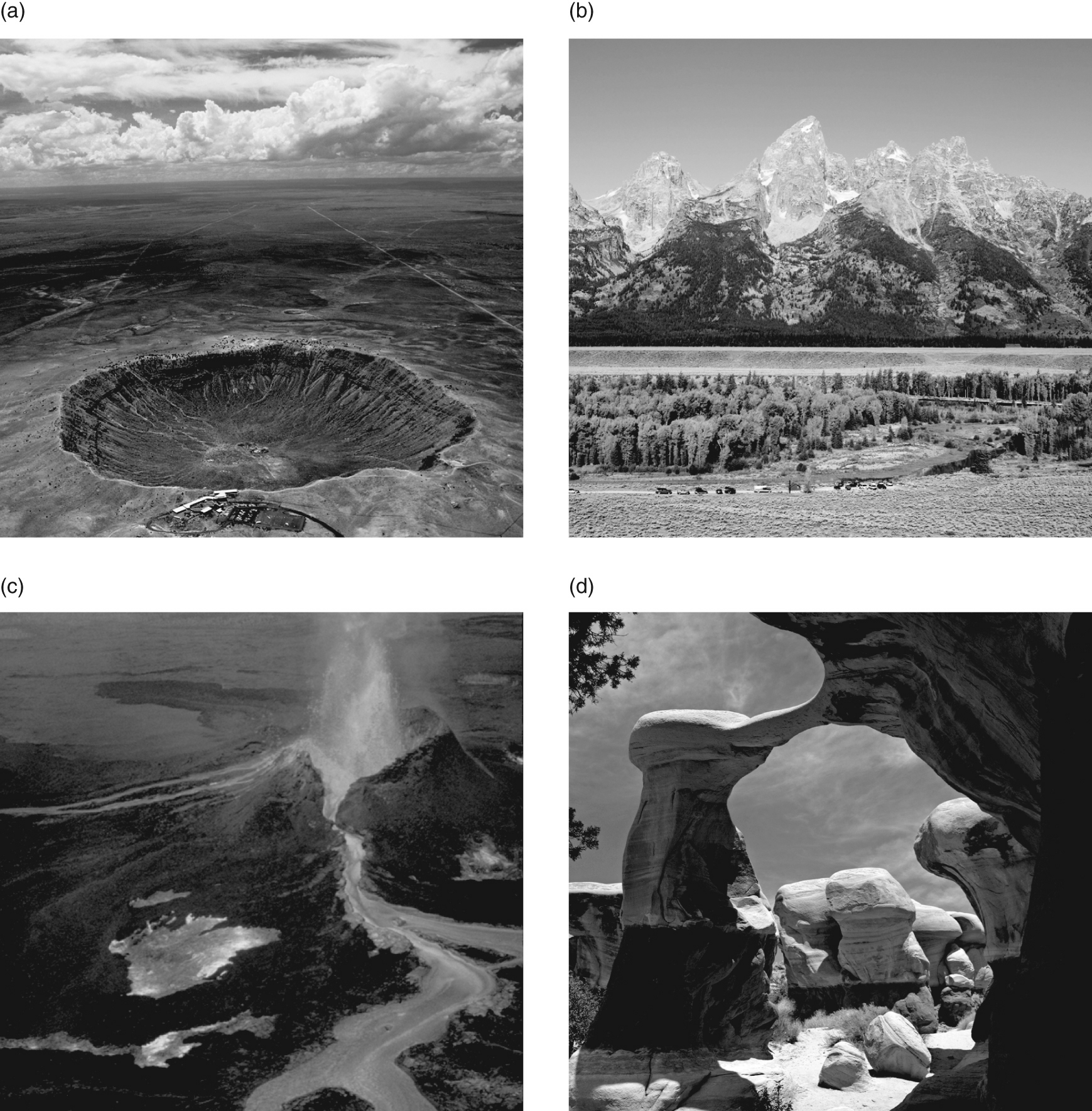
(79) List the main process that shaped the planetary surface features illustrated in each of the four pictures shown below.
(Essay)
4.8/5 (92)
(92) Based on the age of the light- and dark-colored regions of the Moon and the number of craters observed in these regions,we know that impacts in the inner Solar System:
(Multiple Choice)
4.9/5 (78)
(78) Compared to the dark-colored regions of the surface of the Moon,the light-colored regions are approximately:
(Multiple Choice)
4.9/5 (95)
(95) Based on the number of impact craters observed per square meter on their surface,place these terrestrial planets in order of youngest to oldest surface:
(Multiple Choice)
5.0/5 (77)
(77) There are two main forces that shape a planet's surface: impacts and plate tectonics.
(True/False)
4.7/5 (84)
(84) The North American plate and the Pacific plate are sliding past one another at a rate of approximately 3 cm/year.San Francisco,which is located on the edge of the North American plate,is sliding southward toward Los Angles,which is located on the Pacific Plate.If they are currently separated by a distance of 600 km,how many years will it take for the two cities to meet?
(Multiple Choice)
4.7/5 (82)
(82) What will eventually happen to the Earth when radioactive decays in its interior cease?
(Multiple Choice)
5.0/5 (87)
(87) Describe one example of tectonic disruption on Mercury,Venus,and Mars,respectively,and explain how they formed.
(Essay)
4.8/5 (80)
(80) Name the terrestrial planets in order of increasing distance from the Sun.What are the terrestrial planets in order of increasing geologic age of their surface?
(Essay)
4.8/5 (85)
(85) Mars,Venus,and Earth are much less heavily cratered than Mercury and the Moon.This is explained by the fact that:
(Multiple Choice)
4.8/5 (78)
(78) Which is NOT a reason for the large size of volcanoes on Mars as compared to Earth's smaller volcanoes?
(Multiple Choice)
4.8/5 (76)
(76) If you obtained a sample of a meteorite and determined the abundances of uranium (238U)and lead (207Pb)in it,and found that for every 1 uranium atom there were 15 lead atoms,then what would the age of this rock be? Note that this form of uranium decays to this form of lead with a half-life of 700 million years.For simplicity,you can assume that there was no lead in the rock when it originally formed.
(Multiple Choice)
4.8/5 (78)
(78) 
Filters
- Essay(0)
- Multiple Choice(0)
- Short Answer(0)
- True False(0)
- Matching(0)