



 Chat with AI
Exam 5: Light

Exam 1: Why Learn Astronomy 86 Questions
Exam 2: Patterns in the Skymotions of Earth89 Questions
Exam 3: Motion of Astronomical Bodies78 Questions
Exam 4: Gravity and Orbits74 Questions
Exam 5: Light81 Questions
Exam 6: The Tools of the Astronomer88 Questions
Exam 7: The Birth and Evolution of Planetary Systems77 Questions
Exam 8: The Terrestrial Planets and Earths Moon82 Questions
Exam 9: Atmospheres of the Terrestrial Planets81 Questions
Exam 10: Worlds of Gas and Liquid the Giant Planets88 Questions
Exam 11: Planetary Adornments Moons and Rings91 Questions
Exam 12: Dwarf Planets and Small Solar System Bodies87 Questions
Exam 13: Taking the Measure of Stars83 Questions
Exam 14: Our Starthe Sun86 Questions
Exam 15: Star Formation and the Interstellar Medium84 Questions
Exam 16: Evolution of Low-Mass Stars88 Questions
Exam 17: Evolution of High-Mass Stars88 Questions
Exam 18: Relativity and Black Holes87 Questions
Exam 19: The Expanding Universe86 Questions
Exam 20: Galaxies93 Questions
Exam 21: The Milky Waya Normal Spiral Galaxy93 Questions
Exam 22: Modern Cosmology85 Questions
Exam 23: Large-Scale Structure in the Universe59 Questions
Exam 24: Life61 Questions
Select questions type


When an electron moves from a higher energy level in an atom to a lower energy level:
(Multiple Choice)
4.8/5  (82)
(82) Consider an incandescent light bulb.If you wanted to turn a 10 W light bulb into a 100 W light bulb,how would you change the temperature of the filament inside the bulb?
(Multiple Choice)
4.9/5 (85)
(85) At what wavelength does your body radiate the most given that your temperature is approximately that of the Earth,which is 300 K?
(Multiple Choice)
4.8/5 (87)
(87) If an object is moving toward you,the light you see from it will be blueshifted.
(True/False)
4.8/5 (74)
(74) You observe a red star and a blue star and are able to determine that they are the same size.Which star is hotter,and which star is more luminous?
(Multiple Choice)
4.8/5 (87)
(87) Which of the following lists different types of electromagnetic radiation in order from the smallest wavelength to the largest wavelength?
(Multiple Choice)
4.9/5 (65)
(65) You record the spectrum of a star and find that a calcium absorption line has an observed wavelength of 394.0 nm.This calcium absorption line has a rest wavelength is 393.3 nm;what is the radial velocity of this star?
(Multiple Choice)
4.9/5 (94)
(94) The luminosity of an object is independent of its distance from you.
(True/False)
4.9/5 (84)
(84) As wavelength increases,the energy of a photon _________ and its frequency _________.
(Multiple Choice)
4.7/5 (76)
(76) Imagine a satellite is orbiting a planet as shown in the image below.This satellite gives off radio waves with a constant wavelength of 1 meter.An observer on Earth then measures the signal from the satellite when it is at the locations labeled A-D.For each of these locations,how does the wavelength received compare to the wavelength that the satellite gave off?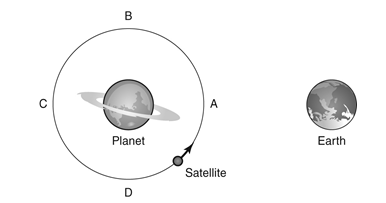
(Essay)
4.9/5 (82)
(82) The average red giant in the night sky is about 1,000 times more luminous than the average main-sequence star.If both kinds of stars have about the same brightness,how much farther away are the red giants compared to the main-sequence stars?
(Multiple Choice)
4.9/5 (68)
(68) The fact that the speed of light is constant as it travels through a vacuum means that:
(Multiple Choice)
4.9/5 (90)
(90) 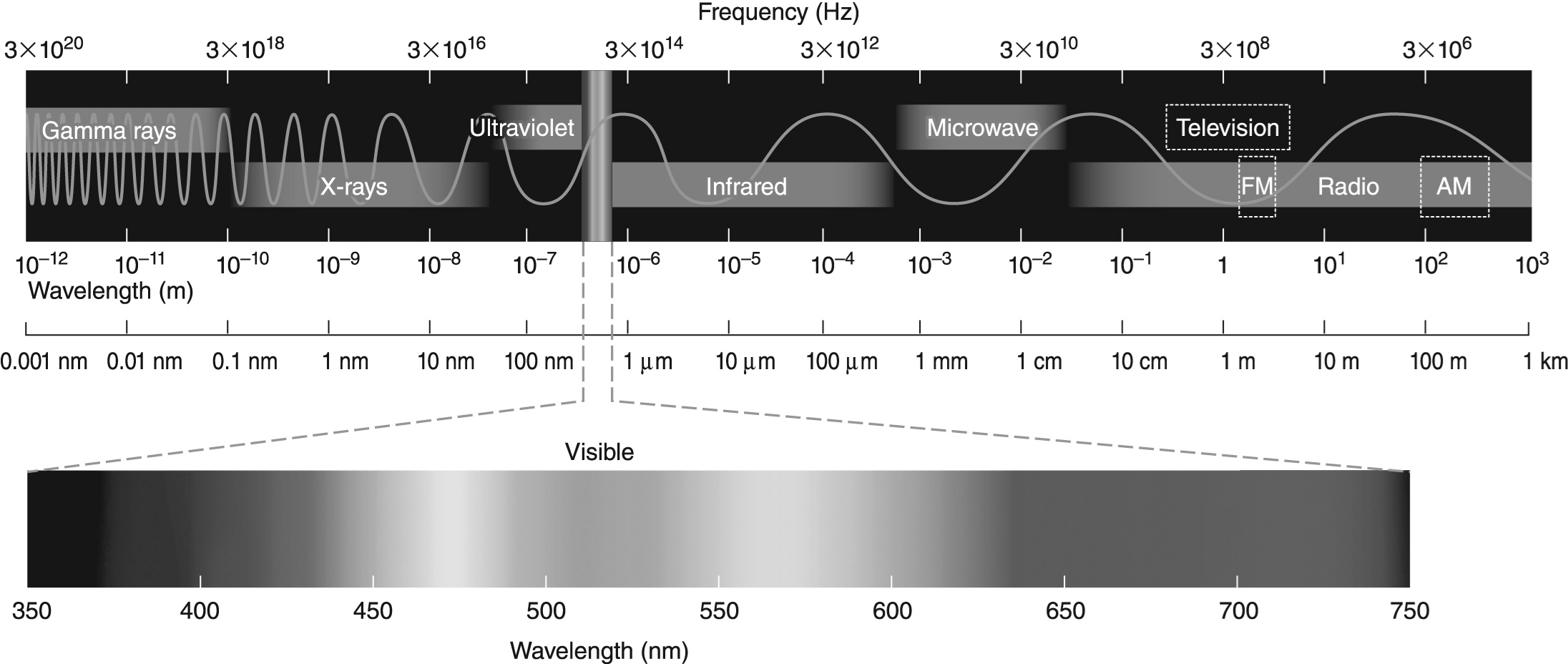 -The difference in energy between the n = 2 and n = 1 electronic energy levels in the hydrogen atom is 1.6 × 10⁻¹⁸ J.If an electron moves from the n = 1 level to the n = 2 level,will a photon be emitted or absorbed? What will its energy be,and what type of electromagnetic radiation is it? Use the electromagnetic spectrum shown above to answer this question.
 (Essay)
4.9/5 (92)
(92) Compare and contrast the wavelengths,frequencies,speeds,and energies of red and blue photons.
(Essay)
4.9/5 (86)
(86) 
Filters
- Essay(0)
- Multiple Choice(0)
- Short Answer(0)
- True False(0)
- Matching(0)