



 Chat with AI
Exam 9: Differential Equations

Exam 1: Functions and Limits95 Questions
Exam 2: Derivatives84 Questions
Exam 3: Applications of Differentiation155 Questions
Exam 4: Integrals169 Questions
Exam 5: Applications of Integration70 Questions
Exam 6: Inverse Functions95 Questions
Exam 7: Techniques of Integration124 Questions
Exam 8: Further Applications of Integration87 Questions
Exam 9: Differential Equations67 Questions
Exam 10: Parametric Equations and Polar Coordinates73 Questions
Exam 11: Infinite Sequences and Series158 Questions
Exam 12: Vectors and the Geometry of Space60 Questions
Exam 13: Vector Functions93 Questions
Exam 14: Partial Derivatives132 Questions
Exam 15: Multiple Integrals124 Questions
Exam 16: Vector Calculus137 Questions
Exam 17: Second-Order Differential Equations63 Questions
Exam 18: Final Exam44 Questions
Select questions type


A phase trajectory is shown for populations of rabbits and foxes . Describe how each population changes as time goes by. 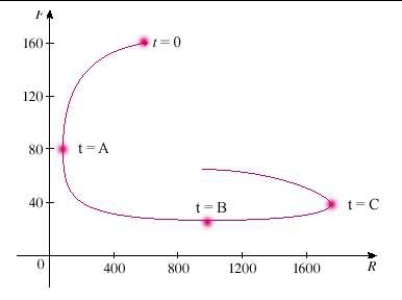 Select the correct statement.
 (Multiple Choice)
4.9/5  (76)
(76) Let c be a positive number. A differential equation of the form where k is a positive constant is called a doomsday equation because the exponent in the expression is larger than the exponent 1 for natural growth. An especially prolific breed of rabbits has the growth term . If such rabbits breed initially and the warren has rabbits after months, then when is doomsday?
(Multiple Choice)
4.8/5 (74)
(74) The Pacific halibut fishery has been modeled by the differential equation where is the biomass (the total mass of the members of the population) in kilograms at time t (measured in years), the carrying capacity is estimated to be and per year. If , find the biomass a year later.
(Short Answer)
4.8/5 (71)
(71) Find the solution of the differential equation that satisfies the initial condition .
(Short Answer)
4.7/5 (81)
(81) Which of the following functions are the constant solutions of the equation
a.
b.
c.
d.
e.
(Short Answer)
4.8/5 (84)
(84) A certain small country has $20 billion in paper currency in circulation, and each day $70 million comes into the country's banks. The government decides to introduce new currency by having the banks replace old bills with new ones whenever old currency comes into the banks. Let denote the amount of new currency in circulation at time t with . Formulate and solve a mathematical model in the form of an initial-value problem that represents the "flow" of the new currency into circulation (in billions per day).
(Short Answer)
4.8/5 (76)
(76) 
Filters
- Essay(0)
- Multiple Choice(0)
- Short Answer(0)
- True False(0)
- Matching(0)