



 Chat with AI
Exam 9: Differential Equations

Exam 1: Functions and Limits95 Questions
Exam 2: Derivatives84 Questions
Exam 3: Applications of Differentiation155 Questions
Exam 4: Integrals169 Questions
Exam 5: Applications of Integration70 Questions
Exam 6: Inverse Functions95 Questions
Exam 7: Techniques of Integration124 Questions
Exam 8: Further Applications of Integration87 Questions
Exam 9: Differential Equations67 Questions
Exam 10: Parametric Equations and Polar Coordinates73 Questions
Exam 11: Infinite Sequences and Series158 Questions
Exam 12: Vectors and the Geometry of Space60 Questions
Exam 13: Vector Functions93 Questions
Exam 14: Partial Derivatives132 Questions
Exam 15: Multiple Integrals124 Questions
Exam 16: Vector Calculus137 Questions
Exam 17: Second-Order Differential Equations63 Questions
Exam 18: Final Exam44 Questions
Select questions type


Newton's Law of Cooling states that the rate of cooling of an object is proportional to the temperature difference between the object and its surroundings. Suppose that a roast turkey is taken from an oven when its temperature has reached and is placed on a table in a room where the temperature is . If is the temperature of the turkey after t minutes, then Newton's Law of Cooling implies that . This could be solved as a separable differential equation. Another method is to make the change of variable . If the temperature of the turkey is after half an hour, what is the temperature after 35 min?
(Multiple Choice)
4.9/5  (86)
(86) One model for the spread of an epidemic is that the rate of spread is jointly proportional to the number of infected people and the number of uninfected people. In an isolated town of inhabitants, people have a disease at the beginning of the week and have it at the end of the week. How long does it take for of the population to be infected?
(Multiple Choice)
4.8/5 (80)
(80) Suppose that a population grows according to a logistic model with carrying capacity and per year. Choose the logistic differential equation for these data.
(Multiple Choice)
4.8/5 (91)
(91) Find the solution of the initial-value problem and use it to find the population when .
(Short Answer)
4.9/5 (77)
(77) Find the solution of the differential equation that satisfies the initial condition .
(Short Answer)
4.8/5 (91)
(91) Suppose that a population grows according to a logistic model with carrying capacity and per year. Write the logistic differential equation for these data.
(Short Answer)
4.9/5 (80)
(80) A function satisfies the differential equation .
What are the constant solutions of the equation?
(Short Answer)
4.9/5 (81)
(81) Use Euler's method with step size 0.25 to estimate , where is the solution of the initial-value problem. Round your answer to four decimal places.
(Multiple Choice)
4.7/5 (72)
(72) Consider the differential equation as a model for a fish population, where t is measured in weeks and c is a constant. For what values of c does the fish population always die out?
(Short Answer)
4.9/5 (87)
(87) A tank contains L of brine with kg of dissolved salt. Pure water enters the tank at a rate of L/min. The solution is kept thoroughly mixed and drains from the tank at the same rate. How much salt is in the tank after minutes?
(Short Answer)
4.9/5 (91)
(91) Biologists stocked a lake with fish and estimated the carrying capacity (the maximal population for the fish of that species in that lake) to be . The number of fish tripled in the first year. Assuming that the size of the fish population satisfies the logistic equation, find an expression for the size of the population after t years.
(Short Answer)
4.8/5 (80)
(80) Use Euler's method with step size 0.1 to estimate , where is the solution of the initial-value problem. Round your answer to four decimal places.
(Short Answer)
4.9/5 (83)
(83) The solution of the differential equation satisfies the initial condition .
Find the limit.
(Short Answer)
4.9/5 (77)
(77) Select a direction field for the differential equation from a set of direction fields labeled I-IV. 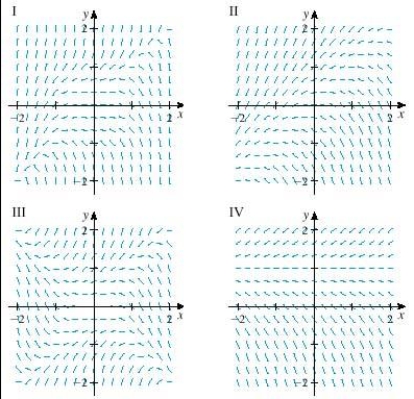
(Short Answer)
4.7/5 (81)
(81) 
Filters
- Essay(0)
- Multiple Choice(0)
- Short Answer(0)
- True False(0)
- Matching(0)