



 Chat with AI
Exam 9: Differential Equations

Exam 1: Functions and Limits95 Questions
Exam 2: Derivatives84 Questions
Exam 3: Applications of Differentiation155 Questions
Exam 4: Integrals169 Questions
Exam 5: Applications of Integration70 Questions
Exam 6: Inverse Functions95 Questions
Exam 7: Techniques of Integration124 Questions
Exam 8: Further Applications of Integration87 Questions
Exam 9: Differential Equations67 Questions
Exam 10: Parametric Equations and Polar Coordinates73 Questions
Exam 11: Infinite Sequences and Series158 Questions
Exam 12: Vectors and the Geometry of Space60 Questions
Exam 13: Vector Functions93 Questions
Exam 14: Partial Derivatives132 Questions
Exam 15: Multiple Integrals124 Questions
Exam 16: Vector Calculus137 Questions
Exam 17: Second-Order Differential Equations63 Questions
Exam 18: Final Exam44 Questions
Select questions type


We modeled populations of aphids and ladybugs with a Lotka-Volterra system. Suppose we modify those equations as follows: ,

Free
(Multiple Choice)
4.9/5  (78)
(78) Correct Answer: Verified
D
Suppose that a population develops according to the logistic equation , where t is measured in weeks. What is the carrying capacity?
Free
(Multiple Choice)
4.9/5 (76)
(76) Correct Answer:Verified
VerifiedB
In the circuit shown in Figure, a generator supplies a voltage of volts, the inductance is 2 H, the resistance is 40 Ω , and . Find the current 0.2 s after the switch is closed. Round your answer to two decimal places. 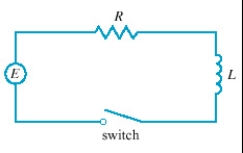
Free
(Multiple Choice)
4.8/5 (81)
(81) Correct Answer:Verified
VerifiedE
For what nonzero values of k does the function satisfy the differential equation for all values of A and B?
(Multiple Choice)
4.7/5 (70)
(70) Which of the following functions is a solution of the differential equation?
(Multiple Choice)
4.9/5 (85)
(85) A common inhabitant of human intestines is the bacterium Escherichia coli. A cell of this bacterium in a nutrient-broth medium divides into two cells every . The initial population of a culture is cells. Find the number of cells after hours.
(Multiple Choice)
4.8/5 (88)
(88) A sum of is invested at interest. If is the amount of the investment at time t for the case of continuous compounding, write a differential equation and an initial condition satisfied by .
(Multiple Choice)
4.8/5 (77)
(77) Kirchhoff's Law gives us the derivative equation .
If , use Euler's method with step size 0.1 to estimate after 0.3 second.
(Short Answer)
4.8/5 (80)
(80) The population of the world was about 5.3 billion in 1990. Birth rates in the 1990s range from 35 to 40 million per year and death rates range from 15 to 20 million per year. Let's assume that the carrying capacity for world population is 100 billion. Use the logistic model to predict the world population in the 2,450 year. Calculate your answer in billions to one decimal place. (Because the initial population is small compared to the carrying capacity, you can take k to be an estimate of the initial relative growth rate.)
(Multiple Choice)
4.8/5 (83)
(83) A curve passes through the point and has the property that the slope of the curve at every point P is times the y-coordinate P. What is the equation of the curve?
(Multiple Choice)
4.9/5 (79)
(79) A population is modeled by the differential equation .
For what values of P is the population decreasing?
(Short Answer)
4.9/5 (89)
(89) One model for the spread of a rumor is that the rate of spread is proportional to the product of the fraction of the population who have heard the rumor and the fraction who have not heard the rumor. Let's assume that the constant of proportionality is . Write a differential equation that is satisfied by y.
(Short Answer)
4.8/5 (83)
(83) 
Filters
- Essay(0)
- Multiple Choice(0)
- Short Answer(0)
- True False(0)
- Matching(0)