



 Chat with AI
Exam 9: Differential Equations

Exam 1: Functions and Limits95 Questions
Exam 2: Derivatives84 Questions
Exam 3: Applications of Differentiation155 Questions
Exam 4: Integrals169 Questions
Exam 5: Applications of Integration70 Questions
Exam 6: Inverse Functions95 Questions
Exam 7: Techniques of Integration124 Questions
Exam 8: Further Applications of Integration87 Questions
Exam 9: Differential Equations67 Questions
Exam 10: Parametric Equations and Polar Coordinates73 Questions
Exam 11: Infinite Sequences and Series158 Questions
Exam 12: Vectors and the Geometry of Space60 Questions
Exam 13: Vector Functions93 Questions
Exam 14: Partial Derivatives132 Questions
Exam 15: Multiple Integrals124 Questions
Exam 16: Vector Calculus137 Questions
Exam 17: Second-Order Differential Equations63 Questions
Exam 18: Final Exam44 Questions
Select questions type


Choose the differential equation corresponding to this direction field. 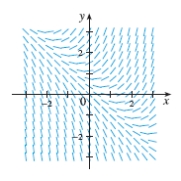
(Multiple Choice)
4.9/5  (79)
(79) Let be the performance level of someone learning a skill as a function of the training time t. The graph of P is called a learning curve. We propose the differential equation as a reasonable model for learning, where r is a positive constant. Solve it as a linear differential equation.
(Multiple Choice)
5.0/5 (83)
(83) A population is modeled by the differential equation. For what values of P is the population increasing?
(Multiple Choice)
4.9/5 (77)
(77) One model for the spread of an epidemic is that the rate of spread is jointly proportional to the number of infected people and the number of uninfected people. In an isolated town of inhabitants, people have a disease at the beginning of the week and have it at the end of the week. How long does it take for of the population to be infected?
(Short Answer)
4.8/5 (85)
(85) Experiments show that if the chemical reaction takes place at , the rate of reaction of dinitrogen pentoxide is proportional to its concentration as follows : How long will the reaction take to reduce the concentration of to 50% of its original value?
(Short Answer)
4.9/5 (91)
(91) Let c be a positive number. A differential equation of the form where k is a positive constant, is called a doomsday equation because the exponent in the expression is larger than the exponent 1for natural growth. An especially prolific breed of rabbits has the growth term . If such rabbits breed initially and the warren has rabbits after months, then when is doomsday?
(Short Answer)
4.8/5 (84)
(84) A sum of is invested at interest. If is the amount of the investment at time t for the case of continuous compounding, write a differential equation and an initial condition satisfied by .
(Short Answer)
4.9/5 (86)
(86) The rate of change of atmospheric pressure P with respect to altitude h is proportional to P provided that the temperature is constant. At the pressure is at sea level and at . What is the pressure at an altitude of ?
(Short Answer)
5.0/5 (82)
(82) An object with mass m is dropped from rest and we assume that the air resistance is proportional to the speed of the object. If is the distance dropped after t seconds, then the speed is and the acceleration is . If g is the acceleration due to gravity, then the downward force on the object is , where c is a positive constant, and Newton's Second Law gives .
Find the limiting velocity.
(Short Answer)
4.8/5 (62)
(62) The population of the world was about 5.3 billion in 1990. Birth rates in the 1990s range from 35 to 40 million per year and death rates range from 15 to 20 million per year. Let's assume that the carrying capacity for world population is 100 billion. Use the logistic model to predict the world population in the 2,450 year. Calculate your answer in billions to one decimal place. (Because the initial population is small compared to the carrying capacity, you can take k to be an estimate of the initial relative growth rate.)
(Multiple Choice)
4.9/5 (77)
(77) For what values of k does the function satisfy the differential equation ?
(Multiple Choice)
4.8/5 (63)
(63) 
Filters
- Essay(0)
- Multiple Choice(0)
- Short Answer(0)
- True False(0)
- Matching(0)