



 Chat with AI
Exam 10: Audit Sampling

Exam 1: Introduction to Auditing38 Questions
Exam 2: Auditors Professional Roles and Responsibilities36 Questions
Exam 3: Auditors Ethical and Legal Responsibilities53 Questions
Exam 4: Reports on Audited Financial Statements49 Questions
Exam 5: Preliminary Audit Planning: Understanding the Auditees Business34 Questions
Exam 6: Assessing Risks in an Audit Engagement42 Questions
Exam 7: Internal Control Over Financial Reporting62 Questions
Exam 8: Audit Evidence and Assurance35 Questions
Exam 9: Control Assessment and Testing40 Questions
Exam 10: Audit Sampling52 Questions
Exam 11: The Revenues, Receivables, and Receipts Process and Cash Account Balance71 Questions
Exam 12: The Purchases, Payables, and Payments Process60 Questions
Exam 13: Payroll and Production Processes42 Questions
Exam 14: The Finance and Investment Process40 Questions
Exam 15: Completing the Audit Work44 Questions
Exam 16: Applying Professional Judgment to Form the Audit Opinion and Issue Theaudit Report45 Questions
Exam 17: Other Public Accounting Services and Reportsreviews and Compilations51 Questions
Exam 18: Professional Rules of Conduct Details and Auditor Responsibilities41 Questions
Exam 19: Part I the Audit of Accounting Estimates: Basic Material Relating to Accountingestimates41 Questions
Exam 20: Legal Liability Cases49 Questions
Exam 21: Other Professional Accounting Services and Reports, Including Fraud43 Questions
Select questions type


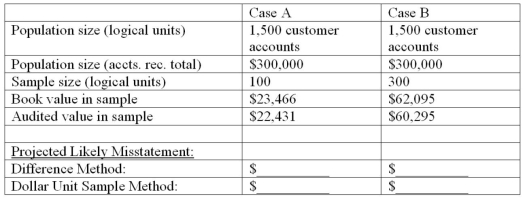
Calculate the projected likely misstatement (PLM) for the data given below using the average difference method and the ratio method. (Round to the nearest dollar.)
(Essay)
4.9/5  (83)
(83) Using the audit risk model: If audit risk is 0.05, inherent risk is 1.0, control risk is 0.20, and analytical procedures risk is 1.0, the risk of incorrect acceptance is 0.25.
(True/False)
4.9/5 (77)
(77) For which of the following audit tests is an auditor most likely to use attribute sampling?
(Multiple Choice)
4.9/5 (79)
(79) Left and Right PAs audited the accounts receivable of Investo Limited on a sample basis. There were 2,000 customer accounts in the subsidiary ledger with a total recorded value of $375,000. As part of the audit program, Left and Right selected a sample of 100 accounts having a recorded value of $20,000. They performed the audit procedures and determined that the audited amount of the sample totalled $19,000.
Required:
A) Calculate the projected likely misstatement (PLM) using (1) the average difference method and (2) the ratio method.
B) Evaluate the results of the calculation in part (A). Assume that Left and Right set the tolerable misstatement for accounts receivable at $25,000.
(Essay)
5.0/5 (71)
(71) Statements or examples that relate to audit sampling are listed below. Match the statements 1 through 5 to the term (A through D) that it best describes and place the identifying letter in the space provided.
A: Statistical sampling
B: Non-statistical sampling
C: Sampling risk
D: Non-sampling risk
____ 1. Jones CPA selected a sample and evaluated the results of her sample using the laws of probability.
____ 2. Wilson CPA checked to see if there were any signatures in the credit approval box on a sample of sales orders rather than looking only for authorized signatures.
____ 3. Based on a statistical sample, Jackson CPA concluded that the client's control system was working on an acceptable basis when in fact the population deviation rate was unacceptable.
____ 4. For his sample Barnum CPA selected all invoices over $1,000 and all invoices recorded on the 15th of each month.
____ 5. When a client could not produce an invoice for a sample selected by the auditor, the auditor accepted the client's assurance that the invoice contained the appropriate approval.
(Short Answer)
4.7/5 (74)
(74) After extrapolating the results of performing substantive tests on a sample of accounts from the accounts receivable subsidiary ledger, Allen CPA concluded that the accounts receivable balance was materially misstated. In fact, the balance was materially correct. This situation illustrates the risk of ________.
(Multiple Choice)
4.8/5 (83)
(83) In the audit of account balances, the sample size will tend to be smaller when the ________.
(Multiple Choice)
4.9/5 (90)
(90) Below are steps in the process of tests of controls for assessing control risk. Indicate, using the correct letter, the phase in which the step belongs.
A: Problem recognition phase
B: Evidence collection phase
C: Evidence evaluation phase
____ 1. Define the deviation conditions.
____ 2. Calculate the sample deviation rate.
____ 3. Judge the deviation rate in relation to the tolerable rate.
____ 4. Determine the sample size.
____ 5. Define the population.
____ 6. Perform procedures to test the controls.
____ 7. Specify the audit objectives.
(Short Answer)
4.7/5 (83)
(83) The determination of an appropriate sample on a representative basis must be made using statistical methods.
(True/False)
4.9/5 (85)
(85) An example of non-sampling risk is the selection of a random sample that is not representative of the population.
(True/False)
4.8/5 (67)
(67) If the association of population items with random numbers is difficult and expensive, but the auditor does not have sufficient knowledge about the population, the auditor should ________.
(Multiple Choice)
4.8/5 (76)
(76) Non-statistical sampling may be better to use than statistical sampling when ________.
(Multiple Choice)
4.9/5 (76)
(76) 
Filters
- Essay(0)
- Multiple Choice(0)
- Short Answer(0)
- True False(0)
- Matching(0)