



 Chat with AI
Exam 10: Audit Sampling


Jack and Jill, two auditors who have separate accounting practices, have independently assessed the risks associated with the accounts receivable of their respective clients. The appropriate audit risk for both is determined to be .02. Both agree that inherent risk should be set at the maximum (1.0) and that no analytical procedures will be performed. Jack evaluates control risk as moderate (.40), while Jill assesses it as relatively low (.20). Using the audit risk model, answer the following questions.
Required:
A) What is the risk of incorrect acceptance (RIA) for Jack and for Jill?
B) Based on your answer in part (A), which auditor will have to collect the most evidence? Explain your reasoning.
C) What effect does differing assessments of control risk have on the sample size of accounts receivable? Explain.

 (77)
 Verified
A) Using the audit risk model, the risk of incorrect acceptance is as follows:
Risk of incorrect acceptance (RIA) = AR/(IR × CR × APR)
For Jack, RIA = .02/(1 × .4 × 1) = .05
For Jill, RIA = .02/(1 × .2 × 1) = .10
B) In general, the lower the risk of incorrect acceptance required by the auditor, the more evidence that will have to be collected. Therefore, Jack, who has an RIA of .05, will require more evidence than Jill.
C) As noted in part (B), the lower the risk of incorrect acceptance, the larger the sample must be. Therefore, Jack's sample for accounts receivable must be larger than Jill's sample. This makes sense because the less risk the auditor is willing to take, the more evidence the auditor requires. If the auditor requires more evidence, then the auditor must draw larger samples.
Auditing a larger sample reduces the probability of determining that the control is working well when in fact it is not.
(85) VerifiedFalse
In a sample-based audit of an account balance, which of the following combinations properly expresses the relationship between changes in the factors indicated and changes in sample size?
(74) VerifiedB
A number of factors can affect the size of a sample for a substantive audit of the details of an account balance. All other factors being equal, which of the following would lead to a larger sample size?
(77) If statistical calculations were not applied, then a sampling method would be considered non-statistical, even though a random sample was selected.
(93) As a result of tests of controls, an auditor assessed control risk too low and decreased substantive testing. This assessment resulted because the true deviation rate in the population was ________.
(89) Assume several auditors selected various unrestricted, unstratified random samples from a population of 1,200 customers' accounts receivable with a recorded value of $480,000. The results of their tests are shown in the table below.
Projected Likely Misstatement
Overstatement (Understatement)
Required:
For each of the sample sizes, calculate the projected likely misstatement (PLM) using (1) average difference method, and (2) the Dollar Unit Sample method. Treat each case independently. Round the PLM solutions to the nearest dollar.
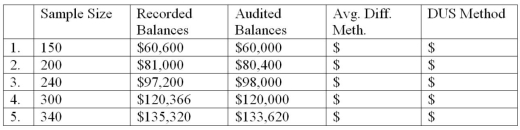
(81) The standard deviation of a population of data is a statistical measure of ________.
(80) The total amount of monetary error that is found in a sample is referred to as the ________.
(69) Which of the following audit procedures is NOT typically used in audit sampling applications?
(89) When auditors perform procedures using statistical sampling and obtain sufficient evidence, a conclusion about the population characteristics will not be wrong.
(86) Attribute sampling is audit sampling in which auditors look for the presence or absence of a control condition.
(88) When evaluating the results of substantive audit procedures, auditors run the sampling risk(s) of ________.
(84) Which of the following is used in attribute sampling to determine the sample size?
(64) An advantage of statistical sampling over non-statistical sampling is that statistical sampling helps an auditor to ________.
(76) In making a decision about the extent of misstatement in a population, the known misstatement in the sample must be projected to the population.
(81) In testing controls over invoices, an auditor discovers that in 10% of her statistical sample invoices were sent for full shipments, even if shipping documents suggested partial shipments. In this case, she would likely ________.
(88) Green CPA audited the inventory of ABC Company on a sample basis. Green audited a sample of 120 items and found a net overstatement of $600. The audited sample had a recorded value of $12,000. The entire inventory contained 2,400 items with a total book value of $280,000. The projected likely overstatement using the average difference method is ________.
(76) The purpose of tests of controls is to determine whether ________.
(71) 
Filters
- Essay(0)
- Multiple Choice(0)
- Short Answer(0)
- True False(0)
- Matching(0)