



 Chat with AI
Exam 6: The Magnetic Field

Exam 1: The Electric Field I: Discrete Charge Distributions87 Questions
Exam 2: The Electric Field II: Continuous Charge Distributions75 Questions
Exam 3: Electric Potential108 Questions
Exam 4: Capacitance73 Questions
Exam 5: Electric Current and Direct-Current Circuits160 Questions
Exam 6: The Magnetic Field71 Questions
Exam 7: Sources of the Magnetic Field115 Questions
Exam 8: Magnetic Induction84 Questions
Exam 9: Alternating-Current Circuits119 Questions
Exam 10: Maxwells Equations and Electromagnetic Waves61 Questions
Exam 11: Properties of Light116 Questions
Exam 12: Optical Images143 Questions
Exam 13: Interference and Diffraction116 Questions
Exam 14: Wave Particle Duality and Quantum Physics153 Questions
Exam 15: Applications of the Schrodinger Equation54 Questions
Exam 16: Atoms128 Questions
Exam 17: Molecules44 Questions
Exam 18: Solids and the Theory of Conduction83 Questions
Exam 19: Relativity83 Questions
Exam 20: Nuclear Physics135 Questions
Exam 21: Elementary Particles and the Beginning of the Universe68 Questions
Select questions type


An alpha particle with a charge 2e and mass 4m is moving with velocity v when it enters a magnetic field B at right angles to its direction of motion. A deuteron of charge e and mass 2m also enters the field in the same direction and the same speed. Calculate the difference in radius of motion between the alpha particle and the deuteron in the magnetic field region.
(Multiple Choice)
4.8/5  (70)
(70) An electron is traveling horizontally east in the magnetic field of Earth near the equator. The direction of the force on the electron is
(Multiple Choice)
4.8/5 (72)
(72) The SI unit of magnetic field is the tesla (T). This is equivalent to
(Multiple Choice)
4.8/5 (80)
(80) A circular, 20-turn coil of radius 5.0 cm is oriented in such a way that its axis makes a 30º angle with a uniform magnetic field of 0.15 T. What is the torque on the coil when it carries a current of 2.5 A?
(Multiple Choice)
4.8/5 (66)
(66) Use the diagram for the next three problems. 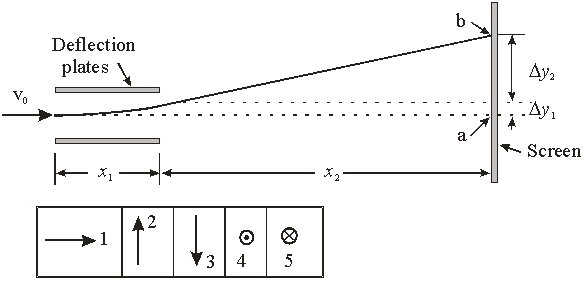 Electrons traveling at a speed of v0 = 3 * 107 m/s pass through the deflection plates. The electric field between the plates is E = 5000 V/m and spans a distance of
x1 = 5 cm. The electrons then travel a further distance of x2 = 40 cm along the x-axis.
-What should the strength of the magnetic field be for the electrons to land at a?
Electrons traveling at a speed of v0 = 3 * 107 m/s pass through the deflection plates. The electric field between the plates is E = 5000 V/m and spans a distance of
x1 = 5 cm. The electrons then travel a further distance of x2 = 40 cm along the x-axis.
-What should the strength of the magnetic field be for the electrons to land at a? (Multiple Choice)
4.8/5 (80)
(80) In a mass spectrometer ions of Ni with mass 9.62 * 10-26 kg and charge +2e are accelerated through a potential difference of X volts and then deflected in a magnetic field of 0.15 T. If the radius of curvature of the ions is 0.55 m, then calculate the value of the potential difference X.
(Multiple Choice)
4.8/5 (78)
(78) Use the following figure for the next problem.
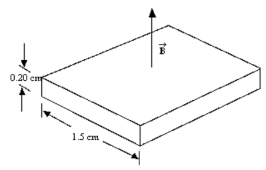 -A metal strip 1.5 cm wide and 0.20 cm thick carries a current in a uniform magnetic field of 1.5 T. The Hall emf is 5.3 V. The drift velocity of the electrons in the strip is approximately
 (Multiple Choice)
4.9/5 (79)
(79) When a compass needle is in stable equilibrium in a magnetic field  ,
, (Multiple Choice)
4.9/5 (84)
(84) A deuteron is moving with a speed of 2.0 *106 m/s at right angles to a magnetic field. The field is uniform, with magnitude B = 0.40 T. The mass and charge of a deuteron are 3.3 * 10-27 kg and 1.6 * 10-19 C, respectively. The radius of the deuteron orbit is approximately
(Multiple Choice)
4.7/5 (73)
(73) 
Filters
- Essay(0)
- Multiple Choice(0)
- Short Answer(0)
- True False(0)
- Matching(0)