



 Chat with AI
Exam 6: The Magnetic Field

Exam 1: The Electric Field I: Discrete Charge Distributions87 Questions
Exam 2: The Electric Field II: Continuous Charge Distributions75 Questions
Exam 3: Electric Potential108 Questions
Exam 4: Capacitance73 Questions
Exam 5: Electric Current and Direct-Current Circuits160 Questions
Exam 6: The Magnetic Field71 Questions
Exam 7: Sources of the Magnetic Field115 Questions
Exam 8: Magnetic Induction84 Questions
Exam 9: Alternating-Current Circuits119 Questions
Exam 10: Maxwells Equations and Electromagnetic Waves61 Questions
Exam 11: Properties of Light116 Questions
Exam 12: Optical Images143 Questions
Exam 13: Interference and Diffraction116 Questions
Exam 14: Wave Particle Duality and Quantum Physics153 Questions
Exam 15: Applications of the Schrodinger Equation54 Questions
Exam 16: Atoms128 Questions
Exam 17: Molecules44 Questions
Exam 18: Solids and the Theory of Conduction83 Questions
Exam 19: Relativity83 Questions
Exam 20: Nuclear Physics135 Questions
Exam 21: Elementary Particles and the Beginning of the Universe68 Questions
Select questions type


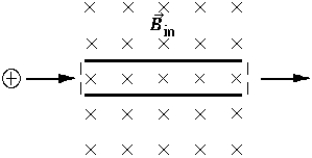 The apparatus in the figure consists of two parallel plates (shown on edge) and a large magnet (not shown). The field of the magnet is uniform, perpendicular to the electric field between the plates, and directed into the plane of the paper. The magnitude of
 is 0.40 T. Charged particles with speeds of 5.0 *105 m/s enter this region through the slit at the left and emerge through the exit slit at the right. What magnitude and direction must the
 field have so that positively charged particles entering from the left will traverse to the exit slit undeviated?
The apparatus in the figure consists of two parallel plates (shown on edge) and a large magnet (not shown). The field of the magnet is uniform, perpendicular to the electric field between the plates, and directed into the plane of the paper. The magnitude of is 0.40 T. Charged particles with speeds of 5.0 *105 m/s enter this region through the slit at the left and emerge through the exit slit at the right. What magnitude and direction must the field have so that positively charged particles entering from the left will traverse to the exit slit undeviated? (Multiple Choice)
4.7/5  (85)
(85) 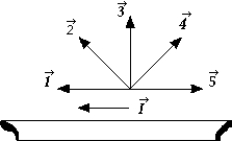 A current I flows in a wire that is oriented as shown. The vector representing the magnetic field that results in a maximum force on the wire is
 (Multiple Choice)
4.8/5 (87)
(87) 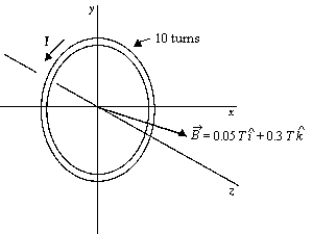 A circular 10-turn coil with a radius of 5.0 cm carries a current of 5 A. It lies in the xy plane in a uniform magnetic field
 = 0.05 T
 + 0.12 T
 . The coil rotates so that its magnetic moment, , is aligned with the magnetic field. The potential energy of the system when the coil's magnetic moment is aligned with the field is
A circular 10-turn coil with a radius of 5.0 cm carries a current of 5 A. It lies in the xy plane in a uniform magnetic field = 0.05 T + 0.12 T . The coil rotates so that its magnetic moment, , is aligned with the magnetic field. The potential energy of the system when the coil's magnetic moment is aligned with the field is (Multiple Choice)
4.9/5 (90)
(90) A proton with a charge +e is moving with a speed v at 50º to the direction of a magnetic field  . The component of the resulting force on the proton in the direction of
 is
. The component of the resulting force on the proton in the direction of is (Multiple Choice)
4.8/5 (80)
(80) An electron is accelerated from rest by an electric field. After the acceleration, the electron is injected into a uniform magnetic field of 1.27 * 10-3 T. The velocity of the electron and the magnetic field lines are perpendicular to one another. The electron remains in the magnetic field for 5.00 * 10-9 s. The angle between the initial electron velocity and the final electron velocity is
(Multiple Choice)
4.8/5 (81)
(81) The radius of curvature of the path of a charged particle moving perpendicular to a magnetic field is given by
(Multiple Choice)
4.9/5 (78)
(78) 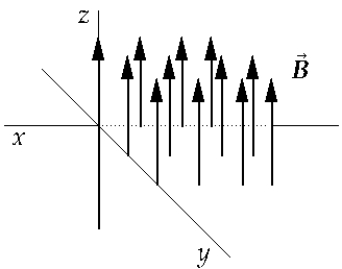 A uniform magnetic field is parallel to and in the direction of the positive z axis. For an electron to enter this field and not be deflected by the field, the electron must be traveling in which direction?
 (Multiple Choice)
4.9/5 (86)
(86) An electric field and a magnetic field are at right angles to each other and to the direction of a beam of electrons. There is no deflection of the beam when the magnitudes of the fields are 30 *104 V/m and 2.0 *10-3 T, respectively. The velocity of the electrons must be approximately
(Multiple Choice)
4.8/5 (88)
(88) 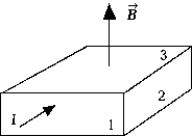 The rectangular aluminum strip in the figure is in a uniform magnetic field,
 . The current I is flowing perpendicular to surface 1. Negative charges will accumulate on
The rectangular aluminum strip in the figure is in a uniform magnetic field, . The current I is flowing perpendicular to surface 1. Negative charges will accumulate on (Multiple Choice)
4.8/5 (76)
(76) A circular, 20-turn coil has a radius of 5.0 cm. What is the magnitude of the magnetic moment of the coil when it carries a current of 2.5 A?
(Multiple Choice)
4.8/5 (91)
(91) A particle with charge q and mass m is moving with speed v in the +x direction enters a magnetic field of strength B pointing in the +y direction. The work done by the magnetic force on the particle as it travels one semi-circle is
(Multiple Choice)
4.9/5 (75)
(75) 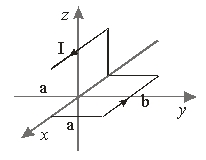 A rectangle is bent on two sides at 90 so that one end lies along the xy plane while the other end lies along the xz plane. The length of each bent portion is illustrated on the Figure. A current I flows through the loop. The magnetic dipole of the rectangle is
 (Multiple Choice)
4.7/5 (89)
(89) An electron is traveling east with an instantaneous velocity of 3.3 * 105 m/s when it enters a uniform magnetic field of 0.25 T that points X degrees north of east. (Take east as to the right of the paper and north as towards the top of the paper, i.e. both in the plane of the paper.) If the magnitude of the force on the electron is 5.5*10-15 N, then calculate the angle X and whether the electron moves up out of or down into the plane of the page, or otherwise.
(Multiple Choice)
5.0/5 (87)
(87) A charged particle is moving horizontally westward with a velocity of 3.5* 106 m/s in a region where there is a magnetic field of magnitude 5.6 * 10-5 T directed vertically downward. The particle experiences a force of 7.8 * 10-16 N northward. What is the charge on the particle?
(Multiple Choice)
4.9/5 (84)
(84) A straight wire segment 3.0 m long makes an angle of 28º with a uniform magnetic field of 1.0 T. The magnitude of the force on the wire if it carries a current of 1.5 A is approximately
(Multiple Choice)
4.9/5 (78)
(78) 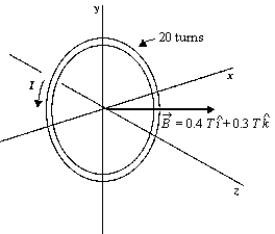 A circular 20-turn coil with a radius of 10 cm carries a current of 3 A. It lies in the xy plane in a uniform magnetic field
 = 0.4 T
 + 0.3 T
 . The coil rotates so that its magnetic moment, , is aligned with the magnetic field. The potential energy of the system when the coil's magnetic moment is aligned with the field is
A circular 20-turn coil with a radius of 10 cm carries a current of 3 A. It lies in the xy plane in a uniform magnetic field = 0.4 T + 0.3 T . The coil rotates so that its magnetic moment, , is aligned with the magnetic field. The potential energy of the system when the coil's magnetic moment is aligned with the field is (Multiple Choice)
5.0/5 (86)
(86) A beam of electrons is undeflected when it passes simultaneously through an electric field of 10 N/C perpendicular to its path and a magnetic field of 2 *10-4 T perpendicular both to its path and to the electric field. The speed of the electrons is approximately
(Multiple Choice)
4.9/5 (75)
(75) An electric field of 3.0 kV/m is perpendicular to a magnetic field of 0.20 T. An electron moving in a direction perpendicular to both  and
 is not deflected if it has a velocity of
and is not deflected if it has a velocity of (Multiple Choice)
4.8/5 (70)
(70) 
Filters
- Essay(0)
- Multiple Choice(0)
- Short Answer(0)
- True False(0)
- Matching(0)