



 Chat with AI
Exam 6: The Magnetic Field

Exam 1: The Electric Field I: Discrete Charge Distributions87 Questions
Exam 2: The Electric Field II: Continuous Charge Distributions75 Questions
Exam 3: Electric Potential108 Questions
Exam 4: Capacitance73 Questions
Exam 5: Electric Current and Direct-Current Circuits160 Questions
Exam 6: The Magnetic Field71 Questions
Exam 7: Sources of the Magnetic Field115 Questions
Exam 8: Magnetic Induction84 Questions
Exam 9: Alternating-Current Circuits119 Questions
Exam 10: Maxwells Equations and Electromagnetic Waves61 Questions
Exam 11: Properties of Light116 Questions
Exam 12: Optical Images143 Questions
Exam 13: Interference and Diffraction116 Questions
Exam 14: Wave Particle Duality and Quantum Physics153 Questions
Exam 15: Applications of the Schrodinger Equation54 Questions
Exam 16: Atoms128 Questions
Exam 17: Molecules44 Questions
Exam 18: Solids and the Theory of Conduction83 Questions
Exam 19: Relativity83 Questions
Exam 20: Nuclear Physics135 Questions
Exam 21: Elementary Particles and the Beginning of the Universe68 Questions
Select questions type


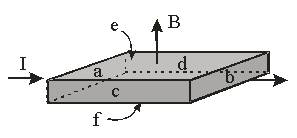 A current I passes through a slab of metal in the presence of a magnetic field B. Between which two sides does a Hall voltage develops? Write the side with the higher potential first. The labels are: a and b the two sides on the left and right, c and d the two sides on the front and back, and e and f the top and bottom respectively.
 (Multiple Choice)
4.8/5  (76)
(76) An electron passes through a region where there is an electric field E = 4.0 * 105 V/m and a magnetic field B = 0.090 T. The directions of the electric field, the magnetic field, and the electron velocity are mutually perpendicular. If the electron is not deflected from its straight-line path through these fields, its velocity must be
(Multiple Choice)
4.7/5 (79)
(79) A beam of electrons moving at a speed of 8 *104 m/s is undeflected when it passes through an electric field of 5 N/C perpendicular to its path and a magnetic field that is perpendicular to its path and also to that of the electric field. Calculate the strength of the magnetic field.
(Multiple Choice)
4.9/5 (92)
(92) Use the diagram for the next two problems. 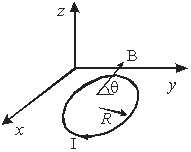 -A circular current loop lies in the xy plane and has radius R = 10 cm. The loop has 20 turns and carries a current I = 4 A. The magnetic dipole of the loop is
 (Multiple Choice)
5.0/5 (73)
(73) 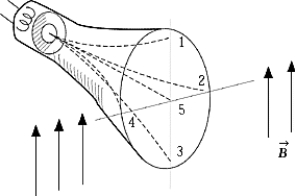 When a cathode-ray tube with its axis horizontal is placed in a magnetic field that is directed vertically upward, the electrons emitted from the cathode follow one of the dashed paths to the face of the tube. The correct path is
 (Multiple Choice)
4.8/5 (83)
(83) The radius of curvature of the path of a charged particle in a uniform magnetic field is directly proportional to
(Multiple Choice)
4.8/5 (87)
(87) An alpha particle of charge +2e and mass 4(1.66 * 10-27) kg, and an 16O nucleus of charge +8e and mass 16(1.66 *10-27) kg have been accelerated from rest through the same electric potential. They are then injected into a uniform magnetic field  , where both move at right angles to the field. The ratio of the radius of the path of the alpha particle to the radius of the path of the nucleus 16O is
 (Multiple Choice)
4.9/5 (84)
(84) 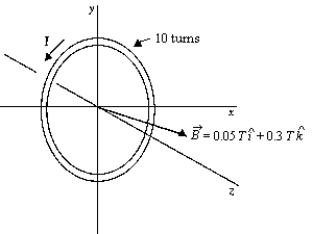 A circular 10-turn coil with a radius of 5.0 cm carries a current of 5 A. It lies in the xy plane in a uniform magnetic field
 = 0.05 T
 + 0.12 T
 . The potential energy of the system is
A circular 10-turn coil with a radius of 5.0 cm carries a current of 5 A. It lies in the xy plane in a uniform magnetic field = 0.05 T + 0.12 T . The potential energy of the system is (Multiple Choice)
4.7/5 (75)
(75) A wire 30 cm long with an east-west orientation carries a current of 3.0 A eastward. There is a uniform magnetic field perpendicular to this wire. If the force on the wire is 0.18 N upward, what are the direction and magnitude of the magnetic field?
(Multiple Choice)
4.9/5 (79)
(79) The radius of the orbit of an electron moving with a speed of 108 m/s perpendicular to a magnetic field of 5.0 * 10-3 T is approximately
(Multiple Choice)
4.8/5 (72)
(72) Use the following figure for the next problem.
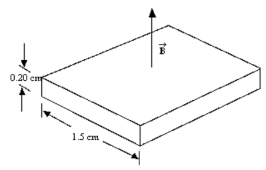 -A metal strip 1.5 cm wide and 0.20 cm thick carries a current of 15 A in a uniform magnetic field of 1.5 T. The Hall emf is 5.3 V. The electronic charge is 1.6 * 10-19 C. The number density of the charge carriers in the strip is approximately
 (Multiple Choice)
4.8/5 (80)
(80) 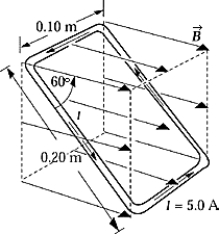 A rectangular loop of wire (0.10 m by 0.20 m) carries a current of 5.0 A in a counterclockwise direction. The loop is oriented as shown in a uniform magnetic field of 1.5 T. The force acting on the upper 0.10-m side of the loop is
 (Multiple Choice)
4.8/5 (85)
(85) 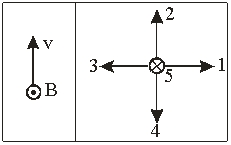 The left diagram shows a positively charged particle is moving with velocity v in a magnetic field B. Using the right diagram, the direction of the magnetic force on the particle is
 (Multiple Choice)
5.0/5 (83)
(83) A long straight wire parallel to the y axis carries a current of 6.3 A in the positive y direction. There is a uniform magnetic field  = 1.5 T
 . The force per unit length on the wire is approximately
= 1.5 T . The force per unit length on the wire is approximately (Multiple Choice)
4.8/5 (73)
(73) The angle through which the pointer on a galvanometer rotates is
(Multiple Choice)
4.9/5 (77)
(77) Use the diagram for the next two problems.
-A circular current loop lies in the xy plane and has radius R = 10 cm. The loop has 20 turns and carries a current I = 4 A. A magnetic field of strength 0.3 T is applied at an angle of = 30 to the loop. The potential energy of the magnetic dipole is
-A circular current loop lies in the xy plane and has radius R = 10 cm. The loop has 20 turns and carries a current I = 4 A. A magnetic field of strength 0.3 T is applied at an angle of = 30 to the loop. The potential energy of the magnetic dipole is (Multiple Choice)
4.7/5 (78)
(78) 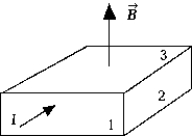 The rectangular aluminum strip in the figure is in a uniform magnetic field,
 . The current I is flowing perpendicular to surface 1. Positive charges will accumulate on
The rectangular aluminum strip in the figure is in a uniform magnetic field, . The current I is flowing perpendicular to surface 1. Positive charges will accumulate on (Multiple Choice)
4.7/5 (73)
(73) If the magnetic field vector is directed toward the north and a positively charged particle is moving toward the east, what is the direction of the magnetic force on the particle?
(Multiple Choice)
4.8/5 (85)
(85) 
Filters
- Essay(0)
- Multiple Choice(0)
- Short Answer(0)
- True False(0)
- Matching(0)