



 Chat with AI
Exam 23: Electric Potential

Exam 1: Systems of Measurement86 Questions
Exam 2: Motion in One Dimension83 Questions
Exam 3: Motion in Two and Three Dimensions60 Questions
Exam 4: Newtons Laws106 Questions
Exam 5: Applications of Newtons Laws73 Questions
Exam 6: Work and Energy60 Questions
Exam 7: Conservation of Energy56 Questions
Exam 8: Systems of Particles and Conservation of Linear Momentum92 Questions
Exam 9: Rotation105 Questions
Exam 10: Conservation of Angular Momentum66 Questions
Exam 11: Gravity84 Questions
Exam 12: Static Equilibrium and Elasticity58 Questions
Exam 13: Fluids77 Questions
Exam 14: Oscillations126 Questions
Exam 15: Wave Motion112 Questions
Exam 16: Superposition and Standing Waves87 Questions
Exam 17: Temperature and the Kinetic Theory of Gases78 Questions
Exam 18: Heat and the First Law of Thermodynamics100 Questions
Exam 19: The Second Law of Thermodynamics59 Questions
Exam 20: Thermal Properties and Processes50 Questions
Exam 21: The Electric Field I: Discrete Charge Distributions55 Questions
Exam 22: The Electric Field Ii: Continuous Charge Distributions64 Questions
Exam 23: Electric Potential87 Questions
Exam 24: Capacitance63 Questions
Exam 25: Electric Current and Direct-Current Circuits107 Questions
Exam 26: The Magnetic Field33 Questions
Exam 27: Sources of the Magnetic Field86 Questions
Exam 28: Magnetic Induction56 Questions
Exam 29: Alternating-Current Circuits106 Questions
Exam 30: Maxwells Equations and Electromagnetic Waves57 Questions
Exam 31: Properties of Light82 Questions
Exam 32: Optical Images106 Questions
Exam 33: Interference and Diffraction91 Questions
Exam 34: Wave Particle Duality and Quantum Physics140 Questions
Exam 35: Applications of the Schrodinger Equation42 Questions
Exam 36: Atoms113 Questions
Exam 37: Molecules39 Questions
Exam 38: Solids and the Theory of Conduction75 Questions
Exam 39: Relativity82 Questions
Exam 40: Nuclear Physics107 Questions
Exam 41: Elementary Particles and the Beginning of the Universe68 Questions
Select questions type


When 5.0 C of charge moves at constant speed along a path between two points differing in potential by 12 V,the amount of work done is
(Multiple Choice)
4.9/5  (85)
(85) A charge of 100 nC resides on the surface of a spherical shell of radius 20 cm.The electric potential at a distance of 15 cm from the center of the spherical shell is
(Multiple Choice)
4.9/5 (77)
(77) Two parallel horizontal plates are spaced 0.40 cm apart in air.You introduce an oil droplet of mass 4.9 × 10⁻¹⁷ kg between the plates.If the droplet carries two electronic charges and if there were no air buoyancy,you could hold the droplet motionless between the plates if you kept the potential difference between them at
(Multiple Choice)
4.8/5 (76)
(76) A conducting sphere of radius r1 = 10 cm and charge q1 = 2 C is placed far apart from a second conducting sphere of radius r2 = 30 cm and charge q2 = 3 C.The two spheres are then connected by a thin conducting wire.What is the potential on the surface of the first sphere after the two spheres are connected by the wire? Use the reference V = 0 for r at infinity.
(Multiple Choice)
4.9/5 (83)
(83) The electric potential in a region of space is given by  The x-component of the electric field in this region is
 (Multiple Choice)
4.7/5 (93)
(93) A positive point charge of 10-4 C is located 3 m from another positive point charge of 10-5 C.Their mutual electric potential energy is
(Multiple Choice)
4.7/5 (73)
(73) Use the following to answer the next question: 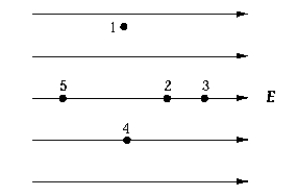 -Which point in the electric field in the diagram is at the highest potential?
 (Multiple Choice)
4.9/5 (85)
(85) 
Filters
- Essay(0)
- Multiple Choice(0)
- Short Answer(0)
- True False(0)
- Matching(0)