



 Chat with AI
Exam 23: Electric Potential

Exam 1: Systems of Measurement86 Questions
Exam 2: Motion in One Dimension83 Questions
Exam 3: Motion in Two and Three Dimensions60 Questions
Exam 4: Newtons Laws106 Questions
Exam 5: Applications of Newtons Laws73 Questions
Exam 6: Work and Energy60 Questions
Exam 7: Conservation of Energy56 Questions
Exam 8: Systems of Particles and Conservation of Linear Momentum92 Questions
Exam 9: Rotation105 Questions
Exam 10: Conservation of Angular Momentum66 Questions
Exam 11: Gravity84 Questions
Exam 12: Static Equilibrium and Elasticity58 Questions
Exam 13: Fluids77 Questions
Exam 14: Oscillations126 Questions
Exam 15: Wave Motion112 Questions
Exam 16: Superposition and Standing Waves87 Questions
Exam 17: Temperature and the Kinetic Theory of Gases78 Questions
Exam 18: Heat and the First Law of Thermodynamics100 Questions
Exam 19: The Second Law of Thermodynamics59 Questions
Exam 20: Thermal Properties and Processes50 Questions
Exam 21: The Electric Field I: Discrete Charge Distributions55 Questions
Exam 22: The Electric Field Ii: Continuous Charge Distributions64 Questions
Exam 23: Electric Potential87 Questions
Exam 24: Capacitance63 Questions
Exam 25: Electric Current and Direct-Current Circuits107 Questions
Exam 26: The Magnetic Field33 Questions
Exam 27: Sources of the Magnetic Field86 Questions
Exam 28: Magnetic Induction56 Questions
Exam 29: Alternating-Current Circuits106 Questions
Exam 30: Maxwells Equations and Electromagnetic Waves57 Questions
Exam 31: Properties of Light82 Questions
Exam 32: Optical Images106 Questions
Exam 33: Interference and Diffraction91 Questions
Exam 34: Wave Particle Duality and Quantum Physics140 Questions
Exam 35: Applications of the Schrodinger Equation42 Questions
Exam 36: Atoms113 Questions
Exam 37: Molecules39 Questions
Exam 38: Solids and the Theory of Conduction75 Questions
Exam 39: Relativity82 Questions
Exam 40: Nuclear Physics107 Questions
Exam 41: Elementary Particles and the Beginning of the Universe68 Questions
Select questions type


The electric potential in a region of space is given by V = 2xy + 3y2 in units of V.The electric field,in V/m,in this region is
(Multiple Choice)
5.0/5  (75)
(75) The charge density of an infinite line of charge is = 100 nC/m.If zero of potential is chosen to be at a point having a perpendicular distance of 1 m from the line,the electric potential at a perpendicular distance of 50 cm from this line is
(Multiple Choice)
4.9/5 (77)
(77) An electric charge q is placed on an isolated metal sphere of radius r1.If an uncharged sphere of radius r2 (with r2 > r1)is then connected to the first sphere,the spheres will have equal
(Multiple Choice)
4.8/5 (83)
(83) The potential of a spherical shell carrying 6.0 C of charge is 540 kV.What is the radius of the shell?
(Multiple Choice)
4.8/5 (72)
(72) Use the following figure to answer the next problem: 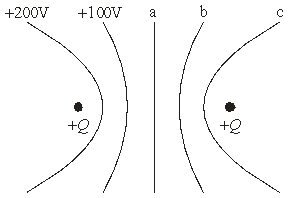 Two equal positive charges are placed x m apart.The equipotential lines are at 100 V interval.
-The work required to move a third charge,q = e,from the 100 V line to b is
Two equal positive charges are placed x m apart.The equipotential lines are at 100 V interval.
-The work required to move a third charge,q = e,from the 100 V line to b is (Multiple Choice)
4.7/5 (82)
(82) The metal sphere at the top of a small Van de Graaf generator has a radius of 8.0 cm.How much charge can be accumulated on this sphere before dielectric breakdown of the air around it occurs? (The dielectric strength of air is 3.0 MV/m.)
(Multiple Choice)
4.8/5 (78)
(78) The electric potential is known to be a function of x only; i.e.,v = V(x).The electric field at a position x1 is given by
(Multiple Choice)
4.9/5 (80)
(80) Use the following to answer the next question. 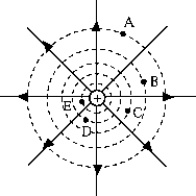 -The electrostatic potential energy of a positively charged body is greatest at point _____.
 (Multiple Choice)
4.9/5 (71)
(71) A solid spherical conductor of radius 15 cm has a charge Q = 6.5 nC on it.A second,initially uncharged,spherical conductor of radius 10 cm is moved toward the first until they touch and is then moved far away from it.How much charge is there on the second sphere after the two spheres have been separated?
(Multiple Choice)
4.7/5 (81)
(81) A solid spherical conductor of radius 20 cm has a charge Q = 25 nC on it.A second,initially uncharged,spherical conductor of radius 12 cm is moved toward the first until they touch and is then moved far away from it.How much charge is there on the second sphere after the two spheres have been separated?
(Multiple Choice)
4.9/5 (84)
(84) Use the following figure to answer the next problem: 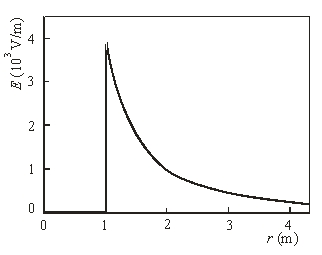 The electric field versus distance for a charge is plotted above.Use the reference point
 -The work required to move a charge,q = e from infinity to r = 2 m is
The electric field versus distance for a charge is plotted above.Use the reference point
-The work required to move a charge,q = e from infinity to r = 2 m is (Multiple Choice)
4.8/5 (83)
(83) Which of the following statements regarding potential is true?
(Multiple Choice)
4.7/5 (79)
(79) When 2.0 C of charge moves at constant speed along a path between two points differing in potential by 6.0 V,the amount of work done is
(Multiple Choice)
4.8/5 (85)
(85) The electric potential in a region of space is given by  The y-component of the electric field in this region is
 (Multiple Choice)
4.7/5 (83)
(83) A proton (charge = e,mass = 1.67 10-27 kg)with initial kinetic energy 3 MeV is fired head-on towards a fixed stationary uranium nucleus (charge 92e,mass = 3.95 10-25 kg).Calculate how close to the uranium the proton gets before it comes to rest.(Assume the uranium nucleus does not move.)
(Multiple Choice)
4.9/5 (86)
(86) Dielectric breakdown occurs in the air at an electric field strength of Emax = 3.0 106 V/m.If the maximum potential at the surface of a spherical conductor is 5.0 106 V,then calculate the radius of the sphere.
(Multiple Choice)
5.0/5 (79)
(79) Use the following to answer the next question.
-The electrostatic potential energy of a negatively charged body is greatest at point _____.
-The electrostatic potential energy of a negatively charged body is greatest at point _____. (Multiple Choice)
4.7/5 (85)
(85) An electric dipole that has a positive charge of 4.8 × 10⁻¹⁹ C is separated from a negative charge of the same magnitude by 6.4 × 10⁻¹⁰ m.The electric potential at a point 9.2 × 10⁻¹⁰ m from each of the two charges is
(Multiple Choice)
4.8/5 (76)
(76) Three charges are brought from infinity and placed at the corner of an equilateral triangle.Which of the following statements is true?
(Multiple Choice)
4.9/5 (83)
(83) Two protons in a nucleus of 238U are 6.0 10-15 m apart.The electrostatic potential energy of the pair is approximately
(Multiple Choice)
4.9/5 (70)
(70) 
Filters
- Essay(0)
- Multiple Choice(0)
- Short Answer(0)
- True False(0)
- Matching(0)