



 Chat with AI
Exam 8: Systems of Particles and Conservation of Linear Momentum

Exam 1: Systems of Measurement86 Questions
Exam 2: Motion in One Dimension83 Questions
Exam 3: Motion in Two and Three Dimensions60 Questions
Exam 4: Newtons Laws106 Questions
Exam 5: Applications of Newtons Laws73 Questions
Exam 6: Work and Energy60 Questions
Exam 7: Conservation of Energy56 Questions
Exam 8: Systems of Particles and Conservation of Linear Momentum92 Questions
Exam 9: Rotation105 Questions
Exam 10: Conservation of Angular Momentum66 Questions
Exam 11: Gravity84 Questions
Exam 12: Static Equilibrium and Elasticity58 Questions
Exam 13: Fluids77 Questions
Exam 14: Oscillations126 Questions
Exam 15: Wave Motion112 Questions
Exam 16: Superposition and Standing Waves87 Questions
Exam 17: Temperature and the Kinetic Theory of Gases78 Questions
Exam 18: Heat and the First Law of Thermodynamics100 Questions
Exam 19: The Second Law of Thermodynamics59 Questions
Exam 20: Thermal Properties and Processes50 Questions
Exam 21: The Electric Field I: Discrete Charge Distributions55 Questions
Exam 22: The Electric Field Ii: Continuous Charge Distributions64 Questions
Exam 23: Electric Potential87 Questions
Exam 24: Capacitance63 Questions
Exam 25: Electric Current and Direct-Current Circuits107 Questions
Exam 26: The Magnetic Field33 Questions
Exam 27: Sources of the Magnetic Field86 Questions
Exam 28: Magnetic Induction56 Questions
Exam 29: Alternating-Current Circuits106 Questions
Exam 30: Maxwells Equations and Electromagnetic Waves57 Questions
Exam 31: Properties of Light82 Questions
Exam 32: Optical Images106 Questions
Exam 33: Interference and Diffraction91 Questions
Exam 34: Wave Particle Duality and Quantum Physics140 Questions
Exam 35: Applications of the Schrodinger Equation42 Questions
Exam 36: Atoms113 Questions
Exam 37: Molecules39 Questions
Exam 38: Solids and the Theory of Conduction75 Questions
Exam 39: Relativity82 Questions
Exam 40: Nuclear Physics107 Questions
Exam 41: Elementary Particles and the Beginning of the Universe68 Questions
Select questions type


Two objects,one of mass m1 = 2 kg and the second of unknown mass,are connected by a compressed spring with negligible mass.The system is at rest on a frictionless table.Both objects are released simultaneously.m1 is observed to recoil with velocity v1 =  2 m/s
 ,and m2 shots forward with velocity v2 = 4 m/s
 .What is the mass of m2?
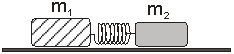
2 m/s ,and m2 shots forward with velocity v2 = 4 m/s .What is the mass of m2? 
Free
(Multiple Choice)
4.7/5  (81)
(81) Correct Answer: Verified
B
A toy car of mass 2.0 kg moving to the right with a speed of 8.0 m/s collides perfectly inelastically with another toy car of mass 3.0 kg that is moving to the left with a speed of 2.0 m/s.Immediately after the collision the velocity of the system is
Free
(Multiple Choice)
4.9/5 (77)
(77) Correct Answer:Verified
VerifiedB
The force exerted on a 10-kg mass is given by  where the units are SI.If the mass starts from rest,its velocity after 2 s is
Free
(Multiple Choice)
4.9/5 (63)
(63) Correct Answer:Verified
VerifiedC
A helium atom (mass = 4m)moving with speed V collides elastically with a tritium (hydrogen 3 )atom (mass = 3m)at rest.Calculate the speed of the tritium atom after the collision.
(Multiple Choice)
4.8/5 (68)
(68) A particle with speed v1 = 2.64 106 m/s makes a glancing elastic collision with another particle that is at rest.Both particles have the same mass.After the collision,the struck particle moves off at 45º to v1.The speed of the struck particle after the collision is approximately
(Multiple Choice)
4.9/5 (73)
(73) Two students,sitting on frictionless carts,push against each other.Both are initially at rest and the mass of student 1 and the cart is M,and that of student 2 and the cart is 1.5M.If student 1 pushes student 2 so that she recoils with velocity  ,what is the change in momentum of the two students?
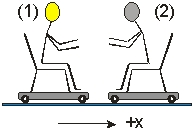
,what is the change in momentum of the two students? (Multiple Choice)
4.8/5 (70)
(70) A railway car having a total mass of 5.8 105 kg,moving with a speed of 9.1 km/h,strikes another car that has a mass of 8.7 105 kg and is initially at rest.The speed of the coupled cars after the collision is
(Multiple Choice)
4.7/5 (80)
(80) Two particles,m1 and m2,each with mass m,is moving with velocity  and
 respectively.The momentum of m1 relative to the center-of-mass is
and respectively.The momentum of m1 relative to the center-of-mass is (Multiple Choice)
4.9/5 (71)
(71) Two particles,each of mass m,are moving with velocity  and
 The kinetic energy at the center-of-mass is
and The kinetic energy at the center-of-mass is (Multiple Choice)
4.8/5 (71)
(71) A bullet is fired at 100 m/s horizontally into a 2-kg block suspended by a light string of length 1.2 m.If the block and bullet system swing up by 20 degrees to the vertical,the mass of the bullet is given by:
(Multiple Choice)
4.9/5 (83)
(83) A projectile with a mass 6M is fired at a speed of 400 m/s at an angle of 60º above the horizontal.At the highest point of its trajectory,the projectile is broken into two equal pieces by an internal explosion.Just after the explosion,one of the two pieces is known to be traveling vertically downward at a speed of 300 m/s.The magnitude of the velocity of the other half of the projectile is
(Multiple Choice)
4.9/5 (77)
(77) A 5.0-kg ball and a 10.0-kg ball approach each other with equal speeds of 20 m/s.If they collide inelastically,the speed of the balls just after the collision is approximately
(Multiple Choice)
4.9/5 (80)
(80) A 20-g bullet with an initial velocity of 3.0 104 cm/s penetrates 6.0 cm into a stationary wall.The average force exerted on the bullet by the wall in bringing it to rest is approximately
(Multiple Choice)
4.8/5 (77)
(77) Use the scenario below for the next question.
You were traveling north at speed vc in your car of mass mc = 2000 kg through an intersection when you were struck by a light truck of mass mt = 4000 kg traveling West. After the collision the two vehicles are stuck together and travel a distance of 20 m in the direction 30° N of W.
-If your speed is 72 km/h,what is the work done by friction in bringing the two vehicles to rest after the collision?
(Multiple Choice)
4.9/5 (76)
(76) A pitcher throws a baseball with a velocity of 27 m/s.After being struck by a bat the ball travels in the opposite direction with a velocity of 40 m/s.If the ball has a mass of 0.11 kg and is in contact with the bat for 3.0 ms,the average force exerted by the bat on the ball is
(Multiple Choice)
4.9/5 (79)
(79) A force acting on an object is approximated as F = 4 sin (100 t)N from t = 0 to t = 10 ms.Calculate the impulse on the object.
(Multiple Choice)
4.8/5 (82)
(82) A moving particle is stopped by a single head-on collision with a second,stationary particle if the moving particle undergoes
(Multiple Choice)
4.8/5 (76)
(76) For this question,assume that all velocities are horizontal and that there is no friction.Two skaters A and B are on an ice surface.A and B have the same mass M = 90.5 kg.A throws a ball with mass m = 200 g toward B with a speed v = 21.5 m/s relative to the ice.B catches the ball and throws it back to A with the same speed.After A catches the ball,his speed with respect to the ice is
(Multiple Choice)
4.9/5 (90)
(90) Two billiard balls are traveling to the right with speeds v1 = +0.5 m/s and v2 = +0.3 m/s.If m1 = 2.5m2,calculate the velocity of m1 after it catches up to and impacts m2.The speed of m2 after the collision is +0.55 m/s.
(Multiple Choice)
4.8/5 (73)
(73) A particle of unknown mass has a momentum of 73 kg · m/s.At a time 7.3 s later,the momentum of the particle is 38 kg · m/s.What is the magnitude of the force acting on the particle during the interval,assuming the motion is in a straight line?
(Multiple Choice)
4.8/5 (76)
(76) 
Filters
- Essay(0)
- Multiple Choice(0)
- Short Answer(0)
- True False(0)
- Matching(0)