



 Chat with AI
Exam 8: Systems of Particles and Conservation of Linear Momentum

Exam 1: Systems of Measurement86 Questions
Exam 2: Motion in One Dimension83 Questions
Exam 3: Motion in Two and Three Dimensions60 Questions
Exam 4: Newtons Laws106 Questions
Exam 5: Applications of Newtons Laws73 Questions
Exam 6: Work and Energy60 Questions
Exam 7: Conservation of Energy56 Questions
Exam 8: Systems of Particles and Conservation of Linear Momentum92 Questions
Exam 9: Rotation105 Questions
Exam 10: Conservation of Angular Momentum66 Questions
Exam 11: Gravity84 Questions
Exam 12: Static Equilibrium and Elasticity58 Questions
Exam 13: Fluids77 Questions
Exam 14: Oscillations126 Questions
Exam 15: Wave Motion112 Questions
Exam 16: Superposition and Standing Waves87 Questions
Exam 17: Temperature and the Kinetic Theory of Gases78 Questions
Exam 18: Heat and the First Law of Thermodynamics100 Questions
Exam 19: The Second Law of Thermodynamics59 Questions
Exam 20: Thermal Properties and Processes50 Questions
Exam 21: The Electric Field I: Discrete Charge Distributions55 Questions
Exam 22: The Electric Field Ii: Continuous Charge Distributions64 Questions
Exam 23: Electric Potential87 Questions
Exam 24: Capacitance63 Questions
Exam 25: Electric Current and Direct-Current Circuits107 Questions
Exam 26: The Magnetic Field33 Questions
Exam 27: Sources of the Magnetic Field86 Questions
Exam 28: Magnetic Induction56 Questions
Exam 29: Alternating-Current Circuits106 Questions
Exam 30: Maxwells Equations and Electromagnetic Waves57 Questions
Exam 31: Properties of Light82 Questions
Exam 32: Optical Images106 Questions
Exam 33: Interference and Diffraction91 Questions
Exam 34: Wave Particle Duality and Quantum Physics140 Questions
Exam 35: Applications of the Schrodinger Equation42 Questions
Exam 36: Atoms113 Questions
Exam 37: Molecules39 Questions
Exam 38: Solids and the Theory of Conduction75 Questions
Exam 39: Relativity82 Questions
Exam 40: Nuclear Physics107 Questions
Exam 41: Elementary Particles and the Beginning of the Universe68 Questions
Select questions type


Two masses M and 5M rest on a horizontal frictionless table with a compressed spring of negligible mass between them.When the spring is released,the energy of the spring is shared between the two masses in such a way that
(Multiple Choice)
4.8/5  (92)
(92) An 1810-kg truck traveling eastward at 64.4 km/h collides at an intersection with a 905-kg automobile traveling northward at 96.5 km/h.The vehicles lock together and immediately after the collision are headed in which direction?
(Multiple Choice)
4.9/5 (88)
(88) Instead of a ballistic pendulum we could use a system where the bullet (mass = m)is fired into a block (mass = M)that is coupled to an uncompressed spring (with spring constant k).The speed of the bullet,v,can be found by measuring the maximum distance,d,of compression of the spring.In this situation the initial speed of the bullet is given by:
(Multiple Choice)
4.9/5 (74)
(74) If a body moves in such a way that its linear momentum is constant,then
(Multiple Choice)
4.7/5 (78)
(78) An automatic rifle fires 0.040-kg projectiles at a speed of 800 m/s.If the gunner holding the rifle in her hands can exert an average force of 160 N against the gun,the maximum number of projectiles she can fire in one minute is
(Multiple Choice)
5.0/5 (80)
(80) A Saturn V rocket with an initial mass m0 of 3 106 kg has a payload that accounts for 27% of this mass,a burn rate of 15 103 kg/s,and a thrust Fth of 35 106 N.The final speed of the rocket is
(Multiple Choice)
4.9/5 (77)
(77) You shoot an arrow with a mass of 0.54 kg from a bow.The bow exerts a force of 125 N for 0.65 s.The speed of the arrow as it leaves the bow is
(Multiple Choice)
4.7/5 (75)
(75) A bullet with a mass of 20 g and a speed of 960 m/s strikes a block of wood of mass 4.5 kg resting on a horizontal surface.The bullet gets embedded in the block.The speed of the block immediately after the collision
(Multiple Choice)
4.8/5 (93)
(93) A Saturn V rocket with an initial mass m0 of 3 106 kg has a payload that accounts for 27% of this mass,a burn rate of 15 103 kg/s,and a thrust Fth of 35 106 N.The acceleration at burnout is
(Multiple Choice)
4.7/5 (70)
(70) A helium atom (mass = 4m)moving with speed  collides elastically with a deuterium (hydrogen 2 )atom (mass = 2m)at rest.Calculate the percentage change in the kinetic energy of the helium atom after the collision.
 (Multiple Choice)
4.9/5 (79)
(79) The force exerted on a body of mass 10 kg varies with time according to  where the units are SI.If the velocity of the body was zero at t = 0,its velocity at t = 5 s is
 (Multiple Choice)
4.8/5 (84)
(84) Calculate the impulse by the force,as shown in the figure below. 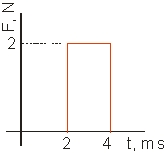
(Multiple Choice)
4.9/5 (81)
(81) A block of wood with a mass M = 4.65 kg is resting on a horizontal surface when a bullet with a mass m = 18 g and moving with a speed v = 725 m/s strikes it.The coefficient of friction between the block and the surface is µ = 0.35.The distance the block moves across the surface is
(Multiple Choice)
4.8/5 (69)
(69) A mass m1 = 2.5 kg is connected to another mass m2 = 4.0 kg by a compressed spring.Both masses are at rest on a frictionless surface.When the spring is released,the masses are pushed apart and a total energy of 16.8 J is given to the two masses.The speed of mass m1 is
(Multiple Choice)
5.0/5 (75)
(75) Two balls of equal mass are thrown against a massive wall with equal velocities.The first rebounds with a speed equal to its striking speed,and the second sticks to the wall.The impulse that the first ball transmits to the wall,relative to the second,is
(Multiple Choice)
4.8/5 (82)
(82) A boy and girl on ice skates face each other.The girl has a mass of 20 kg and the boy has a mass of 30 kg.The boy pushes the girl backward at a speed of 3.0 m/s.As a result of the push,the speed of the boy is
(Multiple Choice)
4.9/5 (78)
(78) For a system consisting of two particles that undergo an elastic collision,
(Multiple Choice)
4.7/5 (75)
(75) Five billiard balls are in contact and at rest on a wire that passes through their centers.Two billiard balls are slammed into one end of the row of five at a velocity  .If the balls are free to slide but not roll and if the collision is elastic,which of the following is most likely to take place?
 (Multiple Choice)
4.7/5 (80)
(80) 
Filters
- Essay(0)
- Multiple Choice(0)
- Short Answer(0)
- True False(0)
- Matching(0)