



 Chat with AI
Exam 23: Electric Potential

Exam 1: Systems of Measurement86 Questions
Exam 2: Motion in One Dimension83 Questions
Exam 3: Motion in Two and Three Dimensions60 Questions
Exam 4: Newtons Laws106 Questions
Exam 5: Applications of Newtons Laws73 Questions
Exam 6: Work and Energy60 Questions
Exam 7: Conservation of Energy56 Questions
Exam 8: Systems of Particles and Conservation of Linear Momentum92 Questions
Exam 9: Rotation105 Questions
Exam 10: Conservation of Angular Momentum66 Questions
Exam 11: Gravity84 Questions
Exam 12: Static Equilibrium and Elasticity58 Questions
Exam 13: Fluids77 Questions
Exam 14: Oscillations126 Questions
Exam 15: Wave Motion112 Questions
Exam 16: Superposition and Standing Waves87 Questions
Exam 17: Temperature and the Kinetic Theory of Gases78 Questions
Exam 18: Heat and the First Law of Thermodynamics100 Questions
Exam 19: The Second Law of Thermodynamics59 Questions
Exam 20: Thermal Properties and Processes50 Questions
Exam 21: The Electric Field I: Discrete Charge Distributions55 Questions
Exam 22: The Electric Field Ii: Continuous Charge Distributions64 Questions
Exam 23: Electric Potential87 Questions
Exam 24: Capacitance63 Questions
Exam 25: Electric Current and Direct-Current Circuits107 Questions
Exam 26: The Magnetic Field33 Questions
Exam 27: Sources of the Magnetic Field86 Questions
Exam 28: Magnetic Induction56 Questions
Exam 29: Alternating-Current Circuits106 Questions
Exam 30: Maxwells Equations and Electromagnetic Waves57 Questions
Exam 31: Properties of Light82 Questions
Exam 32: Optical Images106 Questions
Exam 33: Interference and Diffraction91 Questions
Exam 34: Wave Particle Duality and Quantum Physics140 Questions
Exam 35: Applications of the Schrodinger Equation42 Questions
Exam 36: Atoms113 Questions
Exam 37: Molecules39 Questions
Exam 38: Solids and the Theory of Conduction75 Questions
Exam 39: Relativity82 Questions
Exam 40: Nuclear Physics107 Questions
Exam 41: Elementary Particles and the Beginning of the Universe68 Questions
Select questions type


Two charges Q1 (= +6 C)and Q2 (= -2 C)are brought from infinity to positions on the x-axis of x = -4 cm and x = +4 cm,respectively.How much work was done in bringing the charges together?
(Multiple Choice)
4.7/5  (76)
(76) Use the following figure to answer the next problem. 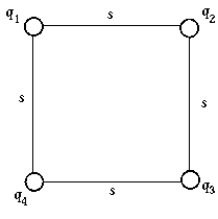 -Four point charges q1 = -1 C,q2 = 2 C,q3 = 3 C,and q4 = 4 C are located at the corners of a square whose side s = 1 m.The electrostatic potential energy of this system of charges is
 (Multiple Choice)
4.9/5 (80)
(80) Use the following to answer the next question: 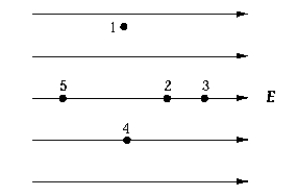 -Which point in the electric field in the diagram is at the lowest potential?
 (Multiple Choice)
4.9/5 (79)
(79) What is the approximate radius of an equipotential spherical surface of 100 V about a point charge of +45 nC if the potential at an infinite distance from the surface is zero?
(Multiple Choice)
4.9/5 (69)
(69) A solid conducting sphere of radius ra is placed concentrically inside a conducting spherical shell of inner radius rb1 and outer radius rb2.The inner sphere carries a charge Q while the outer sphere does not carry any net charge.The potential for rb1 r rb2 is
(Multiple Choice)
4.8/5 (77)
(77) Use the following figure to answer the next problem: 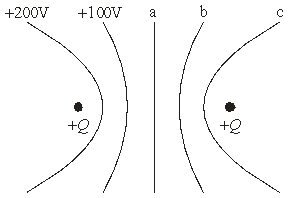 Two equal positive charges are placed x m apart.The equipotential lines are at 100 V interval.
-The potential for line c is
Two equal positive charges are placed x m apart.The equipotential lines are at 100 V interval.
-The potential for line c is (Multiple Choice)
4.7/5 (80)
(80) The potential on the surface of a solid conducting sphere of radius r = 20 cm is 100 V.The potential at r = 10 cm is
(Multiple Choice)
4.8/5 (83)
(83) Use the following figure to answer the next problem: 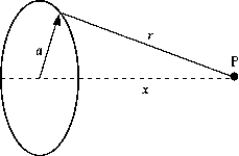 -A ring of radius 5 cm is the yz plane with its center at the origin.The ring carries a uniform charge of 10 nC.A small particle of mass m = 10 mg and charge q0 = 5 nC is placed at x = 12 cm and released.The speed of the particle when it is a great distance from the ring is
 (Multiple Choice)
4.9/5 (87)
(87) Use the following figure to answer the next problem: 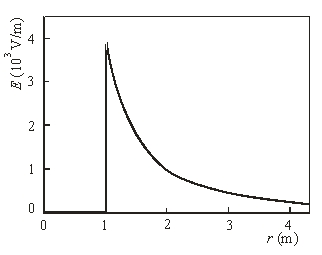 The electric field versus distance for a charge is plotted above.Use the reference point
 -The potential for r < 1 m is
The electric field versus distance for a charge is plotted above.Use the reference point
-The potential for r < 1 m is (Multiple Choice)
4.9/5 (77)
(77) Use the following figure to answer the next problem. 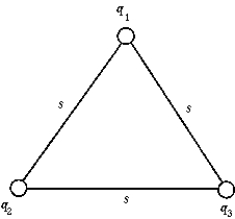 -The electrostatic potential energy of the system of point charges q1 = 1 µC,q2 = 2 µC,and q3 = 3 µC at the corners of the equilateral triangle whose side s = 30 cm is
 (Multiple Choice)
4.9/5 (81)
(81) The metal sphere at the top of a small Van de Graaf generator has a radius of 10 cm.How much charge can be accumulated on this sphere before dielectric breakdown of the air around it occurs? (The dielectric strength of air is 3.0 MV/m.)
(Multiple Choice)
4.9/5 (103)
(103) Use the following figure to answer the next problem: 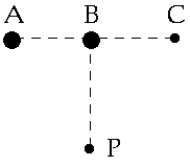 -ABC is a straight line with AB = BC = 0.60 nm.BP is perpendicular to ABC and BP = 0.80 nm.Charges of +3.2 × 10⁻¹⁹ C are placed at A and C,and a charge of -3.2 × 10⁻¹⁹ C is placed at B.The electric potential at P is
 (Multiple Choice)
4.8/5 (81)
(81) Use the following figure to answer the next problem: Two equal positive charges are placed x m apart.The equipotential lines are at 100 V interval.
-The electrical potential 2.5 cm from a point charge of Q1 = +4.5 10-9 C and 2.0 cm from a second charge Q2 is 3.2 kV.Find Q2.
Two equal positive charges are placed x m apart.The equipotential lines are at 100 V interval.
-The electrical potential 2.5 cm from a point charge of Q1 = +4.5 10-9 C and 2.0 cm from a second charge Q2 is 3.2 kV.Find Q2. (Multiple Choice)
4.9/5 (82)
(82) Use the following figure to answer the next problem.
-The electrostatic potential energy of the system of point charges q1 = 1 µC,q2 = -2 µC,and q3 = 3 µC at the corners of the equilateral triangle whose side s = 40 cm is
-The electrostatic potential energy of the system of point charges q1 = 1 µC,q2 = -2 µC,and q3 = 3 µC at the corners of the equilateral triangle whose side s = 40 cm is (Multiple Choice)
4.9/5 (88)
(88) Use the following to answer the next question:
-Which of the points shown in the diagram are at the same potential?
-Which of the points shown in the diagram are at the same potential? (Multiple Choice)
4.8/5 (73)
(73) When a small,positively charged metal ball comes in contact with the interior of a positively charged metal shell,
(Multiple Choice)
4.8/5 (81)
(81) A uniform electric field exists between two parallel plates separated by 1.2 cm.The intensity of the field is 23 kN/C.What is the potential difference between the plates?
(Multiple Choice)
4.7/5 (91)
(91) Use the following to answer the next question. 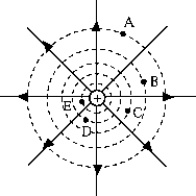 -The work required to bring a negatively charged body from very far is greatest for point _____.
 (Multiple Choice)
4.8/5 (73)
(73) A charge of 2.0 mC is located in a uniform electric field of intensity 4.0 × 10⁵ N/C.How much work is required to move this charge 20 cm along a path making an angle of 60° with the electric field?
(Multiple Choice)
4.9/5 (93)
(93) 
Filters
- Essay(0)
- Multiple Choice(0)
- Short Answer(0)
- True False(0)
- Matching(0)