



 Chat with AI
Exam 13: Fiscal Policy

Exam 1: The Nature of Economics348 Questions
Exam 2: Scarcity and the World of Trade-Offs411 Questions
Exam 3: Demand and Supply451 Questions
Exam 4: Extensions of Demand and Supply Analysis401 Questions
Exam 5: Public Spending and Public Choice362 Questions
Exam 6: Funding the Public Sector201 Questions
Exam 7: The Macroeconomy: Unemployment, Inflation, and Deflation413 Questions
Exam 8: Measuring the Economys Performance416 Questions
Exam 9: Global Economic Growth and Development290 Questions
Exam 10: Real GDP and the Price Level in the Long Run298 Questions
Exam 11: Classical and Keynesian Macro Analyses368 Questions
Exam 12: Consumption, Real GDP, and the Multiplier452 Questions
Exam 13: Fiscal Policy274 Questions
Exam 14: Deficit Spending and the Public Debt146 Questions
Exam 15: Money, Banking, and Central Banking516 Questions
Exam 16: Domestic and International Dimensions of Monetary Policy357 Questions
Exam 17: Stabilization in an Integrated World Economy321 Questions
Exam 18: Policies and Prospects for Global Economic Growth228 Questions
Exam 19: Demand and Supply Elasticity412 Questions
Exam 20: Consumer Choice459 Questions
Exam 21: Rents, Profits, and the Financial Environment of Business445 Questions
Exam 22: The Firm: Cost and Output Determination391 Questions
Exam 23: Perfect Competition432 Questions
Exam 24: Monopoly386 Questions
Exam 25: Monopolistic Competition307 Questions
Exam 26: Oligopoly and Strategic Behavior308 Questions
Exam 27: Regulation and Antitrust Policy in a Globalized Economy310 Questions
Exam 28: The Labor Market: Demand, Supply and Outsourcing376 Questions
Exam 29: Unions and Labor Market Monopoly Power319 Questions
Exam 30: Income, Poverty, and Health Care304 Questions
Exam 31: Environmental Economics299 Questions
Exam 32: Comparative Advantage and the Open Economy282 Questions
Exam 33: Exchange Rates and the Balance of Payments285 Questions
Select questions type


How might fiscal policy be used to correct a recessionary gap?
(Multiple Choice)
4.9/5  (78)
(78) Government spending conducted for the purpose of achieving full employment or price stability is an example of
(Multiple Choice)
4.7/5 (76)
(76) Suppose there currently is an inflationary gap. What could the government do to bring the overall price level down?
(Multiple Choice)
4.9/5 (89)
(89) Expansionary fiscal policy fails to achieve the government's national economic goals. Some economists claim it is due to indirect crowding out. What evidence would be consistent with this claim?
(Multiple Choice)
5.0/5 (89)
(89) The traditional Keynesian approach to fiscal policy assumes
(Multiple Choice)
4.9/5 (74)
(74) When a direct expenditure offset occurs with the implementation of an expansionary fiscal policy,
(Multiple Choice)
4.8/5 (69)
(69) Keynes believed that the way to prevent recessions and depressions was to
(Multiple Choice)
4.8/5 (76)
(76)  -Refer to the above figure. If the relevant aggregate demand curve was AD2, the government could do all of the following to close the existing gap EXCEPT
 (Multiple Choice)
4.8/5 (82)
(82) 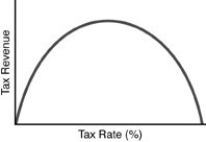 -Consider the above figure. This curve suggests that as the government continues to raise the tax rate, the revenues that are collected will eventually
 (Multiple Choice)
4.8/5 (84)
(84) Fiscal policy may end up being destabilizing to an economy because
(Multiple Choice)
4.8/5 (90)
(90) Suppose the economy has a low level of employment. This would imply
(Multiple Choice)
4.7/5 (97)
(97) 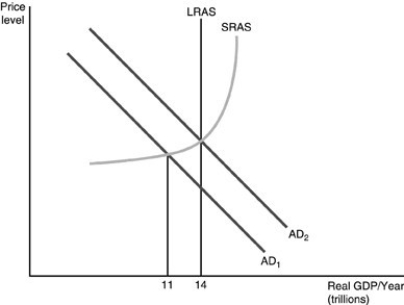 -Refer to the above figure. The government has just engaged in expansionary fiscal policy shifting the aggregate demand curve from AD1 to AD2. Interest rates have started to rise. Which of the following statements is TRUE in the short run?
 (Multiple Choice)
5.0/5 (76)
(76) The traditional Keynesian approach concludes that an increase in government spending
(Multiple Choice)
4.9/5 (81)
(81) Many government programs, such as unemployment compensation, operate on a deficit during recessions and a surplus during periods of economic expansion. The programs are referred to as
(Multiple Choice)
4.9/5 (76)
(76) The amount of time that it takes to identify a national economic problem is
(Multiple Choice)
4.8/5 (81)
(81) Which of the following conditions describes an inflationary gap?
(Multiple Choice)
4.8/5 (79)
(79) When the government deliberately alters its level of spending and/or taxes in order to achieve specific national economic goals, it is exercising
(Multiple Choice)
4.8/5 (90)
(90) 
Filters
- Essay(0)
- Multiple Choice(0)
- Short Answer(0)
- True False(0)
- Matching(0)