



 Chat with AI
Exam 13: Fiscal Policy

Exam 1: The Nature of Economics348 Questions
Exam 2: Scarcity and the World of Trade-Offs411 Questions
Exam 3: Demand and Supply451 Questions
Exam 4: Extensions of Demand and Supply Analysis401 Questions
Exam 5: Public Spending and Public Choice362 Questions
Exam 6: Funding the Public Sector201 Questions
Exam 7: The Macroeconomy: Unemployment, Inflation, and Deflation413 Questions
Exam 8: Measuring the Economys Performance416 Questions
Exam 9: Global Economic Growth and Development290 Questions
Exam 10: Real GDP and the Price Level in the Long Run298 Questions
Exam 11: Classical and Keynesian Macro Analyses368 Questions
Exam 12: Consumption, Real GDP, and the Multiplier452 Questions
Exam 13: Fiscal Policy274 Questions
Exam 14: Deficit Spending and the Public Debt146 Questions
Exam 15: Money, Banking, and Central Banking516 Questions
Exam 16: Domestic and International Dimensions of Monetary Policy357 Questions
Exam 17: Stabilization in an Integrated World Economy321 Questions
Exam 18: Policies and Prospects for Global Economic Growth228 Questions
Exam 19: Demand and Supply Elasticity412 Questions
Exam 20: Consumer Choice459 Questions
Exam 21: Rents, Profits, and the Financial Environment of Business445 Questions
Exam 22: The Firm: Cost and Output Determination391 Questions
Exam 23: Perfect Competition432 Questions
Exam 24: Monopoly386 Questions
Exam 25: Monopolistic Competition307 Questions
Exam 26: Oligopoly and Strategic Behavior308 Questions
Exam 27: Regulation and Antitrust Policy in a Globalized Economy310 Questions
Exam 28: The Labor Market: Demand, Supply and Outsourcing376 Questions
Exam 29: Unions and Labor Market Monopoly Power319 Questions
Exam 30: Income, Poverty, and Health Care304 Questions
Exam 31: Environmental Economics299 Questions
Exam 32: Comparative Advantage and the Open Economy282 Questions
Exam 33: Exchange Rates and the Balance of Payments285 Questions
Select questions type


An advantage of automatic stabilizers over discretionary fiscal policy is that
(Multiple Choice)
4.9/5  (72)
(72) If the government increases its spending but does NOT raise taxes
(Multiple Choice)
4.9/5 (69)
(69) Supply-side economists argue that changes in tax rates cause changes in
(Multiple Choice)
4.9/5 (87)
(87) What are the various time lags that affect discretionary fiscal policy, and what are their effects?
(Essay)
4.8/5 (73)
(73) According to supply-side economics, changes in marginal tax rates will have which of the following effects?
(Multiple Choice)
4.7/5 (74)
(74) Other factors being constant, what happens when the federal government finances a growing budget deficit by increasing the amount it borrows from the private sector?
(Multiple Choice)
4.9/5 (73)
(73) A direct expenditure offset occurs when an increase in government spending
(Multiple Choice)
4.8/5 (82)
(82) The idea that creating incentives for individuals and firms to increase productivity leading to an increase in long-run aggregate supply is
(Multiple Choice)
4.9/5 (79)
(79) Which of the following is an example of an automatic stabilizer?
(Multiple Choice)
4.8/5 (85)
(85) How might fiscal policy be used to correct an inflationary gap?
(Multiple Choice)
4.9/5 (87)
(87) Suppose the government believes the economy is operating beyond the full-employment real GDP. What kind of fiscal policy could it pursue?
(Essay)
4.9/5 (78)
(78) When data on the economy requires some time to gather and interpret, there is
(Multiple Choice)
4.8/5 (76)
(76) Explain how indirect crowding out can offset expansionary fiscal policy.
(Essay)
4.7/5 (71)
(71) What are the automatic stabilizers the United States has in place, and how do they function differently from discretionary fiscal policy?
(Essay)
4.8/5 (76)
(76) 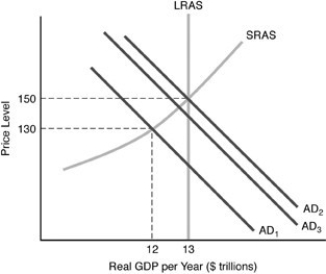 -Refer to the above figure. Suppose that the economy starts at AD1. If the government reduces taxes, then the economy goes to AD2, but then falls back to AD3. This is an example of
 (Multiple Choice)
4.8/5 (86)
(86) 
Filters
- Essay(0)
- Multiple Choice(0)
- Short Answer(0)
- True False(0)
- Matching(0)