



 Chat with AI
Exam 13: Fiscal Policy

Exam 1: The Nature of Economics348 Questions
Exam 2: Scarcity and the World of Trade-Offs411 Questions
Exam 3: Demand and Supply451 Questions
Exam 4: Extensions of Demand and Supply Analysis401 Questions
Exam 5: Public Spending and Public Choice362 Questions
Exam 6: Funding the Public Sector201 Questions
Exam 7: The Macroeconomy: Unemployment, Inflation, and Deflation413 Questions
Exam 8: Measuring the Economys Performance416 Questions
Exam 9: Global Economic Growth and Development290 Questions
Exam 10: Real GDP and the Price Level in the Long Run298 Questions
Exam 11: Classical and Keynesian Macro Analyses368 Questions
Exam 12: Consumption, Real GDP, and the Multiplier452 Questions
Exam 13: Fiscal Policy274 Questions
Exam 14: Deficit Spending and the Public Debt146 Questions
Exam 15: Money, Banking, and Central Banking516 Questions
Exam 16: Domestic and International Dimensions of Monetary Policy357 Questions
Exam 17: Stabilization in an Integrated World Economy321 Questions
Exam 18: Policies and Prospects for Global Economic Growth228 Questions
Exam 19: Demand and Supply Elasticity412 Questions
Exam 20: Consumer Choice459 Questions
Exam 21: Rents, Profits, and the Financial Environment of Business445 Questions
Exam 22: The Firm: Cost and Output Determination391 Questions
Exam 23: Perfect Competition432 Questions
Exam 24: Monopoly386 Questions
Exam 25: Monopolistic Competition307 Questions
Exam 26: Oligopoly and Strategic Behavior308 Questions
Exam 27: Regulation and Antitrust Policy in a Globalized Economy310 Questions
Exam 28: The Labor Market: Demand, Supply and Outsourcing376 Questions
Exam 29: Unions and Labor Market Monopoly Power319 Questions
Exam 30: Income, Poverty, and Health Care304 Questions
Exam 31: Environmental Economics299 Questions
Exam 32: Comparative Advantage and the Open Economy282 Questions
Exam 33: Exchange Rates and the Balance of Payments285 Questions
Select questions type


The idea that a tax reduction funded by government borrowing has no effect on aggregate demand is known as
(Multiple Choice)
4.8/5  (69)
(69) 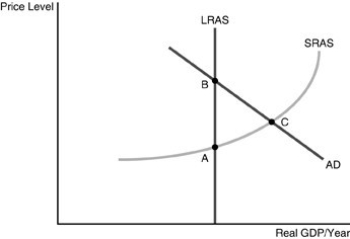 -Refer to the above figure. If the economy is currently operating at point C, then there is
 (Multiple Choice)
4.8/5 (76)
(76) If the government increases spending while holding taxes constant, we expect
(Multiple Choice)
4.8/5 (91)
(91) When fiscal policy is used, time lags are variable and last anywhere from
(Multiple Choice)
4.7/5 (75)
(75) The permanent income hypothesis implies that the effect of a temporary tax cut on economic activity
(Multiple Choice)
4.8/5 (85)
(85) The crowding out effect of expansionary fiscal policy refers to which of the following?
(Multiple Choice)
5.0/5 (67)
(67) Which of the following are time lags that fiscal policy makers must cope with?
(Multiple Choice)
4.9/5 (83)
(83) Fiscal policy to solve short-run economic problems supports the Keynesian notion of
(Multiple Choice)
4.7/5 (101)
(101) According to the permanent income hypothesis, taxpayers react to a one-time tax rebate
(Multiple Choice)
4.8/5 (85)
(85) Suppose there are two economies that are identical in every way with the following exception. Economy A has an unemployment compensation system while economy B does NOT have an unemployment compensation system. Now suppose both economies experience the same drop in planned investment. Which of the following is correct?
(Multiple Choice)
4.8/5 (78)
(78) Suppose the current level of real GDP is below the full-employment level of real GDP. Which of the following represents a fiscal policy action that could be implemented to reduce the size of this recessionary gap?
(Multiple Choice)
4.8/5 (78)
(78) An increase in government spending without any increase in taxes
(Multiple Choice)
4.7/5 (97)
(97) In the traditional Keynesian model, if the government raises current taxes
(Multiple Choice)
4.8/5 (82)
(82) The time required to collect information about the current state of the economy is known as
(Multiple Choice)
4.8/5 (90)
(90) 
Filters
- Essay(0)
- Multiple Choice(0)
- Short Answer(0)
- True False(0)
- Matching(0)