



 Chat with AI
Exam 13: Fiscal Policy

Exam 1: The Nature of Economics348 Questions
Exam 2: Scarcity and the World of Trade-Offs411 Questions
Exam 3: Demand and Supply451 Questions
Exam 4: Extensions of Demand and Supply Analysis401 Questions
Exam 5: Public Spending and Public Choice362 Questions
Exam 6: Funding the Public Sector201 Questions
Exam 7: The Macroeconomy: Unemployment, Inflation, and Deflation413 Questions
Exam 8: Measuring the Economys Performance416 Questions
Exam 9: Global Economic Growth and Development290 Questions
Exam 10: Real GDP and the Price Level in the Long Run298 Questions
Exam 11: Classical and Keynesian Macro Analyses368 Questions
Exam 12: Consumption, Real GDP, and the Multiplier452 Questions
Exam 13: Fiscal Policy274 Questions
Exam 14: Deficit Spending and the Public Debt146 Questions
Exam 15: Money, Banking, and Central Banking516 Questions
Exam 16: Domestic and International Dimensions of Monetary Policy357 Questions
Exam 17: Stabilization in an Integrated World Economy321 Questions
Exam 18: Policies and Prospects for Global Economic Growth228 Questions
Exam 19: Demand and Supply Elasticity412 Questions
Exam 20: Consumer Choice459 Questions
Exam 21: Rents, Profits, and the Financial Environment of Business445 Questions
Exam 22: The Firm: Cost and Output Determination391 Questions
Exam 23: Perfect Competition432 Questions
Exam 24: Monopoly386 Questions
Exam 25: Monopolistic Competition307 Questions
Exam 26: Oligopoly and Strategic Behavior308 Questions
Exam 27: Regulation and Antitrust Policy in a Globalized Economy310 Questions
Exam 28: The Labor Market: Demand, Supply and Outsourcing376 Questions
Exam 29: Unions and Labor Market Monopoly Power319 Questions
Exam 30: Income, Poverty, and Health Care304 Questions
Exam 31: Environmental Economics299 Questions
Exam 32: Comparative Advantage and the Open Economy282 Questions
Exam 33: Exchange Rates and the Balance of Payments285 Questions
Select questions type


In the traditional Keynesian model, if the government raises taxes, then
(Multiple Choice)
4.9/5  (75)
(75) 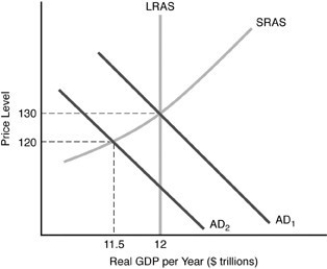 -Refer to the above figure. Suppose the relevant aggregate demand curve is AD2. If the government wants to use discretionary fiscal policy to close the existing gap, it should
 (Multiple Choice)
4.7/5 (80)
(80) Using graphs, explain how indirect crowding out can occur when the government increases spending in an attempt to stimulate the economy.
(Essay)
4.9/5 (70)
(70) According to supply-side economics, lower tax rates on wages
(Multiple Choice)
4.8/5 (80)
(80) According to the Ricardian equivalence theorem, a tax cut that increases the government budget deficit will have
(Multiple Choice)
4.9/5 (93)
(93) Suppose the government pursues expansionary fiscal policy by lowering taxes. What are the expected demand-side effects? What are the possible offsets to the demand-side effect? How might supply-side effects change these results?
(Essay)
4.8/5 (78)
(78) What does research tell us about the impact of Ricardian equivalence effects on the economy?
(Multiple Choice)
5.0/5 (78)
(78) The traditional Keynesian approach to fiscal policy assumes that
(Multiple Choice)
4.8/5 (75)
(75) If an increase in government spending causes an increase in government borrowing, this could induce
(Multiple Choice)
4.8/5 (81)
(81) Suppose policy makers pass a budget that results in a reduction in government spending and no change in taxes. This reduction in government spending will likely
(Multiple Choice)
4.8/5 (90)
(90) If the government began providing free textbooks to college students who would otherwise have bought their books from the private sector, the government's action would result in
(Multiple Choice)
4.8/5 (72)
(72) In the traditional Keynesian model, a cut in current taxes
(Multiple Choice)
4.9/5 (70)
(70) Government-provided unemployment insurance is an example of
(Multiple Choice)
4.7/5 (86)
(86) 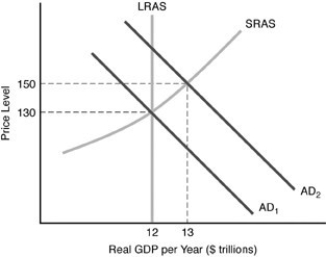 -Refer to the above figure. If the current level of real GDP is $13 trillion, then the economy is experiencing
 (Multiple Choice)
4.9/5 (81)
(81) When real Gross Domestic Product (GDP) falls, which of the following will automatically occur?
(Multiple Choice)
4.7/5 (72)
(72) The Keynesian perspective on the effect of an increase in taxes is that this policy action
(Multiple Choice)
4.9/5 (67)
(67) 
Filters
- Essay(0)
- Multiple Choice(0)
- Short Answer(0)
- True False(0)
- Matching(0)