



 Chat with AI
Exam 20: Consumer Choice

Exam 1: The Nature of Economics348 Questions
Exam 2: Scarcity and the World of Trade-Offs411 Questions
Exam 3: Demand and Supply451 Questions
Exam 4: Extensions of Demand and Supply Analysis401 Questions
Exam 5: Public Spending and Public Choice362 Questions
Exam 6: Funding the Public Sector201 Questions
Exam 7: The Macroeconomy: Unemployment, Inflation, and Deflation413 Questions
Exam 8: Measuring the Economys Performance416 Questions
Exam 9: Global Economic Growth and Development290 Questions
Exam 10: Real GDP and the Price Level in the Long Run298 Questions
Exam 11: Classical and Keynesian Macro Analyses368 Questions
Exam 12: Consumption, Real GDP, and the Multiplier452 Questions
Exam 13: Fiscal Policy274 Questions
Exam 14: Deficit Spending and the Public Debt146 Questions
Exam 15: Money, Banking, and Central Banking516 Questions
Exam 16: Domestic and International Dimensions of Monetary Policy357 Questions
Exam 17: Stabilization in an Integrated World Economy321 Questions
Exam 18: Policies and Prospects for Global Economic Growth228 Questions
Exam 19: Demand and Supply Elasticity412 Questions
Exam 20: Consumer Choice459 Questions
Exam 21: Rents, Profits, and the Financial Environment of Business445 Questions
Exam 22: The Firm: Cost and Output Determination391 Questions
Exam 23: Perfect Competition432 Questions
Exam 24: Monopoly386 Questions
Exam 25: Monopolistic Competition307 Questions
Exam 26: Oligopoly and Strategic Behavior308 Questions
Exam 27: Regulation and Antitrust Policy in a Globalized Economy310 Questions
Exam 28: The Labor Market: Demand, Supply and Outsourcing376 Questions
Exam 29: Unions and Labor Market Monopoly Power319 Questions
Exam 30: Income, Poverty, and Health Care304 Questions
Exam 31: Environmental Economics299 Questions
Exam 32: Comparative Advantage and the Open Economy282 Questions
Exam 33: Exchange Rates and the Balance of Payments285 Questions
Select questions type


Suppose that an individual consumes only two goods. What will happen to the individual if her last dollar spent on one good yields more marginal utility than that from another good?
(Essay)
4.9/5  (73)
(73) Initially, a consumer is at an optimum. Then the price of Y increases. Consequently
(Multiple Choice)
4.9/5 (79)
(79) Other things being equal, when the money price of a good increases, its relative price
(Multiple Choice)
5.0/5 (87)
(87) 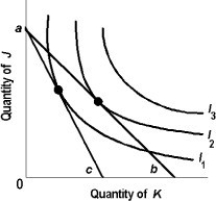 -Use the above figure. When the budget line rotates from "b" to "c"
 (Multiple Choice)
4.9/5 (76)
(76) Basket of goods A is on an indifference curve that lies further from the origin than basket B. From this we know that
(Multiple Choice)
4.9/5 (73)
(73) Carol is very hungry. She has just sat down to eat. Her first bite gives her a certain level of utility. Her second bite increases her utility by more than the first bite. Her third bite increases her utility by more than the second bite. Carol has 40 bites left before she finishes. Which of the following statements is TRUE about Carol?
(Multiple Choice)
4.9/5 (61)
(61) 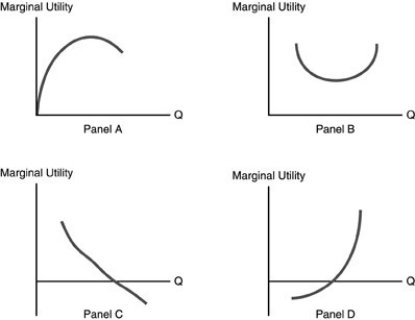 -Refer to the above figures. Which panel best represents marginal utility?
 (Multiple Choice)
4.9/5 (77)
(77) 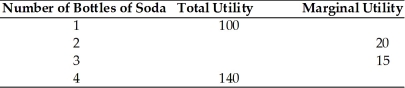 -Using the above table, what is the total utility of consuming 3 bottles of soda?
 (Multiple Choice)
4.8/5 (71)
(71) Maria buys a cup of coffee every day after her economics class. The first cup of coffee always tastes wonderful. The second does not taste quite as good as the first. The third does not taste quite as good as the second. Maria is experiencing
(Multiple Choice)
4.8/5 (99)
(99) Given the price of a good or service, what determines how much a person is willing to pay for that good or service?
(Multiple Choice)
4.9/5 (90)
(90) If the price of tea rises relative to all other prices, consumers are likely to
(Multiple Choice)
4.7/5 (85)
(85) On a hot summer day, a construction worker enters a McDonald's fast-food restaurant. He orders the first Big Mac. He consumes it within 3 minutes. He then orders a second Big Mac and consumes it in 10 minutes. He eats only half of the third one in 18 minutes and throws away the rest. The store manager offers him the fourth for free. The construction worker says: "No thanks." Why?
(Multiple Choice)
4.9/5 (78)
(78) The tendency of people to substitute cheaper commodities for more expensive commodities is the
(Multiple Choice)
4.7/5 (88)
(88) 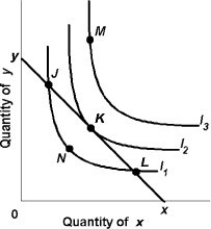 -Use the above figure. What does point N represent?
Suppose that a consumer is at an optimum consuming A and B. If the price of A falls, then to get to a new equilibrium the consumer must
(Multiple Choice)
4.9/5 (76)
(76) With a given level of money income, when the price of a product that a consumer buys declines, the purchasing power of your money income
(Multiple Choice)
4.9/5 (70)
(70) 
Filters
- Essay(0)
- Multiple Choice(0)
- Short Answer(0)
- True False(0)
- Matching(0)