



 Chat with AI
Exam 20: Consumer Choice

Exam 1: The Nature of Economics348 Questions
Exam 2: Scarcity and the World of Trade-Offs411 Questions
Exam 3: Demand and Supply451 Questions
Exam 4: Extensions of Demand and Supply Analysis401 Questions
Exam 5: Public Spending and Public Choice362 Questions
Exam 6: Funding the Public Sector201 Questions
Exam 7: The Macroeconomy: Unemployment, Inflation, and Deflation413 Questions
Exam 8: Measuring the Economys Performance416 Questions
Exam 9: Global Economic Growth and Development290 Questions
Exam 10: Real GDP and the Price Level in the Long Run298 Questions
Exam 11: Classical and Keynesian Macro Analyses368 Questions
Exam 12: Consumption, Real GDP, and the Multiplier452 Questions
Exam 13: Fiscal Policy274 Questions
Exam 14: Deficit Spending and the Public Debt146 Questions
Exam 15: Money, Banking, and Central Banking516 Questions
Exam 16: Domestic and International Dimensions of Monetary Policy357 Questions
Exam 17: Stabilization in an Integrated World Economy321 Questions
Exam 18: Policies and Prospects for Global Economic Growth228 Questions
Exam 19: Demand and Supply Elasticity412 Questions
Exam 20: Consumer Choice459 Questions
Exam 21: Rents, Profits, and the Financial Environment of Business445 Questions
Exam 22: The Firm: Cost and Output Determination391 Questions
Exam 23: Perfect Competition432 Questions
Exam 24: Monopoly386 Questions
Exam 25: Monopolistic Competition307 Questions
Exam 26: Oligopoly and Strategic Behavior308 Questions
Exam 27: Regulation and Antitrust Policy in a Globalized Economy310 Questions
Exam 28: The Labor Market: Demand, Supply and Outsourcing376 Questions
Exam 29: Unions and Labor Market Monopoly Power319 Questions
Exam 30: Income, Poverty, and Health Care304 Questions
Exam 31: Environmental Economics299 Questions
Exam 32: Comparative Advantage and the Open Economy282 Questions
Exam 33: Exchange Rates and the Balance of Payments285 Questions
Select questions type


In the above figure, budget line DF would swivel in to the left if
(Multiple Choice)
4.9/5  (73)
(73) For any two goods, A and B, if MUA divided by PA equals 2.5 and MUB divided by PB equals 4.0, then with given income and prices the consumer should
(Multiple Choice)
4.9/5 (77)
(77) 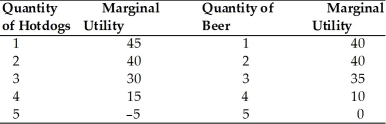 -In the above table, how many hotdogs and beers will Carl consume if the price of one hotdog is $2.00 and the price of a beer is $2.00?
 (Multiple Choice)
4.8/5 (72)
(72) If the quantity of hamburgers is measured along the horizontal axis and the quantity of movies is measured along the vertical axis, an increase in the price of a movie would be shown by
(Multiple Choice)
4.9/5 (78)
(78) 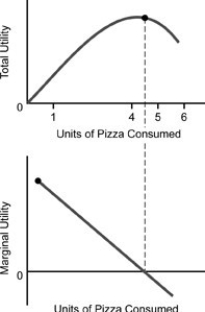 -Given the above figure, when David eats a third piece of pizza his marginal utility is ________ and his total utility is ________.
 (Multiple Choice)
4.9/5 (71)
(71)  -According to the above table, Bill's marginal utility from watching the 9th movie is
 (Multiple Choice)
4.8/5 (96)
(96) The real-income effect of a price change is most significant when
(Multiple Choice)
4.8/5 (82)
(82) 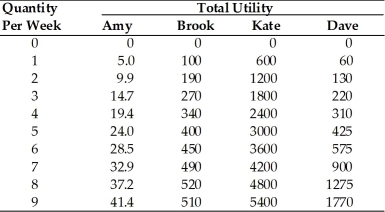 -Refer to the above table. Dave's utility schedule is characterized by
 (Multiple Choice)
4.8/5 (74)
(74) When marginal utility is decreasing but still positive, then total utility is
(Multiple Choice)
4.8/5 (78)
(78) Assuming that the marginal utility of the first four pieces of candy was 30, 28, 22, and 20 respectively, how much total utility was derived from eating the first three pieces of candy?
(Multiple Choice)
4.8/5 (71)
(71) 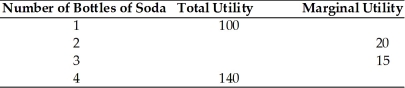 -Using the above table, what is the total utility of consuming 2 bottles of soda?
 (Multiple Choice)
4.7/5 (75)
(75) John is going to spend all of his income. For the last unit of Good X consumed John gets 20 utils and for the last unit of Good Y consumed he gets 10 utils. The price of Good X is $1. The price of Good Y is $10. If John wants to maximize his utility he should
(Multiple Choice)
4.8/5 (85)
(85) The marginal utility of good X is 6 and the marginal utility of good Y is 18. The price of good X is $2. The price of good Y must be ________ if the consumer is optimizing her utility.
(Multiple Choice)
4.8/5 (76)
(76) Along a given indifference curve, a consumer reduces the quantity of one good in favor of more units of the other. In this situation
(Multiple Choice)
4.8/5 (86)
(86) 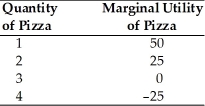 -Using the above table, what is the total utility of the first piece of pizza?
 (Multiple Choice)
4.8/5 (67)
(67) Suppose that the quantity of hamburgers is measured along the vertical axis and that the number of bags of popcorn is measured along the horizontal axis. The budget constraint has a vertical intercept of 10 hamburgers, and the slope of the line is -1. If the price of popcorn doubles, we know that
(Multiple Choice)
4.8/5 (66)
(66)
-Using the above table, what is the total utility of the third piece of pizza?
-Using the above table, what is the total utility of the third piece of pizza? (Multiple Choice)
4.9/5 (75)
(75) 
Filters
- Essay(0)
- Multiple Choice(0)
- Short Answer(0)
- True False(0)
- Matching(0)