



 Chat with AI
Exam 20: Consumer Choice

Exam 1: The Nature of Economics348 Questions
Exam 2: Scarcity and the World of Trade-Offs411 Questions
Exam 3: Demand and Supply451 Questions
Exam 4: Extensions of Demand and Supply Analysis401 Questions
Exam 5: Public Spending and Public Choice362 Questions
Exam 6: Funding the Public Sector201 Questions
Exam 7: The Macroeconomy: Unemployment, Inflation, and Deflation413 Questions
Exam 8: Measuring the Economys Performance416 Questions
Exam 9: Global Economic Growth and Development290 Questions
Exam 10: Real GDP and the Price Level in the Long Run298 Questions
Exam 11: Classical and Keynesian Macro Analyses368 Questions
Exam 12: Consumption, Real GDP, and the Multiplier452 Questions
Exam 13: Fiscal Policy274 Questions
Exam 14: Deficit Spending and the Public Debt146 Questions
Exam 15: Money, Banking, and Central Banking516 Questions
Exam 16: Domestic and International Dimensions of Monetary Policy357 Questions
Exam 17: Stabilization in an Integrated World Economy321 Questions
Exam 18: Policies and Prospects for Global Economic Growth228 Questions
Exam 19: Demand and Supply Elasticity412 Questions
Exam 20: Consumer Choice459 Questions
Exam 21: Rents, Profits, and the Financial Environment of Business445 Questions
Exam 22: The Firm: Cost and Output Determination391 Questions
Exam 23: Perfect Competition432 Questions
Exam 24: Monopoly386 Questions
Exam 25: Monopolistic Competition307 Questions
Exam 26: Oligopoly and Strategic Behavior308 Questions
Exam 27: Regulation and Antitrust Policy in a Globalized Economy310 Questions
Exam 28: The Labor Market: Demand, Supply and Outsourcing376 Questions
Exam 29: Unions and Labor Market Monopoly Power319 Questions
Exam 30: Income, Poverty, and Health Care304 Questions
Exam 31: Environmental Economics299 Questions
Exam 32: Comparative Advantage and the Open Economy282 Questions
Exam 33: Exchange Rates and the Balance of Payments285 Questions
Select questions type


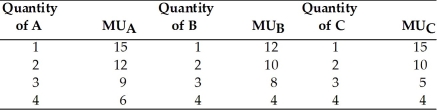 -Based on the information in the above table, the price of A is $3, the price of B is $2, and the price of C is $5. If Lauren has $22 to spend, what combination of products A, B, and C should she buy in order to maximize her satisfaction?
 (Multiple Choice)
4.9/5  (83)
(83) Sam loves cookies. She receives 200 utils for one cookie, 360 for two cookies, 490 for the third, 560 for four cookies, and 600 for five cookies. The marginal utility of the third cookie is
(Multiple Choice)
4.9/5 (76)
(76)  -Refer to the above table. In examining the utility schedules for Michael and Rosie, we can conclude that
 (Multiple Choice)
4.8/5 (68)
(68) The inverse relationship between quantity demanded and price of a good or service can be explained, in part, by
(Multiple Choice)
4.7/5 (86)
(86) Basket of goods A is on an indifference curve that lies closer to the origin than basket B. From this we know that
(Multiple Choice)
4.9/5 (79)
(79) 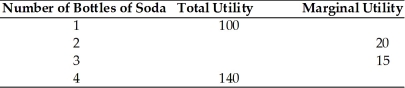 -Using the above table, what is the marginal utility of the 4th soda?
 (Multiple Choice)
4.8/5 (88)
(88) According to the law of diminishing marginal utility, the marginal utility for a particular product
(Multiple Choice)
4.8/5 (80)
(80) Josh has just eaten another cookie and his total utility increased. This means that Josh's marginal utility for this additional cookie is
(Multiple Choice)
4.8/5 (91)
(91) The expression "getting the most bang for your buck" is an illustration of the
(Multiple Choice)
4.9/5 (69)
(69) 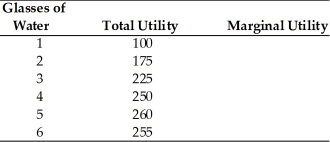 -Using the above table, the marginal utility for the sixth glass of water is
 (Multiple Choice)
4.9/5 (83)
(83) 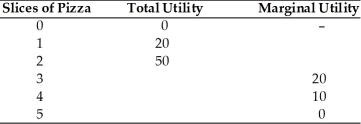 -In the above table, the total utility of three slices of pizza is
 (Multiple Choice)
4.7/5 (71)
(71) Which of the following statements is NOT true about marginal utility when total utility is at its maximum point?
(Multiple Choice)
4.8/5 (79)
(79) If you have been consuming large quantities of ice cream on a hot summer afternoon and you decide to refrain from any additional consumption, it can be concluded that
(Multiple Choice)
4.7/5 (91)
(91) Suppose a consumer is at an optimum. What happens when the price of one good she has been consuming increases?
(Multiple Choice)
4.8/5 (84)
(84) Suppose that indifference curve I1 lies to the left of indifference curve I2. We can conclude that
(Multiple Choice)
4.8/5 (83)
(83) The price of good X is $5 and the price of good Y is $15. If the marginal utility of good X is 20 then the marginal utility of good Y must be ________ to have an optimum combination of goods purchased.
(Multiple Choice)
4.8/5 (78)
(78) 
Filters
- Essay(0)
- Multiple Choice(0)
- Short Answer(0)
- True False(0)
- Matching(0)