



 Chat with AI
Exam 20: Consumer Choice

Exam 1: The Nature of Economics348 Questions
Exam 2: Scarcity and the World of Trade-Offs411 Questions
Exam 3: Demand and Supply451 Questions
Exam 4: Extensions of Demand and Supply Analysis401 Questions
Exam 5: Public Spending and Public Choice362 Questions
Exam 6: Funding the Public Sector201 Questions
Exam 7: The Macroeconomy: Unemployment, Inflation, and Deflation413 Questions
Exam 8: Measuring the Economys Performance416 Questions
Exam 9: Global Economic Growth and Development290 Questions
Exam 10: Real GDP and the Price Level in the Long Run298 Questions
Exam 11: Classical and Keynesian Macro Analyses368 Questions
Exam 12: Consumption, Real GDP, and the Multiplier452 Questions
Exam 13: Fiscal Policy274 Questions
Exam 14: Deficit Spending and the Public Debt146 Questions
Exam 15: Money, Banking, and Central Banking516 Questions
Exam 16: Domestic and International Dimensions of Monetary Policy357 Questions
Exam 17: Stabilization in an Integrated World Economy321 Questions
Exam 18: Policies and Prospects for Global Economic Growth228 Questions
Exam 19: Demand and Supply Elasticity412 Questions
Exam 20: Consumer Choice459 Questions
Exam 21: Rents, Profits, and the Financial Environment of Business445 Questions
Exam 22: The Firm: Cost and Output Determination391 Questions
Exam 23: Perfect Competition432 Questions
Exam 24: Monopoly386 Questions
Exam 25: Monopolistic Competition307 Questions
Exam 26: Oligopoly and Strategic Behavior308 Questions
Exam 27: Regulation and Antitrust Policy in a Globalized Economy310 Questions
Exam 28: The Labor Market: Demand, Supply and Outsourcing376 Questions
Exam 29: Unions and Labor Market Monopoly Power319 Questions
Exam 30: Income, Poverty, and Health Care304 Questions
Exam 31: Environmental Economics299 Questions
Exam 32: Comparative Advantage and the Open Economy282 Questions
Exam 33: Exchange Rates and the Balance of Payments285 Questions
Select questions type


John is going to spend all of his income. For the last unit of Good X consumed John gets 20 utils and for the last unit of Good Y consumed he gets 10 utils. The price of Good X is $4. The price of Good Y is $2. If John wants to maximize his utility he should
(Multiple Choice)
4.9/5  (86)
(86) The change in people's purchasing power that occurs when the price of one good that they purchase changes is the
(Multiple Choice)
4.9/5 (81)
(81) 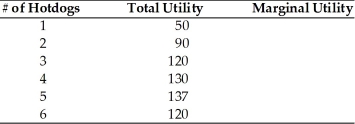 -In the above table, what is the marginal utility of the fourth hotdog consumed?
 (Multiple Choice)
4.8/5 (70)
(70) 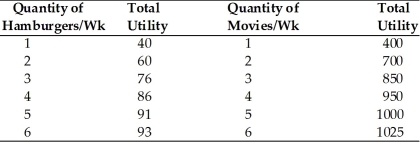 -Refer to the above table. Suppose the price of a hamburger is $2, the price of a movie is $5, and the income of the consumer is $29. What will the consumer's total utility equal at an optimum?
 (Multiple Choice)
4.8/5 (82)
(82) The amount of pleasure or satisfaction derived from consumption of a good is called
(Multiple Choice)
4.8/5 (82)
(82) For good A and good B, the consumer maximizes personal satisfaction when
(Multiple Choice)
4.8/5 (85)
(85) 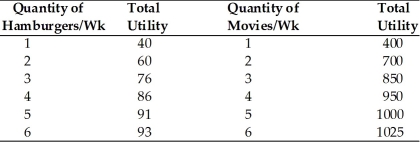 -Refer to the above table. The price of a hamburger is $2, the price of a movie is $10, and the consumer has $44. What is the change in quantity demanded of hamburgers if the price of a hamburger decreases to $1?
 (Multiple Choice)
4.9/5 (81)
(81) The reason that all-you-can-eat restaurants can make a profit is due to
(Multiple Choice)
4.8/5 (75)
(75) 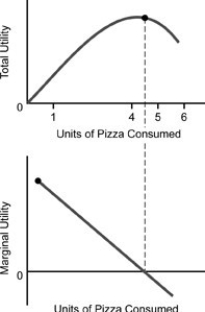 -Given the above figure, marginal utility becomes negative when David consumes the ________ piece of pizza.
 (Multiple Choice)
4.9/5 (78)
(78)  -According to the above table, what is Diva's marginal utility of the 7th unit?
 (Multiple Choice)
5.0/5 (84)
(84) The diamond-water paradox illustrates the idea that ________ determines what consumers are willing to pay for a particular good.
(Multiple Choice)
4.9/5 (77)
(77) The change in satisfaction derived when an individual consumes one more unit of a good or service is called
(Multiple Choice)
4.9/5 (98)
(98) John is currently spending all of his income. For the last unit of Good X consumed John gets 20 utils and for the last unit of Good Y consumed he gets 10 utils. The price of Good X is $2. The price of Good Y is $5. If John wants to maximize his utility he should
(Multiple Choice)
4.8/5 (77)
(77) The price of hamburgers is $2 and the price of brownies is $4. The consumer has $16 of income. The consumer is purchasing 3 hamburgers and receiving 20 utils for the last hamburger. He is also purchasing 2 brownies and receiving 40 utils for the last brownie. This set of goods
(Multiple Choice)
4.8/5 (72)
(72) 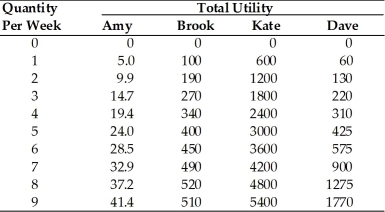 -Refer to the above table. The one who likes the good the most is
 (Multiple Choice)
4.8/5 (85)
(85)
-Refer to the above table. Suppose the price of a hamburger is $2, the price of a movie is $5, and the income of the consumer is $29. How many hamburgers and movies will this consumer buy to be at an optimum?
-Refer to the above table. Suppose the price of a hamburger is $2, the price of a movie is $5, and the income of the consumer is $29. How many hamburgers and movies will this consumer buy to be at an optimum? (Multiple Choice)
4.9/5 (83)
(83) The price of a hotdog is $1, the price of a movie ticket is $5, and the consumer has $13. A consumer has purchased 3 hotdogs and two movie tickets, receiving 10 units of utility for the last hotdog and 10 units of utility for the last movie. The set of goods
(Multiple Choice)
4.9/5 (72)
(72) 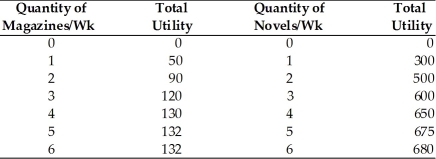 -The price of a magazine is $2, the price of a novel is $5, and the consumer has $33. According to the above table, the rational consumer will purchase
 (Multiple Choice)
4.8/5 (79)
(79) 
Filters
- Essay(0)
- Multiple Choice(0)
- Short Answer(0)
- True False(0)
- Matching(0)